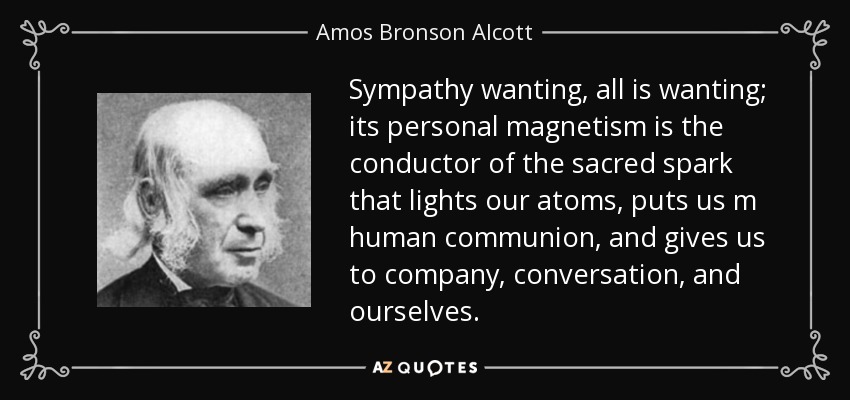
Sympathy wanting, all is wanting; its personal magnetism is the conductor of the sacred spark that lights our atoms, puts us m human communion, and gives us to company, conversation, and ourselves.
Peace is never long preserved by weight of metal or by an armament race. Peace can be made tranquil and secure only by understanding and agreement fortified by sanctions. We must embrace international cooperation or international disintegration. Science has taught us how to put the atom to work. But to make it work for good instead of for evil lies in the domain dealing with the principles of human dignity. We are now facing a problem more of ethics than of physics.
Although there is nothing so bad for conscience as trifling, there is nothing so good for conscience as trifles. Its certain discipline and development are related to the smallest things. Conscience, like gravitation, takes hold of atoms. Nothing is morally indifferent. Conscience must reign in manners as well as morals, in amusements as well as work. He only who is "faithful in that which is least" is dependable in all the world.
I read hard, or not at all; never skimming, never turning aside to merely inciting books; and Plato, Aristotle, Butler, Thucydides, Sterne, Jonathan Edwards, have passed like the iron atoms of the blood into my mental constitution.
For there is a virtue in truth; it has an almost mystic power. Like radium, it seems to give off forever and ever grains of energy, atoms of light.
A distinction has been made between acuteness and subtlety of understanding. This might be illustrated by saying that acuteness consists in taking up the points or solid atoms, subtlety in feeling the air of truth.
Pound St. Paul's Church into atoms, and consider any single atom; it is to be sure, good for nothing; but put all these atoms together, and you have St. Paul's Church. So it is with human felicity, which is made up of many ingredients, each of which may be shown to be very insignificant.
If there be any one principle more widely than another confessed by every utterance, or more sternly than another imprinted on every atom of the visible creation, that principle is not liberty, but law.
But if, indeed, there be a nobler life in us than in these strangely moving atoms; if, indeed, there is an eternal difference between the fire which inhabits them, and that which animates us,--it must be shown, by each of us in his appointed place, not merely in the patience, but in the activity of our hope, not merely by our desire, but our labor, for the time when the dust of the generations of men shall be confirmed for foundations of the gates of the city of God.
Quantum events have a way of just happening, without any cause, as when a radioactive atom decays at a random time. Even the quantum vacuum is not an inert void, but is boiling with quantum fluctuations. In our macroscopic world, we are used to energy conservation, but in the quantum realm this holds only on average. Energy fluctuations out of nothing create short-lived particle-antiparticle pairs, which is why the vacuum is not emptiness but a sea of transient particles. An uncaused beginning, even out of nothing, for spacetime is no great leap of the imagination.
I suppose there is something in all of us that harks back to the soil. When you come to think of it, what are picnics but outcroppings of instinct? No one really enjoys them or expects to enjoy them, but with the first warm days some prehistoric instinct takes us out into the woods, to fry potatoes over a strangling wood fire or spend the next week getting grass stains out of our clothes. It must be instinct; every atom of intelligence warns us to stay at home near the refrigerator.
The fact is that every atom that we're made of is part of that first explosion of a nuclear star billions of years ago. We're connected to the entire universe.
Even if the constants which economists wish to determine were less numerous, and the method of experiment more accessible, we should still be faced with the fact that the constants themselves are different at different times. The gravitation constant is the same always. But the economic constants-these elasticities of demand and supply-depending, as they do, upon human consciousness, are liable to vary. The constitution of the atom, as it were, and not merely its position, changes under the influence of environment.
As science went further and further into the external world, they ended up inside the atom where to their surprise they saw consciousness staring them in the face!
I believe in fate. Sometimes that means an old bearded guy sitting on a cloud and pulling the strings; sometimes it means random atoms swirling through a cheerless universe; sometimes it means everything being preordained thanks to your karma credit from your previous lives.
From the results so far obtained it is difficult to avoid the conclusion that the long-range atoms arising from collision of alpha particles with nitrogen are not nitrogen atoms but probably atoms of hydrogen, or atoms of mass 2. If this be the case, we must conclude that the nitrogen atom is disintegrated under the intense forces developed in a close collision with a swift alpha particle, and that the hydrogen atom which is liberated formed a constituent part of the nitrogen nucleus.
During the 20th century, we came to understand that the essence of all substances - their colour, texture, hardness and so forth - is set by their structure, on scales far smaller even than a microscope can see. Everything on Earth is made of atoms, which are, especially in living things, combined together in intricate molecular assemblages.
One year, I'd completely lost my bearings trying to follow potty training instruction from a psychiatric expert. I was stuck on step on, which stated without an atom of irony: "Before you begin, remove all stubbornness from the child." . . . I knew it only could have been written by someone whose suit coat was still spotless at the end of the day, not someone who had any hands-on experience with an actual two-year-old.
Before it's too late, and time is running out, let us turn from trust in the chain reactions of exploding atoms to faith of the chain reaction of God's love. Love - love of God and fellow men. That is God's formula for peace.
Public opinion is the atmosphere of society, without which the forces of the individual would collapse, and all the institutions of society fly into atoms.
The change from atoms to bits is irrevocable and unstoppable. Why now? Because the change is also exponential - small differences of yesterday can have suddenly shocking consequences tomorrow.
If, in the very intense electric field in the neighbourhood of the cathode, the molecules of the gas are dissociated and are split up, not into the ordinary chemical atoms, but into these primordial atoms, which we shall for brevity call corpuscles; and if these corpuscles are charged with electricity and projected from the cathode by the electric field, they would behave exactly like the cathode rays.
If the Russians ever decide to atom bomb us, they're certain to drop an especially large one on the plant in Pleasantville.
Organic compounds exist in which a hydrogen atom, joined to the carbon, acquires acid properties as a result of the proximity of certain functional groupings.
Chemists have always been in the business of taking atoms and putting them together with other atoms with precisely defined connections.
Follow AzQuotes on Facebook, Twitter and Google+. Every day we present the best quotes! Improve yourself, find your inspiration, share with friends
or simply: