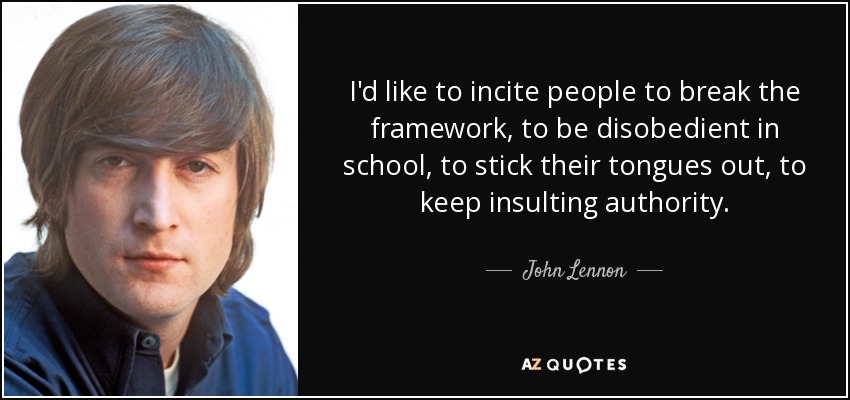
I'd like to incite people to break the framework, to be disobedient in school, to stick their tongues out, to keep insulting authority.
If I rule out violent anarchism, there remains pacifist, anti-nationalist, anti-capitalist, moral, and anti-democratic anarchism (i.e., that which is hostile to the falsified democracy of bourgeois states). There remains the anarchism which acts by means of persuasion, by the creation of small groups and networks, denouncing falsehood and oppression, aiming at a true overturning of authorities of all kinds as people at the bottom speak and organize themselves.
Authority to heal is given from on high.
I think it's very important, and I think that what young people will learn from my experience is that even presidents have to do that and there are consequences when you don't. But I also think that there will be a box score, and there will be that one negative, and then there will be the hundreds and hundreds and hundreds of times when the record will show that I did not abuse my authority as president, that I was truthful with the American people.
Any government is evil if it carries within it the tendency to deteriorate into Tyranny. The danger of such deterioration is more acute in a country in which the government has authority not only over the armed forces but also over every channel of education and information.
To date, there has been no serious attempt in Western countries to use laws to control excessive population growth, although there exists ample authority under which population growth could be regulated.
Don't pay attention to "authorities," think for yourself.
We do not believe that if you cut back what government does you diminish its authority. On the contrary, a government that did less, and therefore did better, would strengthen its authority.
You can never give complete authority and overall power to anyone until trust can be proven.
Find ways to decentralize. Move decision making authority down and out. Encourage a more entrepreneurial approach.
Move decisions out to the Cabinet and agencies. Strengthen them by moving responsibility, authority, and accountability their direction.
There's been a lot of comparisons to "The Prisoner," and sometimes people take a negative tact on that, but to be really honest, I count that as a compliment, in the sense that what I felt "The Prisoner" was for the '60's, in how the individual triumphs over the state and authority, our show is really about how complacent we have become in our lives, which are scrutinized.
What did you learn in school that you still use today? Go ahead teachers, tell me. What? Fear, conformity, don't question authority.
[I]t is contrary to the economy of God for any member of the Church, or any one, to receive instruction for those in authority, higher than themselves . . . if any person have a vision or a visitation from a heavenly messenger, it must be for his own benefit and instruction; for the fundamental principles, government, and doctrine of the Church are vested in the keys of the kingdom.
We do not worship the Prophet. We worship God our Eternal Father and the risen Lord Jesus Christ. But we acknowledge the Prophet; we proclaim him; we respect him; we reverence him as an instrument in the hands of the Almighty in restoring to the earth the ancient truths of the divine gospel, together with the priesthood through which the authority of God is exercised in the affairs of His Church and for the blessing of His people.
The importance of immobility and silence to photographic authority, the nonfilmic nature of this authority, leads me to some remarks on the relationship of photography with death. Immobility and silence are not only two objective aspects of death, they are also its main symbols, they figure it.
I have always questioned everything: education, the obligation to memorize, authority. Perhaps that is why I have photographed everything.
The goal of human freedom is not in freedom itself, nor it is in man, but in God. By giving man freedom, God has yielded to man a piece of His Divine authority, but with the intention that man himself would voluntarily bring it as a sacrifice to God, a most perfect offering.
Words borrowed of Antiquity do lend a kind of Majesty to style, and are not without their delight sometimes. For they have the authority of years, and out of their intermission do win to themselves a kind of grace-like newness. But the eldest of the present, and newest of the past Language, is the best.
I don't use 'always do this,' 'never say that' and I never give advice because I'm not the end-all, be-all authority.
If you care about other people, you might try to organize to undermine power and authority. That's not going to happen if you care only about yourself.
There's always going to be a little bit of autobiographical content to everything. It's how you lend some authority to what you write - you give it that weight by drawing on your direct experiences and indirect experiences from people that you know well, or a little.
Knowledge about God is of two kinds, direct and indirect. Indirectly we can read scriptures, listen to sermons, consult authorities, and from these sources build a reasonable case that God exists. But such a God transmits no love to Earth. Therefore nothing substitutes for gyana, which is direct knowledge of the divine. Instead of having thoughts about God, you share God's own thoughts. Her thoughts can only be about Herself.
Apostles receive revelations from God, and consequently they are able to say 'This is what the Spirit is saying to the churches right now.' Making such a statement with credibility carries with it tremendous authority.
We can expect the climate crisis industry to grow increasingly shrill, and increasingly hostile toward anyone who questions their authority.
Follow AzQuotes on Facebook, Twitter and Google+. Every day we present the best quotes! Improve yourself, find your inspiration, share with friends
or simply: