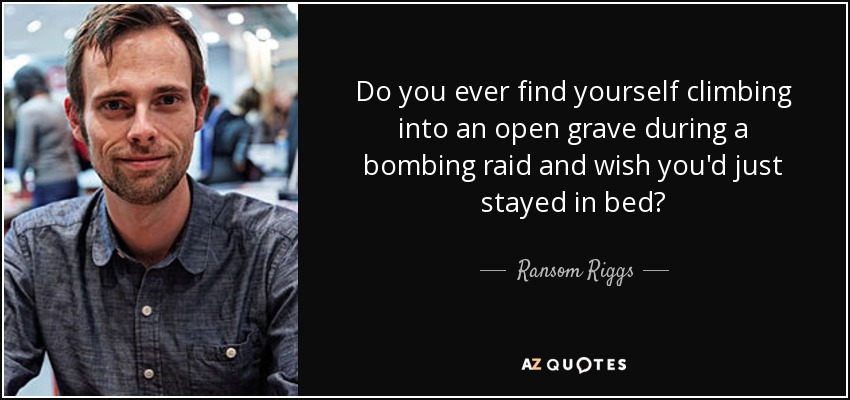
Do you ever find yourself climbing into an open grave during a bombing raid and wish you'd just stayed in bed?
How much atonement is enough? The bombing must be allowed as at least part-payment: those of our young people who are concerned about the moral problem posed by the Allied air offensive should at least consider the moral problem that would have been posed if the German civilian population had not suffered at all.
Nobody has yet found a way of bombing that can prevent foot soldiers from walking.
London in the '70s was a pretty catastrophic dump, I can tell you. We had every kind of industrial trouble; we had severe energy problems; we were under constant terrorist attack from Irish terrorist groups who had started a bombing campaign in English cities; politics were fantastically polarized between left and right.
For a startling period of my life, I reported the Troubles in Ireland for the BBC. I lived in Dublin and was called out to all sorts of incidents that, if taken together, add up to a war - bombings, assassinations, riots, shootings, robberies, jailbreaks, kidnappings, and sieges.
Japan learned from the bombings of Hiroshima and Nagasaki that the tragedy wrought by nuclear weapons must never be repeated and that humanity and nuclear weapons cannot coexist.
I have for some time urged that a nuclear abolition summit to mark the effective end of the nuclear era be convened in Hiroshima and Nagasaki on the 70th anniversary of the bombings of those cities, with the participation of national leaders and representatives of global civil society.
When you're onstage and you know you're bombing, that's very, very scary. Because you know you gotta keep going - you're bombing, but you can't stop.
Heaven opened and the water hammered down, reviving the reluctant old well, greenmossing the pigless pigsty, carpet bombing still, tea-colored puddles the way memory bombs still, tea-colored minds.
In some ways more painful is the fact that their experience appears to be fading from the collective memory of humankind. Having never experienced an atomic bombing, the vast majority around the world can only vaguely imagine such horror, and these days, John Hersey's Hiroshima and Jonathan Schell's The Fate of the Earth are all but forgotten. As predicted by the saying, 'Those who cannot remember the past are condemned to repeat it,' the probability that nuclear weapons will be used and the danger of nuclear war are increasing.
I think all of us have a sense if we imagine the kind of world we would face if the people who bombed the mess hall in Mosul, or the people who did the bombing in Spain, or the people who attacked the United States in New York, shot down the plane over Pennsylvania and attacked the Pentagon, the people who cut off peoples' heads on television to intimidate, to frighten indeed the word 'terrorized' is just that. Its purpose is to terrorize, to alter behavior, to make people be something other than that which they want to be.
Iran has long sponsored terrorists who carry out homicide bombings in Israeli cities. However, it is a mistake to believe the danger Iran poses is directed at Israel alone.
In a war you have to take up arms and people will get killed, and I can support that kind of action by petrol bombing and bombs under cars, and probably at a later stage, the shooting of vivisectors on their doorsteps. It's a war, and there's no other way you can stop vivisectors.
So I think if we want to turn the table around, more than thinking about how can we starve the Islamic State in terms of money, we should think about how can we maximise the amount of resources that we have in order to secure ourselves. For us, instead of bombing so much, which is extremely expensive, perhaps, you know, we should use some of that money in order to protect ourselves.
Those who had demanded no more than an end to the bombing of North Vietnam and a commitment to negotiations saw their demands being realized, and lapsed into silence.
A lot of these people are Iraqis fighting for control of their own government. Maybe there's an argument to make that outside forces that go in and start bombing that country or invading that country are actually terrorists more so than the people in the country.
I wouldn't characterize anybody who fought in Vietnam as a war hero. In 23 bombing sorties, there must have been civilians that were killed and there's no heroism to that.
How would you describe the difference between modern war and modern industry-between say, bombing and strip mining, or between chemical warfare and chemical manufacturing? The difference seems to be only that in war the victimization of humans is directly intentional and in industry it is "accepted" as a "trade-off." Were the catastrophes of Love Canal, Bhopal, Chernobyl, and the Exxon Valdez episodes of war or of peace? They were in fact, peacetime acts of aggression, intentional to the extent that the risks were known and ignored.
The most racist, nastiest act by the USA, after human slavery, was the bombing of Nagasaki. Not of Hiroshima, which might have had some military significance. But Nagasaki was purely blowing away men, women, and children.
I do take the threat of terrorism seriously. You cannot eliminate that threat or diminish that threat by bombing a country.
At the time, we were mad at Moammar Gadhafi, which resulted in us bombing all over Libya and killing a bunch of people, but not him. Then Ronald Reagan gets up and says we're not trying to kill him, we're just dropping bombs. You can kill all the Libyans you want, but legally you can't try to kill the leader.
Despite the war, and bombings, and all the big things that happen to us, the stuff of our lives is small and always will be. During a war it is different, but even then, it is perfectly possible to write novels during a major war, which are about those thing which endure. It is what makes us human and the thing which is going to keep going.
Watching the spontaneous acts of kindness, compassion, and generosity, courage, and bravery in the aftermath of the Boston marathon bombings was so deeply moving. It is in our nature to want to help, to serve, to be part of something larger than ourselves. We have a desire to connect with others. We want to make a difference in the world. I would call this a spiritual longing to be whole, interrelated, interconnected.
I am closer to the pacifist side, in that I think that the British response to German aggression, which was to try to starve the Continent into a state of revolt and to terrorize German civilians with bombing raids, was part of the total catastrophe.
In fact, you could make the argument that a historian like Shlomo Aronson does in passing in one of his books, that the bombing campaign united the German nation behind Hitler, and actually contributed to the sustaining of his power.
Follow AzQuotes on Facebook, Twitter and Google+. Every day we present the best quotes! Improve yourself, find your inspiration, share with friends
or simply: