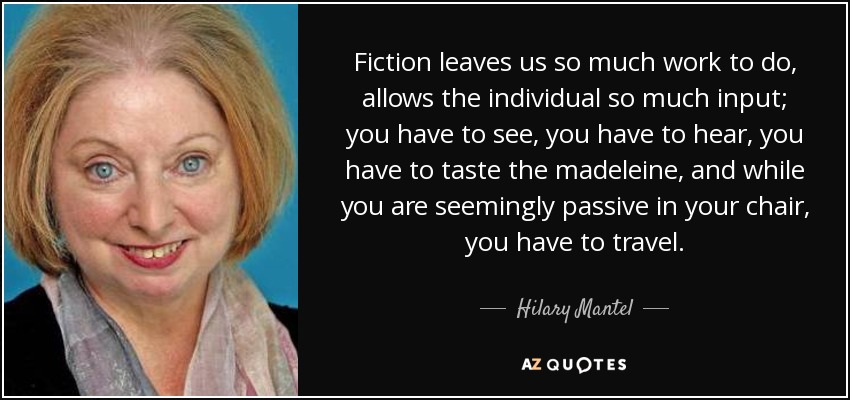
Fiction leaves us so much work to do, allows the individual so much input; you have to see, you have to hear, you have to taste the madeleine, and while you are seemingly passive in your chair, you have to travel.
When I received my first paycheck from my now known day job, I spent it on a period Craftsman chair and a Frank Lloyd Wright-wannabe lamp. With my second paycheck, I bought a stereo.
I intend, before the endgame looms, to die sitting in a chair in my own garden with a glass of brandy in my hand and Thomas Tallis on the iPod. Oh, and since this is England, I had better add, "If wet, in the library." Who could say that this is bad?
Now, I know you expected me to say that, well, I just kick back in the rocking chair, fished a little bit, listened to Willie Nelson tapes and watched old baseball games on the Classic Sports network. And, tell you the truth, I have done that for maybe about five total minutes.
Animation is a great way to work. No early morning call times, no make-up chair. In live action ,you're always fighting the clock; the sun is always going down too soon.
I am one of those people who is not very patient in the makeup chair. I have been offered movies like 'Planet of the Apes' and stuff like 'The Grinch Who Stole Christmas' and I turned them down.
I don't want the chair of the government because it will be controlled by the U.S. and I don't want to be controlled by the U.S.
I don't sort of sit in a chair and pompously feel proud of myself about all the things we might have accomplished.
I did grieve a bit when I wasn't having the chemo anymore. I was used to sitting in the little chair and then the nurse would come and do it. It was like that was your job for that long and it was reassuring.
Starbucks was founded around the experience and the environment of their stores. Starbucks was about a space with comfortable chairs, lots of power outlets, tables and desks at which we could work and the option to spend as much time in their stores as we wanted without any pressure to buy. The coffee was incidental.
The neo-conservatives, who are closely linked to the neo-corporatists, are rather different. They claim to be conservatives, when everything they stand for is a rejection of conservatism. They claim to present an alternate social model, when they are little more than the courtiers of the corporatist movement. Their agitation is filled with the bitterness and cynicism typical of courtiers who scramble for crumbs at the banquet tables of real power, but are always denied a proper chair.
For a moment Jack felt the strongest inclination to snatch up his little gilt chair and beat the white-faced man down with it.
The illusion of freedom will continue as long as it's profitable to continue the illusion. At the point where the illusion becomes too expensive to maintain, they will just take down the scenery, they will pull back the curtains, they will move the tables and chairs out of the way and you will see the brick wall at the back of the theater.
Introduction To Poetry I ask them to take a poem and hold it up to the light like a color slide or press an ear against its hive. I say drop a mouse into a poem and watch him probe his way out, or walk inside the poem's room and feel the walls for a light switch. I want them to waterski across the surface of a poem waving at the author's name on the shore. But all they want to do is tie the poem to a chair with rope and torture a confession out of it. They begin beating it with a hose to find out what it really means.
When you sit right down in the middle of yourself you're gonna wanna have a comfortable chair.
Thurber was asked by a correspondent: "Why did you have a comma in the sentence, 'After dinner, the men went into the living-room'?" And his answer was probably one of the loveliest things ever said about punctuation. "This particular comma," Thurber explained, "was Ross's way of giving the men time to push back their chairs and stand up.
Mama's love had always been the kind that acted itself out with soup pot and sewing basket. But now that these things were taken away, the love seemed as whole as before. She sat in her chair at the window and loved us. She loved the people she saw in the street-- and beyond: her love took in the city, the land of Holland, the world. And so I learned that love is larger than the walls which shut it in.
That was the thing about words, they were clear and specific-chair, eye, stone- but when you talked about feelings, words were too stiff, they were this and not that, they couldn't include all the meanings. In defining, they always left something out.
But that's typical of me. "This is going to end in tears," I tell myself every time I balance a cup of coffee on the upholstered arm of the chair I'm sitting on. And then, lo and behold, the cup topples and even before it lands, I tell myself, "Told me so!" Not to spell out, or spill out, one of the metaphors of my life, but I always do the stupid thing and then I do it again. I never learn.
You forget everything. The hours slip by. You travel in your chair through centuries you seem seem to see before you, your thoughts are caught up in the story, dallying with the details or following the course of the plot, you enter into characters, so that it seems as if it were your own heart beating beneath their costumes.
That was in Crescent City, California, up near the Oregon border. I left soon after. But today I was thinking of that place, of Crescent City, and of how I was trying out a new life there with my wife, and how, in the barber's chair that morning, I had made up my mind to go. I was thinking today about the calm I felt when I closed my eyes and let the barber's fingers move through my hair, the sweetness of those fingers, the hair already starting to grow.
Yes, when I get big and have my own home, no plush chairs and lace curtains for me. And no rubber plants. I'll have a desk like this in my parlor and white walls and a clean green blotter every Saturday night and a row of shining yellow pencils always sharpened for writing and a golden-brown bowl with a flower or some leaves or berries always in it and books . . . books . . . books. . . .
There was something about being in the vicinity of Grahame Coats that always made Fat Charlie (a) speak in cliches and (b) begin to daydream about huge black helicopters first opening fire upon, then dropping buckets of flaming napalm onto the offices of the Grahame Coats agency. Fat Charlie would not be in the office in those daydreams. He would be sitting in a chair outside a little cafe on the other side of Aldwych, sipping a frothy coffee and occasionally cheering at an exceptionally well-flung bucket of napalm.
I sometimes used to ask myself, what on earth did I love her for? Maybe fore the warm hazel iris of her fluffy eyes, or for the natural side-wave of her brown hair, done anyhow, or again for that movement of her plump shoulders. But, probably the truth was that I loved her because she loved me. To her I was the ideal man: brains, pluck. And there was none dressed better. I remember once, when I first put on that new dinner jacket, with the vast trousers, she clapsed her hands, sank down on a chair and murmured: 'Oh, Hermann...." It was ravishment bordering upon something like heavenly woe.
He lay on his chair with his hands clasped above his paunch not reading, or sleeping, but basking like a creature gorged with existence.
Follow AzQuotes on Facebook, Twitter and Google+. Every day we present the best quotes! Improve yourself, find your inspiration, share with friends
or simply: