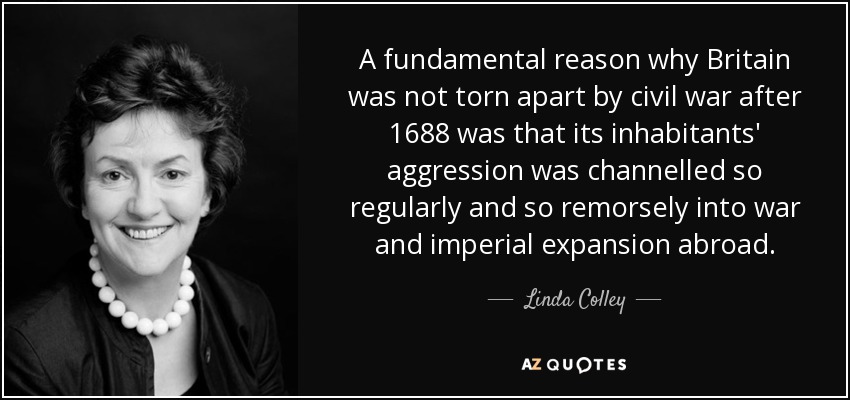
A fundamental reason why Britain was not torn apart by civil war after 1688 was that its inhabitants' aggression was channelled so regularly and so remorsely into war and imperial expansion abroad.
Jacobitism involved much more than a debate about the merits of a particular dynasty. Men and women were well aware that its success was almost certain to involved them in civil war. And the more politically educated knew that the Stuart Pretender was a pawn in a worldwide struggle for commercial and imperial primacy between Britain and France.
Be assured, he is not an ordinary man.
Every man that tried to destroy the Government, every man that shot at the holy flag in heaven, every man that starved our soldiers... every man that wanted to burn the negro, every one that wanted to scatter yellow fever in the North, every man that opposed human liberty, that regarded the auction-block as an altar and the howling of the bloodhound as the music of the Union, every man who wept over the corpse of slavery, that thought lashes on the naked back were a legal tender for labour performed, every one willing to rob a mother of her child - every solitary one was a Democrat.
The enduring realization that when a great challenge comes, the most ordinary people can show that they value something more than they value their own lives. When the last of the veterans had gone, and the sorrows and bitterness which the war created had at last worn away, this memory remained.
Here was the greatest and most moving chapter in American history, a blending of meanness and greatness, an ending and a beginning. It came out of what men were, but it did not go as men had planned.
It began with one act of madness, and it ended with another. John Brown heard history's clock strike in the night and tried to hurry dawn along with gunfire; now John Wilkes Booth heard the clock strike, and he tried with gunfire to restore the darkness. Each man stood outside the human community, directed by voices the sane do not hear, and each kept history from going logically... The line from Harper's Ferry to Ford's Theater is a red thread binding the immense disorder of the Civil War into an irrational sort of coherence.
Nathan Bedford Forrest ... used his horsemen as a modern general would use motorized infantry. He liked horses because he liked fast movement, and his mounted men could get from here to there much faster than any infantry could; but when they reached the field they usually tied their horses to trees and fought on foot, and they were as good as the very best infantry. Not for nothing did Forrest say the essence of strategy was to git thar fust with the most men.
The Civil War was fought in 10,000 places, from Valverde, New Mexico, and Tullahoma, Tennessee, to St. Albans, Vermont, and Fernandina on the Florida coast. More than 3 million Americans fought in it, and over 600,000 men, 2 percent of the population, died in it.
Between 1861 and 1865, Americans made war on each other and killed each other in great numbers - if only to become the kind of country that could no longer conceive of how that was possible.
...fiction is made out of the writer's experience, his whole life from infancy on, everything he's thought and done and seen and read and dreamed. But experience isn't something you go and get - it's a gift, and the only prerequisite for receiving it is that you be open to it. A closed soul can have the most immense adventures, go through a civil war or a trip to the moon, and have nothing to show for all that "experience"; whereas the open soul can do wonders with nothing.
Know what you're talking about.
When you read a history or biography you are entitled to imagine that it is as accurate as the authors can make it. That research has gone into it and we say "This is a history of the civil war, this is a biography of Lincoln" whatever. But you don't make any such supposition when you say "This is a historical novel."
We simply argue that climate change consequences was one of the impacts, but interestingly enough, even though a major effort was made in 2008 to try and resurrect the problem over food, now the consequences of the civil war are making the situation even worse.
When I talk to entrepreneurs today, I feel like the grandfather who was in the Civil War.
Obama is now fighting for his life. He's fighting for a federal government. I believe in a federal government. I hope it sticks around. We had the American Revolution. There was this whole tension between the federalists and the anti-federalists. Then we had the Civil War. We had Lincoln fighting for it. And the secessionists were there. And we have the same issue today.
In regard to this Great Book, I have but to say, it is the best gift God has given to man.
My God, is it possible that all the people have gone mad? The civil war now being inaugurated will be as horrible as his Satanic Majesty could desire.
Empires, essentially, create order. In their absence, you don't end up with lots of happy, little nation-states full of people sitting around campfires singing John Lennon's "Imagine." What you end up with is civil war, anarchy.
We're dealing with such enormous problems today that we have no other choice but to work together. If Iraq fails, if a religious civil war breaks out and the neighboring states are drawn into this conflict, if the Kurds declare independence and al-Qaida takes over an entire province - that's when the consequences will be dramatic.
The terrorists want civil war. Al-Qaida is attacking Shiites. The Shiite militias are taking revenge on the Sunnis. And the Sunnis are become more extremist, with some joining al-Qaida.
Economist and Africa expert Collier analyzes why a group of 50 nations, home to the poorest one billion people, are failing. Considering issues such as civil war, dependence on extractive industries, and bad governance, he argues that the strongest industrialized countries must enact a plan to help with international policies and standards.
Few Americans born after the Civil War know much about war. Real war. War that seeks you out. War that arrives on your doorstep - not once in a blue moon, but once a month or a week or a day.
The Romans have provided a lot of writers with a model for various interstellar empires, of course, and no wonder. The Roman Empire is a really good example of a large empire that, in one form or another, functioned for quite a long time over a very large area. And over all that time, there was all sorts of exciting drama - civil wars and assassinations and revolts and bits breaking off and being forced back in ... But I didn't want my future - however fanciful it was - to be entirely European. The Radchaai aren't meant to be Romans in Space.
In every aspect and among almost every demographic, how American society digested and processed the long, dark chapter between the end of the Civil War and the beginning of the civil rights movement has been delusion.
Follow AzQuotes on Facebook, Twitter and Google+. Every day we present the best quotes! Improve yourself, find your inspiration, share with friends
or simply: