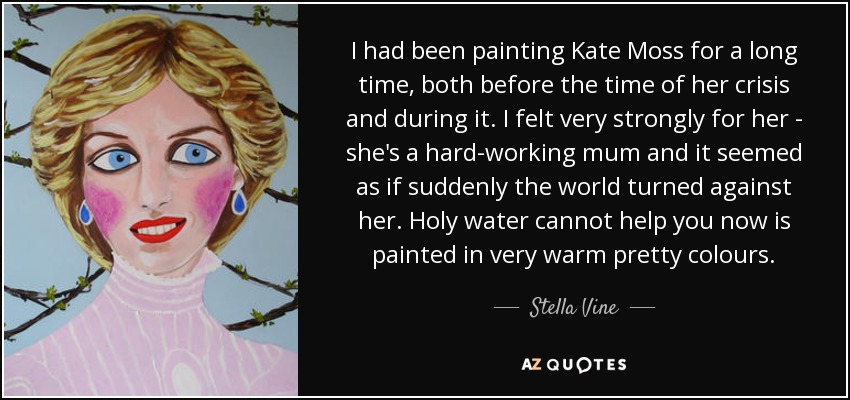
I had been painting Kate Moss for a long time, both before the time of her crisis and during it. I felt very strongly for her - she's a hard-working mum and it seemed as if suddenly the world turned against her. Holy water cannot help you now is painted in very warm pretty colours.
I know the colour rose, and it is lovely, But not when it ripens in a tumour; And healing greens, leaves and grass, so springlike, In limbs that fester are not springlike.
Men of superior vivacity and wit, when they take a wrong turn, are generally worse than other men: because wit, consisting in a lively representation of ideas assembled together, gives every sensible object those heightening touches, and that striking imagery, which is unknown to men of slower apprehensions: wit being to sensible objects, what light is to bodies; it does not merely show them as they are in themselves: it gives an adventitious colour, which is not a property inherent in them: it lends them beauties which are not their own.
The eighteenth-century view of the garden was that it should lead the observer to the enjoyment of the aesthetic sentiments of regularity and order, proportion, colour and utility, and, furthermore, be capable of arousing feelings of grandeur, gaiety, sadness, wildness, domesticity, surprise and secrecy.
The ideal garden is one in which a collection of trees, shrubs and plants have been procured and allotted to the best space available and are so arranged and tended that they are seen to their advantage, each in relation to the other. Every plant, of whatever shape or size, should be chosen not only for its individual merits but for its power to enhance the charms of neighbouring plants by contrast or combination in foliage or in flower colour.
Like many musicians, I can hear the weight in the sound. Sound is matter. We speak of the colour of an instrument, of transparency... We can demand more sombre or lighter colours, deeper playing and singing, heavier or lighter sound. And manipulating those means is like creating a painting.
My general view is that best actor best suited to role should get the job. Obviously when it comes to colour and issues of ethnicity the choice is clear. But I do not believe you have to be transgender or have undergone sex reassignment surgery to be able play a character who has.Acting is acting after all.
I believe that one should not think too much about nature when painting, at least not during the painting's conception. The colour sketch should be made exactly as one has perceived things in nature. But personal feeling is the main thing.
Though painting borrows help indeed from colours... it has nothing more wide of its real aim or more remote from its intention than to make a show of colours... to raise a separate and flattering pleasure to the sense.
I was trained to look at colour, edges, to see negative space. I honestly think my greatest influence as a writer is from Cubism - the idea of a multi-faceted, multi-perspective way of looking at things.
Fashion is meant to be wild and expressive. I love colour but I also love basics - grungy minimalism mixed with this kind of broken-down cheerleader, is my thing.
If there's loads of material going by you don't notice the individual things quite so much. Also it really foregrounds the sonic dimensions like electronic ambient music, it's pushes all of that colour to the foreground so you hear little every atom of sound.
I don't like when things don't match. I love some Eighties fashion, like Grace Jones but primary colours only work in certain situations.
I make sure I have the best: I figure you could spend $800 on an outfit you wear three times, but with your hair it's there all the time. I also think it is really important to look after your colour once it's been done. I try and give my hair a really nourishing mask every so often to combat against all the styling. I also love to have beauty treatments that really benefit, like massages. t's divine to get up and feel all zen and relaxed.
I tried to get the word out to people who are information hubs in their communities, because they could propagate the call quickly. One challenge is that breaking science fiction means, well, breaking science fiction. Many communities of colour have a different approach to narratives of science.
Homophobia's just one form of abjection, and wherever you have a marker of deviance - skin colour, gender, gender identity, disability - you get the same mechanisms of prejudice.
The orthodox view of colour experience assumes that, when we see a colour difference between two surfaces viewed side-by-side, this is because we have different responses to each of the two surfaces viewed singly. Since we can detect colour differences between something like ten million different surfaces, this implies that we are capable of ten million colour responses to surfaces viewed singly.
I don't think that we are capable of anything like this many possible colour responses. Instead I argue that the perception of colour differences between two surfaces viewed side-by-side is a gestalt phenomenon.
There is a brain mechanism that works to identify colour differences directly, without first identifying the absolute colour of each surface. So on my view there is no reason to suppose anything like ten million colour responses to surface viewed singly.
I think my view is rather more radical than Pete Mandik's. Both of us want to show that colour perception doesn't transcend what can be conceptualized, but I don't think he goes so far as to deny that it doesn't involve different responses to all the discriminable surfaces.
After all, in supporting phenomenal concepts I am in a sense siding with introspection against the more behaviourist Wittgensteinians. But even so I don't think that introspection is powerful enough to resolve the specific issue about how many colours you can see.
I don't think that we can figure out what is going on in conscious colour perception just by phenomenological introspection. We need to know about brain mechanisms as well. We need to figure out what information is present in the mechanisms that constitute conscious colour perception.
If neuroscientific research shows that those mechanisms only contain comparative information about colour differences, and have 'thrown away' more fine-grained information about the absolute colours of single surfaces, then that would support my position, in a way that just introspecting our colour experiences can't.
I rather incline towards 'conceptualism', in line with my view of colour perception - I don't think that we can represent objects and properties for which we have no concepts, not even in perceptual experience. In this sense I differ from those who defend 'non-conceptual content' like Michael Tye and Chris Peacocke.
We just worked hard to not just get things right and authentic, but also to make it consistent and visually right. For instance, there are colours that aren't in the film that would have been there in reality. I think part of the look of the film not only has to do with the way it's shot and lit, but also the lack of certain colours that give it a softness which really suits it because there's more focus on the characters. For instance, there's no yellow at all until we get to Miss Stubbs' flat at the very end.
Follow AzQuotes on Facebook, Twitter and Google+. Every day we present the best quotes! Improve yourself, find your inspiration, share with friends
or simply: