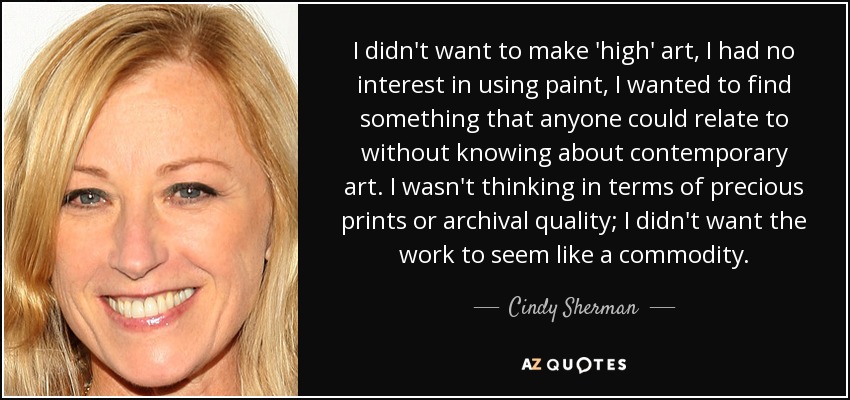
I didn't want to make 'high' art, I had no interest in using paint, I wanted to find something that anyone could relate to without knowing about contemporary art. I wasn't thinking in terms of precious prints or archival quality; I didn't want the work to seem like a commodity.
Contemporary art is based on that an artist is supposed to go into art history in the same way as an art historian. When the artist produces something he or she relates to it with the eye of an art historian/critic. I have the feeling that when I am working it is more like working with soap opera or glamour. It is emotional and not art criticism or history of art.
In 1967 there was no place for photography in a contemporary art gallery. It was almost impossible to get an art dealer to look at, let alone exhibit, anything photographic.
We need to remind ourselves that contemporary art is first of all a form of conceptual gymnastics, in which we learn to coexist with what we don't understand.
"Contemporary art" for me is a kind of historical term that describes the 40 years between the Berlin Wall going up and then coming down. I'm not sure who will come up with a better term to describe art, but I think contemporary art is actually done for.
People think that the art market is about opportunists and hedge-fund managers getting broken art, but what really happened is that there was a new configuration of bourgeois values in the U.S. and an acceptance among the bourgeoisie of contemporary art as an idea. I think that bourgeois people are horrible.
Obviously my own work comes from a conceptual art tradition, but I love the graffiti artists, and I feel spiritually closer to them than to most contemporary art; they make the city a free space of diverse voices and we shouldn't get all cynical about them just because Banksy made some money. I collaborate sometimes with Krae, who is an old school east London graffiti writer.
The Metropolitan Museum of Art some time ago held a display of contemporary art at which $52,000 was awarded to American sculptors, painters, and artists in allied fields. The award for the best painting went to the canvas of an Illinois artist. It was described as "a macabre, detailed work showing a closed door bearing a funeral wreath." Equally striking was the work's title: "That which I should have done, I did not do."
I feel like contemporary art is everywhere now and with the rise of the internet, it's so much easier to see what artists are doing and to follow their careers.
My art gives contemporary art a juvenile-delinquent phase. Its self-made style gleefully trashes conventions of beauty and society while pick-pocketing from the coolest underground styles and beliefs of the previous centuries.
I have a passion for modern and contemporary art. I spend a lot of time in museums; I particularly like the Guggenheim, MoMA in New York or LACMA and the Getty Museum in Los Angeles, for example. I cannot wait for the Louis Vuitton Foundation to open.
Contemporary art and manga - what is the same about them? Nothing, right? The manga industry has a lot of talented people, but contemporary art works on more of a solitary model. No one embarks on collaboration in contemporary art in order to make money. But in the manga world, everyone is invested in collaboration. The most important point is that the manga industry constantly encourages new creations and creators.
Few people in contemporary art demonstrate much curiosity. The majority spend their days blathering on, rather than trying to work out why one artist is more interesting than another, or why one picture works and another doesn't.
When we talk about contemporary art and contemporary artists, we usually imagine artists who are alive. But I feel very uncomfortable about placing a border between living artists and dead artists.
The issue is Kinkade's ideology, and particularly his nostalgia; his paintings endlessly trumpet a nonexistent past when times were simpler and morality more pure. There's nothing wrong with this, but it stands at odds with a contemporary art world that looks to the future for inspiration. We value complexity and innovation, and distrust saccharine pictures of the past.
I don't decide where I live. My wife decides. She's a curator of contemporary art, and she works at an art museum, so we go wherever she has a job. All basements look the same, so I can write from whatever basement I happen to be living in.
I cast people from right around me. I was at my alma mater. It's special to have most of the graduate students in it [and] one professor, because I feel like in terms of this school, I was one of the few students lucky enough to break into the art industry or the contemporary art world.
Certainly being in California has encouraged a sustained commitment to rethinking the nature, purposes, and relevance of the contemporary arts, specifically music, for a society which by and large seems to manage quite well without them.
For me it's very important to turn Kiev into one of the main centers of contemporary art in the world. There is New York. There's London. And there will be Kiev. Everyone will come and say, 'Wow!
Underground electronic music is art - fundamentally it's based on contemporary art, culture, dance, and real music. If you look at EDM, how many of those cultural standpoints are the same?
It's no longer terribly sexy to own shares in certain companies; it used to be that being a shareholder in a corporation would connect you with it. The result is that people really want to invest in valuable things, and contemporary art has become a very stable material value with great growth potential.
I had no idea what to expect moving to New York. It's embarrassing to say, but I didn't even realize that people bought contemporary art... that people actually paid for it... I know that's really dumb. I was really naive. I had no idea artists made money.
By the late Nineties, we had become a more visual nation. Big-money taste moved to global standards - new architecture, design and show-off contemporary art. The Sloane domestic aesthetic - symmetry, class symbolism and brown furniture - became as unfashionable as it had been hot in the early Eighties.
I tried to grow up. Honest. Didn’t quite happen. I guess I’m someone for whom youth still seems more real than the present, or the half century in between. And why not? I'm deeply underwhelmed by most contemporary art, literature, music, films, TV, the heinous little phones, money talk, real estate talk, all that stuff. The Internet, which at first seemed so fascinating, appears to be evolving into something even worse than TV, but we'll see.
There are no categories in contemporary art. There are no rules. Artists are given the freedom to make and create whatever they please and call it whatever they please. I identify with that system, or lack of system, much more than I do the landscape of contemporary publishing.
Follow AzQuotes on Facebook, Twitter and Google+. Every day we present the best quotes! Improve yourself, find your inspiration, share with friends
or simply: