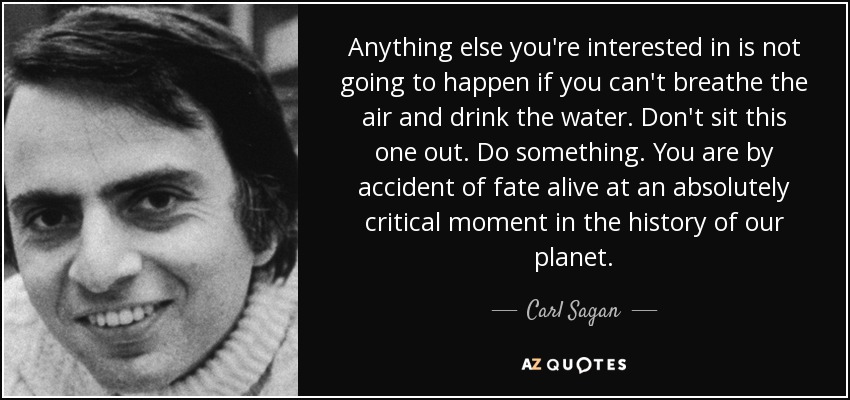
Anything else you're interested in is not going to happen if you can't breathe the air and drink the water. Don't sit this one out. Do something. You are by accident of fate alive at an absolutely critical moment in the history of our planet.
We live in a culture in which intelligence is denied relevance altogether, in a search for radical innocence, or is defended as an instrument of authority and repression. In my view, the only intelligence worth defending is critical, dialectical, skeptical, desimplifying.
I am convinced that the moment is coming when, with its message of eternal, universal values, it will come to the aid of our society. For in these words: "Thou shalt not kill; Thou shalt love thy neighbor as thyself," lie those very moral principles that will enable us to survive even the most critical situations.
The only way to escape misrepresentation is never to commit oneself to any critical judgement that makes an impact - that is, never to say anything. I still, however think that the best way to promote profitable discussion is to be as clear as possible with oneself about what one sees and judges, to try and establish the essential discriminations in the given field of interest, and to state them as clearly as one can (for disagreement, if necessary).
After the initial critical learning period of youth is over, the areas of the brain that need to be 'turned on' to allow enhanced, long lasting learning can only be activated when something important, surprising, or novel occurs, or if we make the effort to pay close attention.
Teaching needs an ecosystem that supports evidence-based practice. It will need better systems to disseminate the results of research more widely, but also a better understanding of research, so that teachers can be critical consumers of evidence.
Optimism is an alienated form of faith, pessimism an alienated form of despair. If one truly responds to man and his future, ie , concernedly and "responsibly." one can respond only by faith or by despair. Rational faith as well as rational despair are based on the most thorough, critical knowledge of all the factors that are relevant for the survival of man.
The light of common sense is fundamentally the same light as that of science, that is to say, the natural light of the intellect. But in common sense this light does not return upon itself by critical reflection, and is not perfected by what we shall learn to know as a scientific habit.
It seems important that the social value factor be more generally recognized as a powerful causal agent in its own right and something to be dealt with directly as such. No more critical task can be projected for the 1970s than that of seeking for civilized society a new, elevated set of value guidelines more suited to man's expanded numbers and new powers over nature, a frame of reference for value priorities that will act to secure and conserve our world instead of destroying it.
Questioning our own motives, and our own process, is critical to a skeptical and scientific outlook. We must realize that the default mode of human psychology is to grab onto comforting beliefs for purely emotional reasons, and then justify those beliefs to ourselves with post-hoc rationalizations.
[T]he crucial question is not, as so many believe, whether property rights should be private or governmental, but rather whether the necessarily 'private' owners are legitimate owners or criminals. For ultimately, there is no entity called 'government'; there are only people forming themselves into groups called 'governments' and acting in a 'governmental' manner. All property is therefore always 'private'; the only and critical question is whether it should reside in the hands of criminals or of the proper and legitimate owners.
Creationists argue that natural selection is only a negative process, and therefore cannot create anything. Chopra argues that skepticism is only a negative process, and therefore does not lead to knowledge. Both are wrong for the same reasons. They ignore the generation of diversity and new ideas upon which natural selection and skepticism acts. Weeding out the unfit is critical to both - natural selection allows evolution to proceed, and skepticism allows science to advance.
We know that pumping oil out of the ground does not create many jobs. It does not foster an entrepreneurial spirit, nor does it sharpen critical faculties.
Women have always been more critical of marriage than men. The great mysterious irony of it is - at least it's the stereotype - that women want to get married and men are trying to avoid it. Marriage doesn't benefit women as much as men, and it never has. And women, once they are married, become very critical of marriages in a way that men don't.
I don't think you can say that feminism has made women critical of marriage because women have been critical of marriage for centuries.
We often think more highly of ourselves than we ought to, and it's easy to judge others and be critical of their weaknesses and shortcomings. But this self-righteous attitude is a sin that we can be blinded to because we're so focused on what the other person did wrong. The reality is this attitude is worse than the wrong behavior we're judging.
I make films but I am trained as a designer. I come from this series of designers called critical designers, speculative designers.
The Germans should be the first to sympathize with us [Egyptians]. They know how difficult it is to build a democracy following a dictatorship, and they were the first to be critical of Morsi's anti-democratic policies.
I am not a politician. I have often been approached in this regard, but I have always declined these sorts of offers. I view myself as an independent, critical intellectual, as someone who tries to stimulate thought on the left and the right, to encourage intellectual evolution.
If you have to fight an enemy at a critical point in time, and you have an ally who happens to be a dictator, you don't say: Let's stop fighting right now, because you're not a democrat. That would be ridiculous.
I went to law school which is a 3-year program in the US that is focused primarily on memorizing certain doctrines and taking exams that test whether you can apply those doctrines to help prepare for the bar exam. If you are lucky, you get a few classes where you are encouraged to think more critically and read critical texts rather than just casebooks, and perhaps write a paper that is not a legal memo or brief.
Because my graduate academic training at law school was not one that included most of the intellectual traditions I find useful for understanding the conditions and problems that most concern me - anti-colonial theories, Foucault, critical disability studies, prison studies and the like are rarely seen in standard US Law School curricula, where students are still fighting on many campuses to get a single class on race or poverty offered - I developed most of my thinking about these topics through activist reading groups and collaborative writing projects with other activist scholars.
There is a way to support the art and to allow and encourage the art to flourish while being critical. In fact, I find in teaching that self-critique is one of the best ways to have your art grow, but if you start tearing yourself down then, it's not going to go anywhere. I feel the same about critics. I feel that's happening all too often.
I strive to find materials that will engage students, expand their capacities as critical readers and thinkers, and feel immediately relevant to their daily lives and future work in court and social service systems.
Many people are afraid to fail, so they don't try. They may dream, talk, and even plan, but they don't take that critical step of putting their money and their effort on the line. To succeed in business, you must take risks. Even if you fail, that's how you learn. There has never been, and will never be, an Olympic skater who didn't fall on the ice.
Follow AzQuotes on Facebook, Twitter and Google+. Every day we present the best quotes! Improve yourself, find your inspiration, share with friends
or simply: