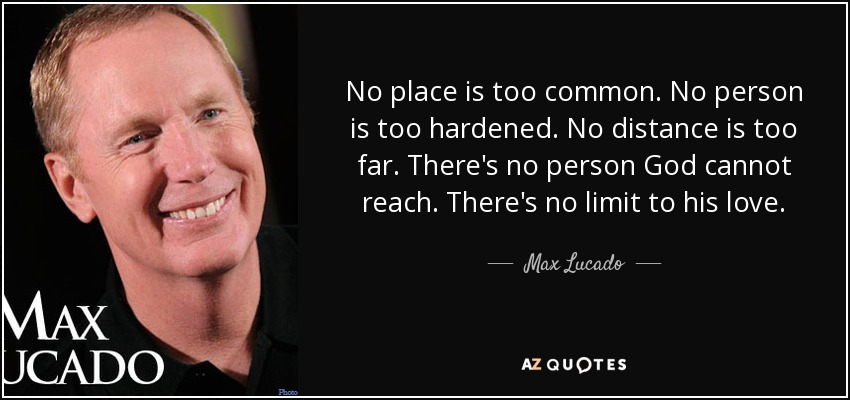
No place is too common. No person is too hardened. No distance is too far. There's no person God cannot reach. There's no limit to his love.
Our thoughts, our language, are always at a distance from whatever they're trying to describe. We have other kinds of languages, like mathematics, like music, like art, but there's always that gap.
People make fun of cybersex, but it's really something to take into account: it is a drama, a split of the human being! The human being can now be changed into some kind of spectrum or ghost who has sex at a distance. That is really scary because what used to be the most intimate and the most important relationship to reality is being split. This is no simulation but the coexistence of two separate worlds.
It's amazing to me in retrospect that I wrote as much as I did with full-time jobs. Each city gave me a new distance from - and a new way of looking at - India. I'm grateful for the movement. I feel as if I've crammed several lives into one.
Sometimes educators suffer from the "I already do that" syndrome. In those cases, we feel inadequate if we admit we have a distance to go as learners of our craft.
I used my Karate footwork to control the distance, and I use is as a penetration drill that I do, this is my speciality, the way I penetrate on people, the explosiveness and the timing. It all started with Kyokoshin and Sports Karate.
I remember being fascinated by the graduated sizes and perspective on the sets [of Star Wars]. And how they put shorter people and kids in the uniforms and placed them in the distance to give the idea that these sets had more depth than they really did.
Moreover, I would like to say that the sort of polar inertia we witnessed in the Kosovo War, the polar inertia involving 'automated war' and 'war-at-a-distance' is also terribly weak in the face of terrorism. For instance, in such situations, any individual who decides to place or throw a bomb can simply walk away. He or she has the freedom to move. This also applies to militant political groups and their actions.
Past tense offers authority, distance, and present tense offers emotional immediacy.
I do identify with Olympic athletes quite a lot because they have to push to reach a certain plateau and some of them go on and some of them give up and some art - you know, some people are very talented in art and do a few amazing things and then give it up and go on and do other things, and others are in it for the long haul, more or less long-distance runners.
I am a lonely runner, but I am a long-distance runner.
I think the Internet shortens the distance between people, and that can often lead to inappropriateness.
Once you become somebody, that don't mean you distance yourself from people. There is no such thing as no one can walk the streets or go outside. That I will never believe. There might be some fanfare. There might be some paparazzi, but you can control that. All you have to do is maintain the person you were before that when you would tell someone to back up or get out of my way or just stop and address people. Give them what they want. Have a smile, kick a few lyrics, and be out.
Today, we have come a distance. We have made a lot of progress. That cannot be denied. You cannot dispute the fact that our country is so different from 50 years ago. But we still have problems. There are too many people that have been left out and left behind, and they are African American, they are White, Latino, Asian American, and Native American.
There's something I have about being Canadian - there's a distance it gives you when you live in the States and operate in American culture. You approach familiar things a different way; you come at it from a different angle. It's a trait that runs through a lot Canadian artists' work and actors' work and musicians' - that kind of special remove.
If you want to draw people into the story, you really have to write as if you're writing a novel and make these actually-existing people, including the actually-existing person with my name, into a believable person on the page. And that requires distance. That requires not being right up against the events you're talking about.
I think that America is an ideal place for the privileged homeless, who are used to different cultures. It's easiest and most accommodating because it is a country of exiles and immigrants and newcomers. There are no walls, in that sense. There is always the sense that traditions are being made as we speak. So you can slot yourself in. If you are living at a distance in society, this is one of the most congenial societies to live in.
I think the most important thing I wanted to say at various times to Franklin and Eleanor Roosevelt was that it seemed so sad to me that - I really believe they loved each other and had a great deal of affection - but because of that early hurt in their marriage, there was a certain kind of distance from then on, until their deaths actually. So at times, I just wanted to push them together and say, "Come on, you guys! I know you love each other. This is crazy!"
Having that little bit of breathing room to work, and not feeling like it's going to fall apart at any second, has allowed me to recover the feeling I had when I was a little kid, when I was writing stories for fun or drawing pictures for my parents to put on their refrigerator. It was about playing and doing something fun, and kind of making your own little world. And that's how art should feel for me, and how having a little bit more distance between my ass and the ground has helped me.
There are great parents of small children - they keep their little hair in bows - but those parents are not always good parents of young adults. As soon as their children get up to some size, it's "Shut up, sit down, you talk too much, keep your distance, I'll send you to Europe!" My mom was a terrible parent of small children but a great parent of young adults. She'd talk to me as if I had some sense.
Bike riding is where I go to solve all the problems. I know you can't tell from looking at me, but I'm a long distance bike rider, I'll ride my bike and by the time I get back I will have solved whatever problem I had creatively or found that other thing that I was looking for. That's a big part of it.
I did this campaign that was called "Back to the Basics" where I went back to the street, went back to my block, and really felt the people. We've got to go back to that sometimes. We distance ourselves from that and we see it from afar. Some people can't relate back to that; once you're out of it, they don't want to relate back to that. It's always good to get back to the basics, though. You've got to touch the roots, you've got to touch those people. Regardless of what's going on, people always respect that.
Images work on so many different levels. As a writer you feel them, try not to get in their way or narrow them down to anything other or less complex. A writer is a curator of sorts - once you've brought the images together you try to stand at a respectful distance and let them speak for themselves. Try not to mess with their ambiguities and contradictions. They are what they are, irreducible. This is their integrity.
The religious training inspired in me a desire for learning. In fact, I am immensely grateful for my Catholic education for instilling in me a desire for learning. However, the Catholic training also gave me a desire for questioning. The desire to question led me eventually to distance myself from the Catholic institution and its dogma.
Distance is where people get really confused. If you stand really far away from someone you're like, "That's not me. I'm so far away from that person. That person is so different from me." It's easy to forget that people - refugees from Syria, for example - are exactly like us.
Follow AzQuotes on Facebook, Twitter and Google+. Every day we present the best quotes! Improve yourself, find your inspiration, share with friends
or simply: