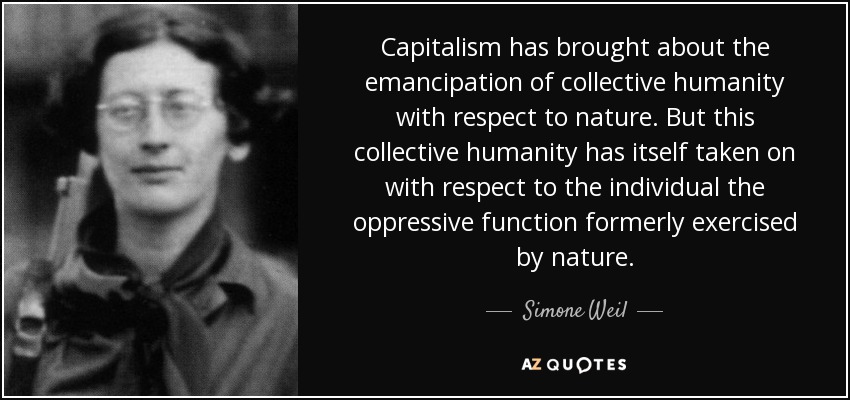
Capitalism has brought about the emancipation of collective humanity with respect to nature. But this collective humanity has itself taken on with respect to the individual the oppressive function formerly exercised by nature.
The demolishment of the power of organized Christianity in the Western world to finally realize the emancipation of women and give them the vote in 1920. Women couldn't even own property in their own names until the last quarter of the 19th century in America.
You know, the Emancipation Proclamation was like giving freedom to domestic animals.
My mother was in the kind of late-sixties, early-seventies origins of female emancipation. And she was very much like, "You're not going to be defined by how you look. It's going to be about who you are and what you do."
The same thing that Uncle Tom did on the plantation before [Abe] Lincoln issued the so-called Emancipation Proclamation.I have no thinking on the matter. But he's teaching the black people to suffer peacefully, patiently, until the white man makes up his mind that you're a human being the same as he.
I can't say with certainty that slavery would have ended more quickly and more completely if the South had been allowed to leave and escaped former slaves had been allowed to remain free, and the North and the rest of the world had been a positive influence on the South. However, it's certainly a possibility that it would have ended sooner if the southern slave owners had agreed to a system of compensated emancipation and freed the slaves without a war and without secession, as most nations that ended slavery did. That absolutely would have been preferable to the Civil War as it happened.
If you are going to abolish slavery, that opens up all these other questions: what system of labor is going to replace slave labor? What system of race relations is going to replace the race relations of slavery? Who is going to have power in the post-war South? The Emancipation Proclamation doesn't answer that question, but it throws [it] open.
You point out that war is only a symptom of the whole horrid business of human behavior, and cannot be isolated. And that, even if we abolish war, we shall not abolish hate and greed. So might it have been argued about slave emancipation, that slavery was but one aspect of human disgustingness, and that to abolish it would not end the barbarity that causes it. But did the abolitionists therefore waste their breath? And do we waste ours now in protesting against war?
Loyal and substansial Catholic service on the battlefield undermined one of the most longstanding objections to emancipation: namely, that since Catholics owed religious allegiance to a foreign authority in the person of the Pope, their political and patriotic allegiance must necessarily be suspect.
Emancipation of human labor from economic servitude and exploitation, i.e., from organizations of production in which the conditions of work are determined by a master class who own the means of production, and in which the fruits of work are alienated from workers to the benefit of masters.
One belief, more than any other, is responsible for the slaughter of individuals on the alter of the great historical ideas - justice or progress or happiness of future generations... or emancipation of a nation or race or class... this is the belief that somewhere... there is a final solution.
When the happy era shall arrive for the emancipation of nations, hastened on as it will be by the example of America, shall they not resort to the Declaration of our Independence as the charter of their rights, and will not its author be hailed as the benefactor of the redeemed?
At the moment of their emancipation, women have a need to write their own histories.
In 1949, I believed that social progress, the triumph of the proletariat, socialism would lead to the emancipation of women. But I saw that nothing came of it: first of all, that socialism was not achieved anywhere, and that in certain countries which called themselves socialist, the situation of women was no better than it was in so-called capitalist countries.
I was a tomboy running around in the garden. I used to play on a local cricket team. I grew up with all boy cousins, for the most part, and my brother. My mother was in the kind of late-sixties, early-seventies origins of female emancipation. And she was very much like, "You're not going to be defined by how you look. It's going to be about who you are and what you do."
I don't think I'm an idealist. I'm a realist. And I see the progress. The progress has been remarkable. Look at the emancipation of woman in my lifetime. You're sitting here as a female. Look what's happened to the same-sex marriages. To tell somebody a man can become a woman, a woman can become a man, and a man can marry a man, they would have said, "You're crazy." But it's a reality today. So the world is changing. And you shouldn't - you know - be despairing because it's never happened before. Nothing new ever happened before.
The Emancipation Proclamation is predicated upon the idea that the President may so annul the constitutions and laws of sovereign states, overthrow their domestic relations, deprive loyal men of their property, and disloyal as well, without trial or condemnation.
In emancipation from the fears that beset the slave of circumstance he will experience a profound joy, and through all the vicissitudes of his outward life he will remain in the depths of his being a happy man.
The liberation of women has brought a lot of equality to the man, in the emancipation of the man as a bulldog; we can also be soft. It's interesting, because sometimes I maybe push the men a little bit more than the women, because it's a little bit less expected.
In Stalinism the tragedy is that its origin is some kind of radical emancipatory project. In the origins you had a kind of workers' uprising; the true enigma is how this project of emancipation went so wrong.
In all of human history no country or no people have suffered such terrible slavery, conquest and foreign oppression and no country and no people have struggled so strenuously for their emancipation than Sicily and the Sicilians.
The Renaissance had resulted in the emancipation of the individual, in making him feel that the universe had no other purpose than his happiness. This brought an entirely new answer to the question, 'Why should I do this or that?' It used to be, 'Because self-instituted authority command you.' The answer now was, 'Because it is good for men.' In this lies our greatest debt to the Renaissance, that it instituted the welfare of men as the end of all action.
Grateful to Almighty God for the blessings which, through Jesus Christ Our Lord, He had conferred on my beloved country in her emancipation and on myself in permitting me, under circumstances of mercy, to live to the age of 89 years, and to survive the fiftieth year of independence, adopted by Congress on the 4th of July 1776.
It has been said "the truth will make men free". The truth alone has never set anyone free. It is only DOUBT which will bring mental emancipation.
I appeal to women not to let themselves become corrupted by male power. Emancipation is something more than a 'ticket' to serve in the army.
Follow AzQuotes on Facebook, Twitter and Google+. Every day we present the best quotes! Improve yourself, find your inspiration, share with friends
or simply: