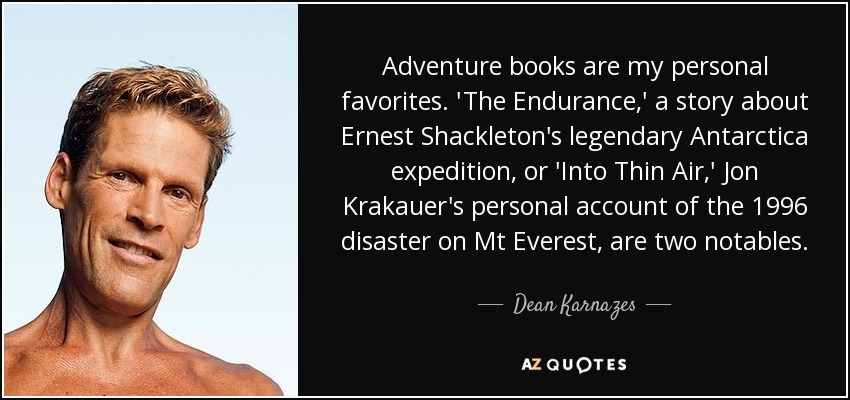
Adventure books are my personal favorites. 'The Endurance,' a story about Ernest Shackleton's legendary Antarctica expedition, or 'Into Thin Air,' Jon Krakauer's personal account of the 1996 disaster on Mt Everest, are two notables.
My biggest love is space. I completed 800 hours' space training in Moscow and I became the world's oldest man to go to the North Magnetic Pole. At 67, I also became the oldest man to reach 28,400ft on Everest without oxygen.
We don't train executives, we find them. If a mountain stands up like Everest, you don't have to be a genius to figure out that it's a high mountain.
Only the person who risks is truly free. A man's conquest of himself dwarfs the conquest of Mt. Everest.
I was asked to give a speech on the Everest swim, and during the Everest swim, I changed. I changed as a person, I honestly did. That mountain changed me, and I gave a speech about it for nine minutes.
Dreams, in their essence, include risk. This risk could be physical danger (often true in climbing big mountains like Everest), or it could be financial (leaving a comfortable job and pouring your life savings into a business venture), or it could be emotional (like the feelings of loss and questioning that comes with losing friends and coworkers to climbing accidents).
I've often thought about that and the only suitable member to join me on that climb [to Everest] was George Lowe: he was strong, a good man on a mountain, with a great sense of humour, and I liked that. I think George and I could've done that together ... I've probably never told George that.
I'm kind of obsessed by Everest and all those men that mountaineer and take themselves to extreme limits. Having gone back to Scotland to work on Outlander, I've been climbing a lot and getting out in the Highlands.
Spiritual guidance needs guidance. It's like comparing walking on the ground and mountain climbing. Once you learn how to walk, you can walk on the ground by yourself, but if you want to climb Mount Everest, you need a guide.
The nuclear peril is usually seen in isolation from the threats to other forms of life and their ecosystems, but in fact it should be seen at the very center of the ecological crisis, as the cloud-covered Everest of which the more immediate, visible kinds of harm to the environment are the mere foothills.
I have always been fiery; I go after things. But what I learned from my mother is to step back and actually experience things that are happening. So for me, it's about meditating. My Everest is to have that become a real part of my life.
It's kind of too movie-like to say, "When I started climbing, I knew I wanted to climb Everest some day." Instead, I just started rock climbing as a kid, when I was 16, and then I started teaching and a buddy of mine started taking me out.
The sheer volume of evidence for survival after death is so immense that to ignore it is like standing at the foot of Mount Everest and insisting that you cannot see the mountain.
When the climbers in 1953 planted their flags on the highest mountain, they set them in snow over the skeletons of creatures that had lived in the warm clear ocean that India, moving north, blanked out. Possibly as much as twenty thousand feet below the seafloor, the skeletal remains had turned into rock. This one fact is a treatise in itself on the movements of the surface of the earth. If by some fiat I had to restrict all this writing to one sentence, this is the one I would choose: The summit of Mt. Everest is marine limestone.
Above the comforts of Base Camp, the expedition in fact became an almost Calvinistic undertaking. The ratio of misery to pleasure was greater by an order of magnitude than any mountain I'd been on; I quickly came to understand that climbing Everest was primarily about enduring pain. And in subjecting ourselves to week after week of toil, tedium and suffering, it struck me that most of us were probably seeking above all else, something like a state of grace.
This forms the nub of a dilemna that every Everest climber eventually comes up against: in order to succeed you must be exceedingly driven, but if you're too driven you're likely to die.
You don't need to go to the ends of the earth, you don't need to climb Everest to have a great adventure, it's invariably on our doorstep.
If you have a high-way on Everest, you don't meet the mountain. If everything is prepared, and you have a guide who is responsible for your security, you cannot meet the mountain. Meeting mountains is only possible if you . . . are out there in self-sufficiency.
Think about climbing a mountain. If you decide you're going up Everest, you don't start with a sprint. You'll never make it out of base camp if you do that. The secret is two fold: make sure your approach is consistent and steady so that you can maintain the progress you're making as your journey continues.
You don't play triathlon. You play soccer; it's fun. You play baseball. Triathlon is work that you can leave you crumpled in a heap, puking on the roadside. It's the physical brutality of climbing Mount Everest without the great view from the top of the world. What kind of person keeps coming back for more of that?
The main thing is to be honest with yourself, know and recognize your limits and attain maximum achievement within them. I would for example get more satisfaction from climbing Snowdon, which I know I could, than from attempting Everest, which I couldn't.
I tell the players that they can't relive any day in their lives and that they can't relive the minutes of a game, so they should make a great effort, a Mount Everest type effort, to live up to their potential. Success is a communal type thing, and if we win, then everyone can be considered successful and we can move uptown together.
Many people have been getting too casual about climbing Everest. I forecast a disaster many times.
I really haven't liked the commercialization of mountaineering, particularly of Mt. Everest. By paying $65,000, you can be conducted to the summit by a couple of good guides.
I like to think of Everest as a great mountaineering challenge, and when you've got people just streaming up the mountain - well, many of them are just climbing it to get their name in the paper, really.
Follow AzQuotes on Facebook, Twitter and Google+. Every day we present the best quotes! Improve yourself, find your inspiration, share with friends
or simply: