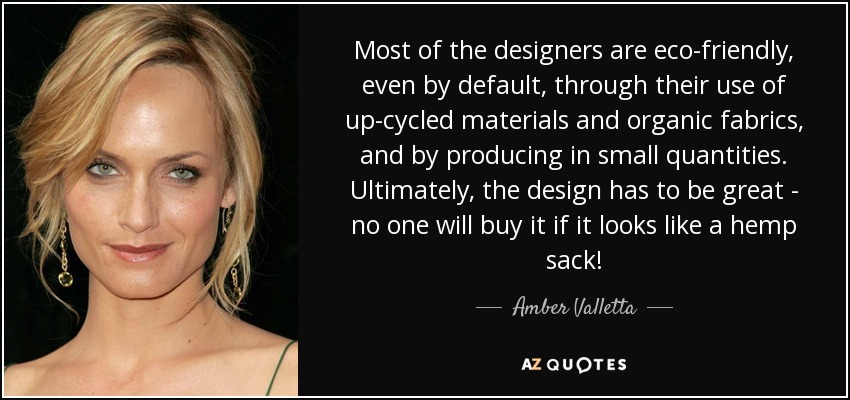
Most of the designers are eco-friendly, even by default, through their use of up-cycled materials and organic fabrics, and by producing in small quantities. Ultimately, the design has to be great - no one will buy it if it looks like a hemp sack!
My mom used to sell fabric and lace when I was younger. She would bring back these elaborate fabrics from Nigeria. I always enjoyed being around it. However, it wasn't until I started making music that I started taking a vested interest.
Even though I was painted, even though I had on seven layers of paint - to the point that I got a tan, it was as thick as a fabric - I think I felt the most naked because I couldn't cover myself at all. I didn't have to, so I had to be much more open and relaxed.
I grew up on the beaches, and I always found it kind of funny that it's considered decent if you cover three tiny spots with pieces of fabric.
I'd make my whole collection with just one square of fabric. I wouldn't do anything else; everything had to be made from one square. This is just one example.
I started with wanting to think about witches, about strong women who have special powers - who are often misunderstood. Then I found some beautiful blue fabric, so I made Blue Witches. My creative process is always like that. Organic, text, theme, subtext, each day evolving and trying to make strong, beautiful clothes. It's that simple.
We also had a team of costumers that would do samples for us, of fabrics, textures, people doing silhouettes of things up on dress forms, just to kind of inform the design process. Through all of that we got to the point that we had to figure out how to light them up. So that was a huge undertaking.
Honesty . . . is the foundation upon which relationships and many societies are built. Without it . . . there can be no trust. Widespread lying destroys the fabric of democratic societies, in which the necessary assumption is that people mostly tell the truth.
I love working in the markets, I love working with fabric. So I'm not that conditioned to one thing.
When I came to Delhi first and said, "This is not India. And then I was taken to Varanasi and there I loved, loved the culture. It was a beautiful journey. The way the people dressed - even the poorest people, and the fabrics! With vegetable dyes, and I was fascinated by the color. But in the end I loved the men - all in white - so many shades of white. And I said, "What am I going to do? A color collection or a white collection?" I finally did a neutral white collection.
The fabric of a mighty state, which has been reared by the labours of successive ages, could not be overturned by the misfortune of a single day, if the fatal power of the imagination did not exaggerate the real measure of the calamity.
The zooming wealth of the top 1 percent is a problem, but it's not nearly as big a problem as the tens of millions of Americans who have dropped out of high school or college. It's not nearly as big a problem as the 40 percent of children who are born out of wedlock. It's not nearly as big a problem as the nation's stagnant human capital, its stagnant social mobility and the disorganized social fabric for the bottom 50 percent.
Through its interpretation of the Constitution, the Supreme Court hugely shapes the fabric of our society for us and for future generations.
People buy very badly made furniture and fabric. Instead, buy a beautiful dining table, well-made upholstery. It's almost like dressing for success.
By leaning on companies, by leaning on infrastructure providers, by leaning on researchers, graduate students, post-docs, even undergrads, to look at the challenges having an untrusted internet, where we have to put our communications on wires that are owned by a phone company that we can't trust, that's working in collaboration with a government that we can't trust, in areas around the world, we can restructure that communications fabric in a way that it's encrypted.
There's such an advantage to being involved in the day-to-day details of each other's lives. It's a marvelous fabric to exist in.
Technology and the Internet have created a new set of relationships. It's changed the social fabric of promotion: advertising, dating. Part of art world judgment, part of it, is based on people's statistics; their measure of financial value: of likes, of popularity. Data and technology are invading the traditional and classic set of criteria.
Through me you pass into the city of woe: Through me you pass into eternal pain: Through me among the people lost for aye. Justice the founder of my fabric moved: To rear me was the task of power divine, Supremest wisdom, and primeval love. Before me things create were none, save things Eternal, and eternal I shall endure. All hope abandon, ye who enter here.
Within a few decades, machine intelligence will surpass human intelligence, leading to The Singularity -- technological change so rapid and profound it represents a rupture in the fabric of human history. The implications include the merger of biological and nonbiological intelligence, immortal software-based humans, and ultra-high levels of intelligence that expand outward in the universe at the speed of light.
What you are basically, deep, deep down, far, far in, is simply the fabric and structure of existence itself.
Claudia Rankine's Citizen comes at you like doom. It's the best note in the wrong song that is America. Its various realities-'mistaken' identity, social racism, the whole fabric of urban and suburban life-are almost too much to bear, but you bear them, because it's the truth. Citizen is Rankine's Spoon River Anthology, an epic as large and frightening and beautiful as the country and various emotional states that produced it.
Im just a normal person. Its not like I come home and think about opera. My thoughts are about completely other things. Shoes! Dresses! Expensive ones: with a pretty silhouette, beautiful fabrics.
The place where I think social media fails is in showing the knowledge, the tradition of stitching the clothing, of cutting the fabric, of the tannery, of the skinning of the jewels - this knowledge needs respect. Online and social media is the future, but we need to learn from the past, too.
I have, for my own projected works and ideas, only the silliest and dewiest of hopes; no matter what, I am romantic enough or sentimental enough to wish to contribute something to life's fabric, to the world's beauty.... [S]imply to live does not justify existence, for life is a mere gesture on the surface of the earth, and death a return to that from which we had never been wholly separated; but oh to leave a trace, no matter how faint, of that brief gesture! For someone, some day, may find it beautiful!
This is what art is all about. It is weaving fabric from the feathers you have plucked from your own breast. But no one must ever see the process - only the finished bolt of goods. They must never suspect that that crimson thread running through the pattern is blood.
Follow AzQuotes on Facebook, Twitter and Google+. Every day we present the best quotes! Improve yourself, find your inspiration, share with friends
or simply: