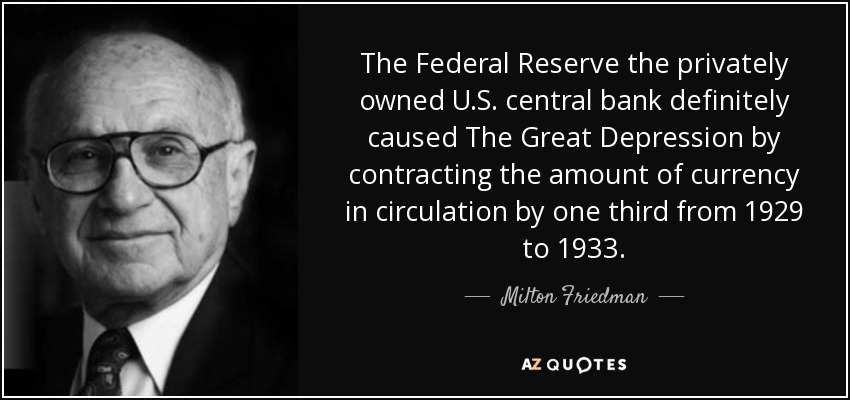
The Federal Reserve the privately owned U.S. central bank definitely caused The Great Depression by contracting the amount of currency in circulation by one third from 1929 to 1933.
Nothing did more to spur the boom in stocks than the decision made by the New York Federal Reserve bank, in the spring of 1927, to cut the rediscount rate. Benjamin Strong, Governor of the bank, was chief advocate of this unwise measure, which was taken largely at the behest of Montagu Norman of the Bank of England....At the time of the Banks action I warned of its consequences....I felt that sooner or later the market had to break.
Prior to 1968, the gullible gentiles could take a one dollar Federal Reserve note into any bank in America and redeem it for a dollar which was by law a coin containing 412 1/2 grains of 90 per cent silver. Up until 1933, one could have redeemed the same note for a coin of 25 4/5ths grains of 90 per cent gold. All we do is give the goy more non-redeemable notes, or else copper slugs. But we never give them their gold and silver. Only more paper.
The international monetary order is more precarious by far today than it was in 1929. Then, gold was international money, incorruptible, unmanageable, and unchangeable. Today, the U.S. dollar serves as the international medium of exchange, managed by Washington politicians and Federal Reserve officials, manipulated from day to day, and serving political goals and ambitions. This difference alone sounds the alarm to all perceptive observers.
The greatest threat facing America today is the disastrous fiscal policies of our own government, marked by shameless deficit spending and Federal Reserve currency devaluation. It is this one-two punch - Congress spending more than it can tax or borrow, and the Fed printing money to make up the difference - that threatens to impoverish us by further destroying the value of our dollars.
That is the one thing in my public career that I regret--my work to secure the enactment of the Federal Reserve Law.
Perhaps more to the point for TBTF (Too Big To Fail bank), if a SIFI (Systemically Important Financial Institution) does fail I have little doubt that private investors will in fact bear the losses-even if this leads to an outcome that is messier and more costly to society than we would ideally like. Dodd-Frank is very clear in saying that the Federal Reserve and other regulators cannot use their emergency authorities to bail out an individual failing institution
I cannot disagree with you that having something like 500 economists is extremely unhealthy. As you say, it is not conducive to independent, objective research. You and I know there has been censorship of the material published. Equally important, the location of the economists in the Federal Reserve has had a significant influence on the kind of research they do, biasing that research toward noncontroversial technical papers on method as opposed to substantive papers on policy and results
The Federal Reserve is not currently forecasting a recession.
The Federal Reserve will not monetize the debt.
Ever since the Federal reserve was born, (in 1913) we have been living under a lie.
Musicians burn through more cash than the Federal Reserve.
Lethargy bordering on sloth remains the cornerstone of our investment style. The exception was Wells Fargo, a superbly-managed, high-return banking operation in which we increased our ownership to just under 10%, the most we can own without the approval of the Federal Reserve Board.
I don't think it's possible for the Fed to end its easy-money policies in a trouble-free manner. Recent episodes in which Fed officials hinted at a shift toward higher interest rates have unleashed significant volatility in markets, so there is no reason to suspect that the actual process of boosting rates would be any different. I think that real pressure is going to occur not by the initiation by the Federal Reserve, but by the markets themselves.
I cannot morally blame all Americans for allowing, for instance, the birth of the Federal Reserve System and the money destruction that has followed. They are simply ignorant about it and don’t know what happened or what is happening. They think that prices go up rather than that dollars go down.
It's true that the Federal Reserve faces a lot of political pressure and is unpopular in many circles.
The Federal Reserve was not founded to bail out Bear Stearns or a few hedge funds. It was founded to keep a stable currency and maintain its value.
You have safety and soundness as primary purpose of the Federal Reserve, the OCC, and the other agencies which control banking regulation.
In 1977, when I started my first job at the Federal Reserve Board as a staff economist in the Division of International Finance, it was an article of faith in central banking that secrecy about monetary policy decisions was the best policy: Central banks, as a rule, did not discuss these decisions, let alone their future policy intentions.
A snarky but accurate description of monetary policy over the past five years is that the Federal Reserve successfully replaced the technology bubble with a housing bubble
In the United States we have, in effect, two governments ... We have the duly constituted Government ... Then we have an independent, uncontrolled and uncoordinated government in the Federal Reserve System, operating the money powers which are reserved to Congress by the Constitution.
Intriguingly, in poll after poll, when Americans are asked what public institutions they most respect, three bodies are always at the top of their list: the Supreme Court, the armed forces, and the Federal Reserve System. All three have one thing in common: they are insulated from the public pressures and operate undemocratically. It would seem that Americans admire these institutions, precisely because they lead rather than follow.
The Federal Reserve is no more federal than Federal Express.
Bad as "independence" is, the main fault of the Federal Reserve System - an admirable system if conducted in the public interest - is that too much power and control rests in the hands of people whose private interests are directly affected by the Federal Reserves' actions.
I know this, the Federal Reserve is private and the I.R.S. is screwing us.
Follow AzQuotes on Facebook, Twitter and Google+. Every day we present the best quotes! Improve yourself, find your inspiration, share with friends
or simply: