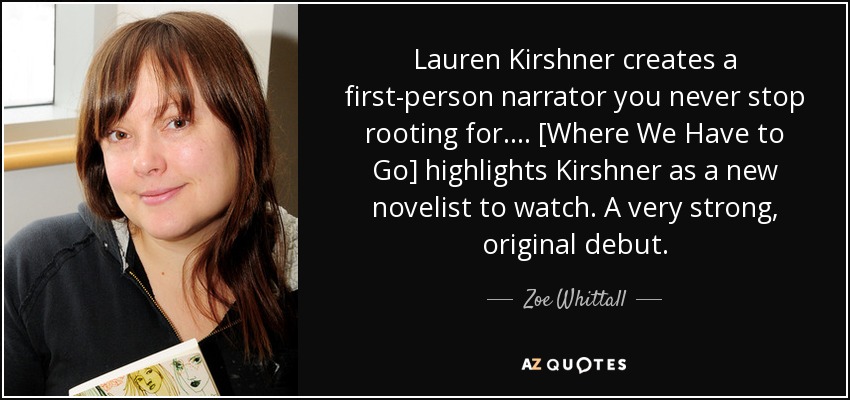
Lauren Kirshner creates a first-person narrator you never stop rooting for. . . . [Where We Have to Go] highlights Kirshner as a new novelist to watch. A very strong, original debut.
With the adult ones, I feel I need to get as deep inside the psychology of a character as I can, and that needs to be first-person. In the children's books, I feel I need some distance. I don't want to be the nine-year-old at the center of the story. I need to have some type of narrative voice.
If somebody says 'singer-songwriter' to me, the first person I think of is James Taylor. There are plenty of modern singer-songwriters, but there is something about James Taylor that has always resonated with me.
The first person besides my mother who believed in me was a man whose last name I never knew. He was my boss, the manager of Swenson's Ice Cream shop.
Jung Chang was the first person to tell a grand historical, political story through a personal narrative.
Jeremy Popkin's collection of first-person narratives of the Haitian Revolution is an extremely valuable work, accessible, sound and intelligent. I only wish such a book had been available fifteen years ago when I was in the early stages of researching my series of novels. Popkin has been deft and tactful in stitching together these excerpts, and as a result, he manages to tell a complete version of the Revolution almost entirely in the words of the people who experienced it-this book engaged me deeply.
For me, personally, I'm more comfortable with what I would call third-person entertainment, meaning watching a character that's explicitly not me and experiencing something through a character's eyes, than what I would call first-person entertainment, which is a video game in which I am the character.
The first person I learned I could make happy with laughter was my mother, whom I idolize. It was a powerful thing to realize. I knew I had found my life's work.
In literary representation, the distinction between the genuinely erotic and the licentious is a distinction not of subject-matter, but of perspective. The genuinely erotic work is one which invites the reader to re-create in imagination the first-person point of view of someone party to an erotic encounter. The pornographic work retains as a rule the third-person perspective of the voyeuristic observer.
Congratulations to Sachin Tendulkar for becoming the first person ever to score 50 test hundreds, absolute superstar
The first person to make me realize there was someone behind the film was Steven Spielberg.
The earth has been cultivated before it has been divided; the cultivation itself having been the only motive for a division, and for that law which secures to every one his property. For the first persons who have employed themselves in cultivation, have probably worked as much land as their strength would permit, and, consequently, more than was necessary for their own nourishment.
I was the first person in my family born in the United States. My mom is from Croatia, and my dad is from Iran. They met at music school in Belgium. I grew up as a pianist.
In novels you're able to occupy character's internal thoughts and it's really hard to do in a film or a TV show. When you're reading a character's thoughts or when it's in first person, you're reading kind of their own story, so you have the opportunity to see what makes that character complex or complicated. And to me that's what the whole point of fiction is.
Sex scenes in books are always like first person, from this male perspective and just about how awesome he is. It feels like such a fantasy.
A fashion icon to me is somebody who has, the first person who struck you and introduced you to the world of fashion, and that person is my mom.
Just because I write in the first person doesn't mean that all my songs are autobiographical.
I think the female first-person is still dismissed, demonized, especially if the book does not end on an empowering note, especially if the main character is perceived as unlikeable, or too privileged.
I did a lot of reading of first person accounts from Koreans and combatants and aid workers. And I spoke to relatives. A lot of wonderful photographs were made available to me from that period - 1950-1956 - and those were given to me by a Korean newspaper in Seoul. Ruined villages, refugees streaming through a river valley, GI's and orphans and orphanages, those tiny details that you can only see in a picture.
I'm always telling my students, don't - don't worry so much third person, first person. It doesn't make that much difference.
The point is that you free the ego. The ego is only a pronoun. It's a Greek first person pronoun, ergo. When you're in Greece you say, Ergo wants to take a bus, and you don't mean your ego wants to take a bus, like some big entity, you only mean I want to take a bus.
It was so enticing from the beginning to be this woman who was entrenched in The Flash's world. She's not there to just tell him what a great job he's doing, she's also there to push him further and help him to be the best that he can be. She's often the first person to be a little bit skeptical of him, which is kind of nice. She really challenges him.
I believe that if we would carefully apply the distinction between transparency and opacity to the different layers of the human self-model, looking at self-consciousness in a much more careful and fine-grained manner, then we might also arrive at a new answer to your original question: What a "first-person perspective" really is.
Consciousness is phenomenologically subjective whenever there is a stable, consciously experienced first-person perspective.
For a human being, to possess a consciously experienced first-person perspective means to have acquired a very specific functional profile and distinctive level of representational content in one's currently active phenomenal self-model: It has, episodically, become a dynamic inner model of a knowing self.
Follow AzQuotes on Facebook, Twitter and Google+. Every day we present the best quotes! Improve yourself, find your inspiration, share with friends
or simply: