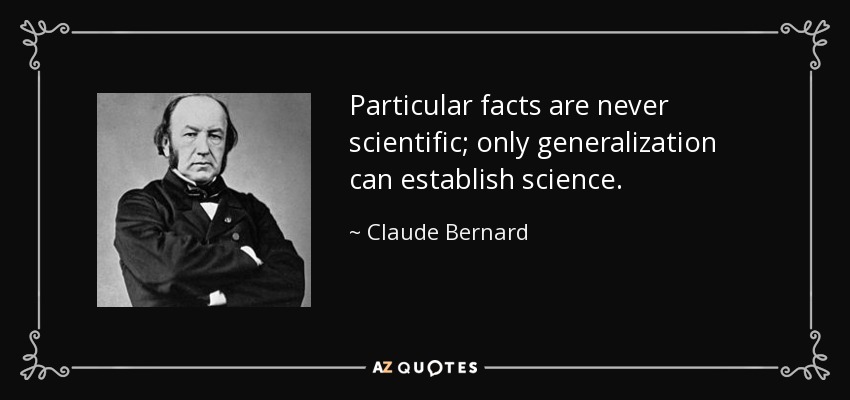
Particular facts are never scientific; only generalization can establish science.
If it is to be effective as a tool of thought, a notation must allow convenient expression not only of notions arising directly from a problem, but also of those arising in subsequent analysis, generalization, and specialization.
( ...philosophy is more often the systematization of the prejudices of philosophers than the systematization of nature.) Distrust all generalizations: stick to the concrete.
Writing about race and crime was not new territory for me. But it can be treacherous. So here are my rules: No stereotypes. No generalizations. No explanations. No apologies. Just the facts, ma'am.
The church as we know it today seems a million miles from the New Testament church. That may be a great generalization, but I will stand on it. There is a gulf between our average Christianity and the church of New Testament that makes the Grand Canyon look like a cavity in someone's tooth.
It is wiser, I believe, to arrive at theory by way of evidence rather than the other way around.... It is more rewarding, in any case, to assemble the facts first and, in the process of arranging them in narrative form, to discover a theory or a historical generalization emerging of its own accord.
Travelers are much at the mercy of phrases ... vast generalizations formulate in their exposed brains.
Happiness is a specific. Misery is a generalization. People usually know exactly why they are happy. They very rarely know why they are miserable.
Newton's great generalization, which he called the "third law of motion," was that "Action and reaction are always equal to each other;" and that law has been one of the most pregnant of all truths about the mystery of force;--one of the brightest windows through which modern eyes have looked into the world of Nature.
He resented such questions as people do who have thought a great deal about them. The superficial and slipshod have ready answers, but those looking this complex life straight in the eye acquire a wealth of perception so composed of delicately balanced contradictions that they dread, or resent, the call to couch any part of it in a bland generalization. The vanity (if not outrage) of trying to cage this dance of atoms in a single definition may give the weariness of age with the cry of youth for answers the appearance of boredom.
What distinguishes the historian from the collector of historical facts is generalization.
It is, I believe, justifiable to make the generalization that anything an organic chemist can synthesize can be made without him. All he does is increase the probability that given reactions will 'go.' So it is quite reasonable to assume that given sufficient time and proper conditions, nucleotides, amino acids, proteins, and nucleic acids will arise by reactions that, though less probable, are as inevitable as those by which the organic chemist fulfills his predictions. So why not self-duplicating virus-like systems capable of further evolution?
The first man who said "fire burns" was employing scientific method, at any rate if he had allowed himself to be burnt several times. This man had already passed through the two stages of observation and generalization. He had not, however, what scientific technique demands - a careful choice of significant facts on the one hand, and, on the other hand, various means of arriving at laws otherwise than my mere generalization.
Color is crucial in painting, but it is very hard to talk about. There is almost nothing you can say that holds up as a generalization, because it depends on too many factors: size, modulation, the rest of the field, a certain consistency that color has with forms, and the statement you're trying to make.
[This] may prove to be the beginning of some embracing generalization, which will throw light, not only on radioactive processes, but on elements in general and the Periodic Law.... Chemical homogeneity is no longer a guarantee that any supposed element is not a mixture of several of different atomic weights, or that any atomic weight is not merely a mean number.
In the field one has to face a chaos of facts, some of which are so small that they seem insignificant; others loom so large that they are hard to encompass with one synthetic glance. But in this crude form they are not scientific facts at all; they are absolutely elusive, and can be fixed only by interpretation, by seeing them sub specie aeternitatis, by grasping what is essential in them and fixing this. Only laws and generalizations are scientific facts, and field work consists only and exclusively in the interpretation of the chaotic social reality, in subordinating it to general rules.
I am bad at cultural generalizations but I would venture to say that by a wide margin there is less hypocrisy about sex in France than in America.
Making an investment decision is like formulating a scientific hypothesis and submitting it to a practical test. The main difference is that the hypothesis that underlies an investment decision is intended to make money and not to establish a universally valid generalization.
At each stage...entirely new laws, concepts and generalizations are necessary, requiring inspiration and creativity to just as great a degree as in the previous one.
The idea which...shuts out the Second Coming from our minds, the idea of the world slowly ripening to perfection, is a myth, not a generalization from experience.
As a piece of writing, The Elementary Particles feels like a bad, self-conscious pastiche of Camus, Foucault and Bret Easton Ellis. And as a philosophical tract, it evinces a fiercely nihilistic, anti-humanistic vision built upon gross generalizations and ridiculously phony logic. It is a deeply repugnant read.
Generalization is flawed thinking only when applied to individuals. It is the most accurate way to describe the mass, the Wad. And yours is a democracy, a dictatorship of the Wad.
The principle of science, the definition, almost, is the following: The test of all knowledge is experiment. Experiment is the sole judge of scientific "truth." But what is the source of knowledge? Where do the laws that are to be tested come from? Experiment, itself, helps to produce these laws, in the sense that it gives us hints. But also needed is imagination to create from these hints the great generalizations--to guess at the wonderful, simple, but very strange patterns beneath them all, and then to experiment to check again whether we have made the right guess.
How can a modern anthropologist embark upon a generalization with any hope of arriving at a satisfactory conclusion? By thinking of the organizational ideas that are present in any society as a mathematical pattern.
Most people traffic in abstractions and generalizations because they are grossly incompetent at culturing their intuition or powers of evidency, refining it to grasp the Thisness (Haecceitas) of what is before them. Thinking is like a Stradivarius that has more potential variations in how it is played than any human can finitely perform or capture.
Follow AzQuotes on Facebook, Twitter and Google+. Every day we present the best quotes! Improve yourself, find your inspiration, share with friends
or simply: