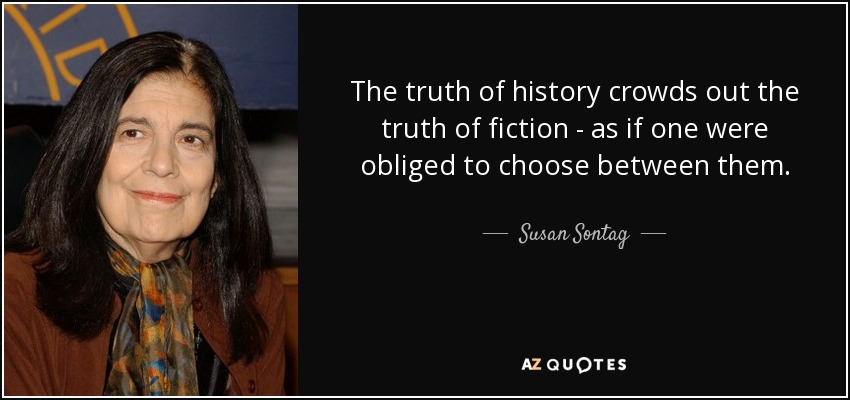
The truth of history crowds out the truth of fiction - as if one were obliged to choose between them.
The past is our treasure. Its works, whether we know them or not, flourish in our lives with whatever strength they had. From it we draw provision for our journey, the collected wisdom whose harvests are all ours to reap and carry with us, though we may never live again in the fields that grew them.
History ... with its long, leisurely, gentlemanly labors, the books arriving by post, the cards to be kept and filed, the sections to be copied, the documents to be checked, is the ideal pursuit for the New England mind.
History must always be taken with a grain of salt. It is, after all, not a science but an art.
There is also, in any history, the buried, the wasted, and the lost.
In becoming archaeologists of the world of our mothers, we are trying to retrieve the female past and to invent a future.
Every age cuts and pastes history to suit its own purposes; art always has an ax to grind.
Every generation tailors history to its taste.
History is clarified experience.
Completeness is rare in history.
The poets have familiarized more people with history than have the historians.
History, the winnowing wind, never halts. We see the chaff rise, forget the waiting grain, seed of the future, fallen to the threshing floor. We never learn, but live on, slit-narrow, as if our living were a pencil line traced upon paper, behaving as trapped denizens of a flat world hemmed in by the bigoted horizon of our own making. Yet the meaning of living is a pushing back, a pulling down of the great walls and domes of fear and ignorance, is relinquishing the nest for the sky, ignorance for understanding. The look back is also a look forward.
A nation does not create the historians it deserves; the historians are far more likely to create the nation.
somewhere about the eighteenth century, history tacitly replaced religion as the school of public morals.
The selective winnowing of time leaves only a few recognizable individuals behind for the historian to light on. Thus the historian who finds the human being more interesting than what the human being has done must inevitably endow the comparatively few individuals he can identify with too great an importance in relation to their time. Even so, I prefer this overestimate to the opposite method which treats developments as though they were the massive anonymous waves of an unhuman sea or pulverizes the fallible surviving records of human life into the grey dust of statistics.
All history must be mobilized if one would understand the present.
History unravels; circumstances, following their natural inclination, prefer to remain ravelled.
The lessons of the past suggest that racism and resentment against people of color will continue to flourish in America as long as the history that is taught transposes the heroes and the villains. That is the unspoken truth at the heart of the nation's racial divide.
Despite the modern dogma to the effect that women were a subject sex until the nineteenth century 'emancipated' them from history, women in history had demonstrated strong wills and purposes, had made assertions, and had directed or influenced all human destiny, including their own, since human life began.
Most American heroes of the Revolutionary period are by now two men, the actual man and the romantic image. Some are even three men - the actual man, the image, and the debunked remains.
It's really hard for me to use the term 'history' in the singular, because it suggests a reductivist view of how moments and events congeal and reflect the passage of time. I'd rather stick to the pluralness of 'histories' in order to suggest the simultaneity, the parallel forces at work, which produce lived experience.
History is a great painter, with the world for canvas, and life for a figure. It exhibits man in his pride, and nature in her magnificence,--Jerusalem bleeding under the Roman, or Lisbon vanishing in flame and earthquake. History must be splendid. Bacon called it the pomp of business. Its march is in high places, and along the pinnacles and points of great affairs.
History presents the pleasantest features of poetry and fiction,--the majesty of the epic, the moving accidents of the drama, the surprises and moral of the romance. Wallace is a ruder Hector; Robinson Crusoe is not stranger that Croesus; the Knights of Ashby never burnish the page of Scott with richer lights of lance and armor than the Carthaginians, winding down the Alps, cast upon Livy.
It is the winners who write history - their way.
Although it is tempting to imagine an ancient era innocent of biochemical weaponry, in fact this Pandora's box of horrors was opened thousands of years ago. The history of making war with biological weapons begins in mythology, in ancient oral traditions that preserved records of actual events and ideas of the era before the invention of written histories.
Follow AzQuotes on Facebook, Twitter and Google+. Every day we present the best quotes! Improve yourself, find your inspiration, share with friends
or simply: