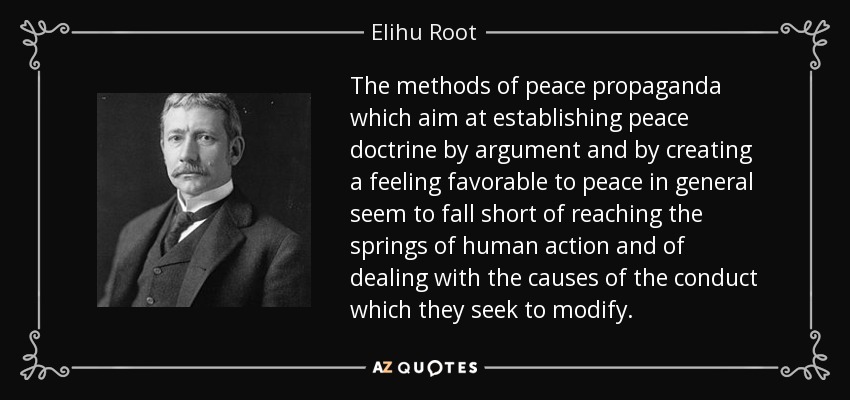
The methods of peace propaganda which aim at establishing peace doctrine by argument and by creating a feeling favorable to peace in general seem to fall short of reaching the springs of human action and of dealing with the causes of the conduct which they seek to modify.
History being the record of human action is a richly variegated material, and it is not easy to give a true impression of the stuff by snipping off an inch or two for a pattern.
The history of mankind is the history of ideas. For it is ideas, theories, and doctrines that guide human action, determine the ultimate ends men aim at, and the choice of the means employed for the attainment of these ends.
I will be guided by the Christian ethic and an awareness that human action is by nature transient.
Human action can be modified to some extent, but human nature can not be changed
Human judgment of human actions is true and void , that is to say, first true and then void.... The judgment of the word is true, the judgment in itself is void.... Only he who is a party can really judge, but as a party he cannot judge. Hence it follows that there is no possibility of judgment in the world, only a glimmer of it.
Human action is governed largely by instinct and emotion.
Always, in every human action, there are leaders.
One can relish the varied idiocy of human action during a panic to the full, for, while it is a time of great tragedy, nothing is being lost but money.
The world looks with some awe upon a man who appears unconcernedly indifferent to home, money, comfort, rank, or even power and fame. The world feels not without a certain apprehension, that here is someone outside its jurisdiction; someone before whom its allurements may be spread in vain; some one strangely enfranchised, untamed, untrammelled by convention, moving independent of the ordinary currents of human action.
Hunger, love, vanity, and fear. There are four great motives of human action.
The notion that a society could be regulated entirely by market forces is a utopian fantasy: an impossible dream generated by imagining what the world would be like if everyone's behavior was utterly consistent with some abstract moral ideal-in this case, economic theories that assume all human action is based on calculating, systematic, (but scrupulously law-abiding), greed.
Economics is uncertain because its fundamental subject matter is not money but human action. That's why economics is not the dismal science, it's no science at all.
Professional psychologists seem to think that they are the only people who make sense out of human actions. The rest of us know that everybody tries to do just this. What else is gossip?
Decisive inventions and discoveries always are initiated by an intellectual or moral stimulus as their actual motivating force, but, usually, the final impetus to human action is given by material impulses ... merchants stood as a driving force behind the heroes of the age of discovery; this first heroic impulse to conquer the world emanated from very mortal forces
A burning desire is the greatest motivator of every human action. The desire for success implants 'success consciousness' which, in turn, creates a vigorous and ever-increasing 'habit of success'.
The main thing history can teach us is that human actions have consequences, and that certain choices, once made, cannot be undone.
Fear or stupidity has always been the basis of most human actions.
Either the distances betweem the distant quarters of the globe are diminished, or you have extended the powers of human action.
We can learn from history how past generations thought and acted, how they responded to the demands of their time and how they solved their problems. We can learn by analogy, not by example, for our circumstances will always be different than theirs were. The main thing history can teach us is that human actions have consequences and that certain choices, once made, cannot be undone. They foreclose the possibility of making other choices and thus they determine future events.
No honest work of man or woman "fails"; it feeds the sum of all human action.
I have discovered a universal rule which seems to apply more than any other in all human actions or words: namely, to steer away from affectation at all costs, as if it were a rough and dangerous reef, and (to use perhaps a novel word for it) to practise in all things a certain nonchalance [sprezzatura] which conceals all artistry and makes whatever one says or does seem uncontrived and effortless.
It is impossible to describe any human action if one does not refer to the meaning the actor sees in the stimulus as well as in the end his response is aiming at.
Take, say, the solidarity movement in Central America, which I think is what you probably had in mind. To a large extent, it comes out of mainstream Christianity, based on beliefs that have had outrageous human consequences in the past, and that I think are totally indefensible. In this case, they happen to lead to some of the most courageous, heroic, and honourable human action that's taking place anywhere in the world. Well, that's how life is, I guess. It doesn't come in neat little packages.
Where intellectuals have played a role in history, it has not been so much by whispering words of advice into the ears of political overlords as by contributing to the vast and powerful currents of conceptions and misconceptions that sweep human action along.
Follow AzQuotes on Facebook, Twitter and Google+. Every day we present the best quotes! Improve yourself, find your inspiration, share with friends
or simply: