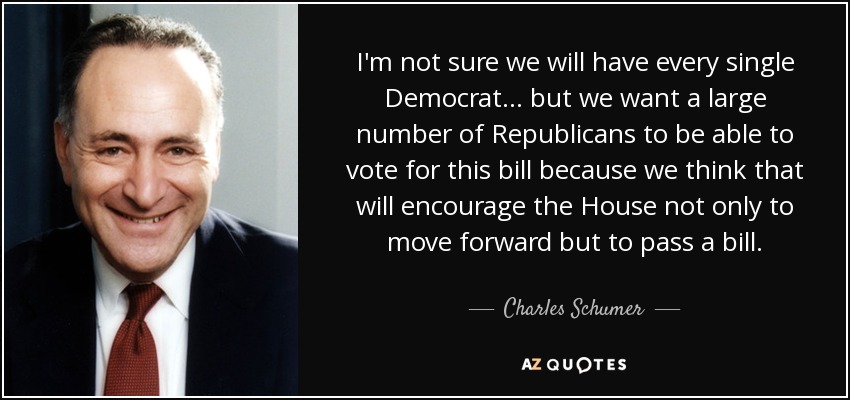
I'm not sure we will have every single Democrat ... but we want a large number of Republicans to be able to vote for this bill because we think that will encourage the House not only to move forward but to pass a bill.
I think on this issue more than any other we're going to see sort of a bipartisan longing to get something done, and hopefully you're not going to find the fisticuffs that you would find on lots of other issues. I think you'll be able to glean a sense of progress without us revealing the specifics.
Reforms to our complex and dysfunctional immigration system should not in any way favor those who came here illegally over the millions of applicants who seek to come here lawfully. Additionally, the framework carves out a special exception for agricultural workers that has little justification.
I intend to have protections for the L.G.B.T. community in there. I'm not going to make choices between that community and the non-L.G.B.T. community.
I'd like something that faces reality. We have 12 million people in this country that are undocumented - that's a reality. It's not going to be like they're all going to leave. One of the reasons I'm holding this hearing in the morning is to hear from somebody who actually understands what's involved here - Janet Napolitano - and I hope that from what she says and what we hear from her, we can start building some consensus.
I do feel immigration will probably be dealt with as long as [the solution] doesn't provide amnesty ... Five years ago, all hell broke loose ... This year, I thought phones would ring off the hook again. They really haven't. I think everybody realizes we have a problem.
We believe that people should wait their time, and people should be able to be accepted here - over a million a year - in an orderly process, not a disorderly process, and that we should not be rewarding those who violate the law, and making even harder for those who try to comply with the law.
There seems to be a lot of momentum behind immigration reform.
We have history as a guide, and history suggests that this brand of comprehensive reform ... is a recipe for failure.
Amnesty will not help balance our budget ... In fact, a large-scale amnesty is likely to add trillions of dollars to the debt over time, accelerate Medicare's and Social Security's slide into insolvency and put enormous strain on our public-assistance programs.
I've always said that the 1986 [Immigration Reform and Control] Act had a fourth leg [in addition to law enforcement, increased immigration and amnesty] to its stool which was wishful thinking. And that pattern of a four-legged stool was copied in the failed attempts to enact a second and bigger general amnesty for illegal aliens in 2006, 2007, and in the current year 2013.
This bill [Immigration Reform and Control act of 1986] is a gamble, a riverboat gamble. There is no guarantee that employer sanctions will work or that amnesty will work. We are headed into uncharted waters.
I recently spoke with Barbara Jordan of the U.S. Commission on Immigration Reform, and I increasingly believe we need a system to verify employment eligibility. The Commission's recommendation of a national registry may be the way to go.
Beyond budget fights, the Obama second-term agenda was supposed to be about passing comprehensive immigration reform.
There's a lot of overconfidence about this bill. We're going to expose it. It will not pass.
Our timing is right... The election results are still fresh in the minds of my Republican colleagues and they don't want to go through this again.
This isn't all going to be done in one day, either.
I've always been for immigration reform; in 2007 I just didn't feel it had enough protections.
I am confident - very confident - that if I help solve this problem in a way that we won't have 20 million illegal immigrants 20 years from now, not only will I get re-elected, I can look back and say I was involved in something that was important.
When it comes to immigration reform, now is the time ... I've never seen a better political environment ... I'm not doing immigration reform to solve the Republican Party's political problem. I'm trying to save our nation from, I think, a shortage of labor and a catastrophic broken system.
From a policy point of view, I don't think it's the right approach. I don't like the idea of having millions of people here for their entire life without being able to assimilate into America...From a political point of view, we've got 55 Democrats sent and a 72 percent support for a path to citizenship. It's just not practical to think we'll be able to pass any bill in the United States Senate without a path to citizenship.
There will never be a bill without a pathway to citizenship signed by the president...And in turn there will never be a pathway to citizenship without a new immigration system replacing the current one.
I'm also particularly pleased that there is bipartisan support to include the input of border communities. Not only will security be strengthened according to Washington, D.C., but border communities will have a say as well.
These are people who wanted to provide for their family and wanted a better life. We've got to have a secure border. But we've also, we've got to act compassionately and recognize labor markets as well. ... I've never thought that it's [path to citizenship] a bad thing. If somebody is going to be here for 20, 30 years, to give them some skin in the game, if you will, to hold out the prospect of citizenship.
It's going to take a while for some of these things.
Follow AzQuotes on Facebook, Twitter and Google+. Every day we present the best quotes! Improve yourself, find your inspiration, share with friends
or simply: