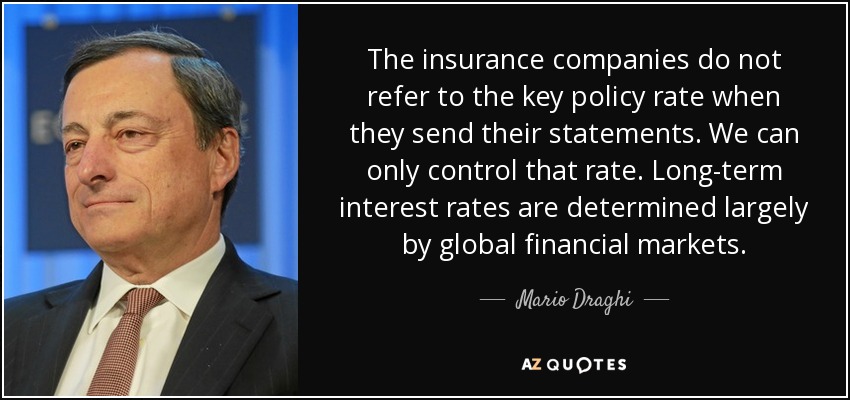
The insurance companies do not refer to the key policy rate when they send their statements. We can only control that rate. Long-term interest rates are determined largely by global financial markets.
The central banks cannot control interest rates. That's a mistake. They can control a particular rate, such as the Federal Funds rate, if they want to, but they can't control interest rates.
What central banks can control is a base and one way they can control the base is via manipulating a particular interest rate, such as a Federal Funds rate, the overnight rate at which banks lend to one another. But they use that control to control what happens to the quantity of money. There is no disagreement.
Italy may well be the main problem. It has benefited most from the euro by having been able to get the euro interest rate instead of what otherwise would have been its own. That would be much higher because Italy has been accumulating so much debt. In the past, Italy has inflated away its debt. The virtue of the euro is that Italy can't do it alone. A tight ECB policy wouldn't permit that to happen again.
I want to build a studio in my backyard. The interest rates are low now, so who knows
Central banks have gotten out of the central banking business and into the central planning business, meaning that they are devoted to raising up-if they can-economic growth and employment through the dubious means of suppressing interest rates and printing money. The nice thing about gold is that you can't print it.
I think the millions of people who had been able to renegotiate their mortgages so they are paying lower interest rates are better off.
The bankers might not have said it in so many words, but gradually their strategy emerged: Target families who were already in a little trouble, lend them more money, get them entangled in high fees and astronomical interest rates, and then block the doors to the bankruptcy exit if they really got in over their heads.
The Fed should make a clear commitment to stable money to reduce the swings in interest rates and inflation. Instead, it champions and flaunts unstable money. This encourages momentum trading and the growth of derivatives. Meanwhile, layers of financial regulation make Washington bigger and more powerful but dont fix the underlying problems.
Despite a lingering low inventory and increasing prices, consumers still have the confidence to purchase a home. More and more people recognize the many opportunities in this market and the significant value of low interest rates. As job creation and wages continue to improve, many more first-time buyers are now making the decision to become homeowners.
Britain was set to repeat the boom-bust cycle that led to 15 per cent. interest rates for one whole year in the early 1990s.
Our approach is to reject the old vicious circle of the '80s-rising debt, higher long-term interest rates, higher debt repayment costs, lower growth, higher unemployment, then enforced cuts in public spending. That was the old boom and bust.
If we want to contrast what we have done in the past few years on delivery with what the right hon. and learned Gentleman delivered, let us remember the interest rates at 10 per cent. to 15 per cent., the 1.5 million fewer people in work, the boom and the bust and the borrowing at 8 per cent.
Sound economic fundamentals coupled with a number of positive factors have partially offset the psychological impact of rising interest rates in Hong Kong.
Thus a long term corporate bond could actually be sold to three separate persons. One would supply the money for the bond; one would bear the interest rate risk, and one would bear the risk of default. The last two would not have to put up any capital for the bond, though they might have to post some sort of collateral.
I think the concern over rising interest rates is ahead of itself because I think inflationary fears themselves might be premature.
The fact that the bond market is rallying today is a plus. If this ends up being a bear market, it will be one of the first ever that began when interest rates are down.
I don't think it's possible for the Fed to end its easy-money policies in a trouble-free manner. Recent episodes in which Fed officials hinted at a shift toward higher interest rates have unleashed significant volatility in markets, so there is no reason to suspect that the actual process of boosting rates would be any different. I think that real pressure is going to occur not by the initiation by the Federal Reserve, but by the markets themselves.
Greece will not manage to get back on its feet without restructuring its debt. There is no way around it. The country's creditors will have to reduce a portion of its debts by extending maturity dates, lowering interest rates or giving them what's called a 'haircut' in financial jargon.
The petroDollar system breaking down, where oil is no longer paid for in Dollars internationally, essentially would be the death knell to the US Dollar as the reserve currency. It means the US can't borrow with 'exorbitant privilege' anymore, and it means the US Treasury market is set for an out-of-control interest rate spiral.
Believe me: The day [Barack] Obama goes off, and he leaves, and goes out to the golf course for the rest of his life to play golf, when they raise interest rates, you're going to see some very bad things happen, because the Fed is not doing their job. The Fed is being more political than Secretary [Hillary] Clinton.
If you are, consolidating at a lower interest rate can help you pay off your debt faster. But if there's even a small chance that you'll spiral back into debt, it's not for you.
A consolidation makes sense only if you can lower your overall interest rate. Many people consolidate by taking out a home equity line loan or home equity line of credit (HELOC), refinancing a mortgage, or taking out a personal loan. They then use this cheaper debt to pay off more expensive debt, most frequently credit card loans, but also auto loans, private student loans, or other debt.
You fall a bit behind on a credit card bill, your interest rate soars, your minimum payment rises, and you start falling more and more behind every month. You don't see an end. But you don't want to file bankruptcy either. What you can do - and should do - is negotiate.
The interest rate you receive, however, is contingent on your credit score.
Follow AzQuotes on Facebook, Twitter and Google+. Every day we present the best quotes! Improve yourself, find your inspiration, share with friends
or simply: