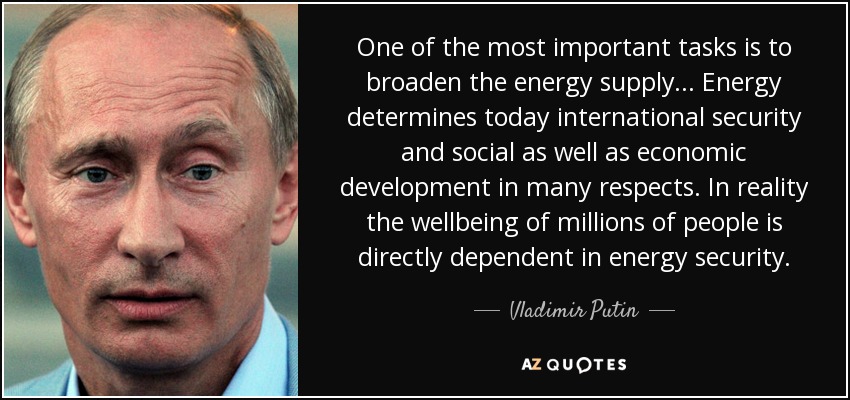
One of the most important tasks is to broaden the energy supply ... Energy determines today international security and social as well as economic development in many respects. In reality the wellbeing of millions of people is directly dependent in energy security.
But one must say clearly that we redistribute de facto the world's wealth by climate policy...One has to free oneself from the illusion that international climate policy is environmental policy any more.
Despite the international scientific community's consensus on climate change, a small number of critics continue to deny that climate change exists or that humans are causing it. Widely known as climate change "skeptics" or "deniers," these individuals are generally not climate scientists and do not debate the science with the climate scientists.
The concept of national sovereignty has been an immutable, indeed sacred, principle of international relations. It is a principle which will yield only slowly and reluctantly to the new imperatives of global environmental cooperation. It is simply not feasible for sovereignty to be exercised unilaterally by individual nation states, however powerful. The global community must be assured of environmental security.
Together with international unity and resolve we can meet the challenge of this global scourge and work to bring about an international law of zero tolerance for terrorism.
Terrorism is a principal preoccupation in most of our international contacts.
In the election campaign of 1930, Hitler seldom spoke explicitly of Jews. The crude tirades of the early 1920s were missing altogether. 'Living-space' figured more prominently, posed against the alternative international competition for markets ... The key theme now was the collapse of Germany under parliamentary democracy and party government into a divided people with separate and conflicting interests, which only the NSDAP could overcome by creating a new unity of the nation, transcending class, estate and profession.
Hostility towards China distorted Australia's international affairs for 20 years until 1972, but reconciliation with China 30 years ago had produced a quarter century of constructive bipartisan relations with our region and the world, unmatched in Australian history.
Our intention to regard the closing of the Straits as a casus belli was communicated...to the foreign ministers of those states which had supported international navigation in the Straits in 1957 and thereafter. There can be no doubt that these warnings reached Cairo. One thing was now clear. If Nasser imposed a blockade, the explosion would ensue not from 'miscalculation', but from an open-eyed and conscious readiness for war.
Even if we act immediately, the world is doomed to lose many of its animal and plant species and this inturn will reduce the ability of ecosystems to deliver vital services to human populations. The Red List gives all of us a practical tool for raising awareness of the biodiversity crisis and for forging new partnerships within the international community.
International friendly games are not worth the lives of the silk worms who perish to make the pennants. They do not even have the philanthropic excuse that softens the otherwise unendurable tedium of testimonial matches. Quite simply, they are rotten games staged to pick the public's pocket, tiresome red tape left over from an era when nations and players were still insular and therefore curious about each other's potential.
It may be long before the law of love will be recognised in international affairs. The machineries of government stand between and hide the hearts of one people from those of another.
In Asia, a lot of successful economies that had been living on their own saving, decided to open up their financial markets to international capital in the early 1990s. So here were countries doing quite well, but they decided to borrow a bit more and do even better.
The dominant propaganda systems have appropriated the term "globalization" to refer to the specific version of international economic integration that they favor, which privileges the rights of investors and lenders, those of people being incidental. In accord with this usage, those who favor a different form of international integration, which privileges the rights of human beings, become "anti-globalist."
In today's global economy, however, it is important to raise the bar of excellence even higher. Today's students must be prepared to compete effectively on an international level.
Nations are in effect ceding portions of their sovereignty to the international community and beginning to create a new system of international environmental governance.
We need an international solution to the challenge of climate change, there's no question about it. But the real key is, can you actually get that - or get that solution - without the US' involvement? Can you not lead domestically, and expect the rest of the world will take action... the US needs to lead, we need to be out there.
Given the nature and magnitude of the challenge, national action alone is insufficient. No nation can address this challenge on its own. No region can insulate itself from these climate changes. That is why we need to confront climate change within a global framework, one that guarantees the highest level of international cooperation.
The debate's over. The people who dispute the international consensus on global warming are in the same category now with the people who think the moon landing was staged on a movie lot in Arizona.
We believe that climate change must be viewed not only as a danger to natural systems, but also as a direct threat to human survival and well-being. We are convinced that this negotiation process must not be viewed as a traditional series of governmental trade-offs, but as an urgent international effort to safeguard human lives, homes, rights and livelihoods.
We can hardly expect the nation-state to make itself superfluous, at least not overnight. Rather what we must aim for is really nothing more than caretakers of a bankrupt international machine which will have to be transformed slowly into a new one. The transition will not be dramatic, but a gradual one. People will still cling to national symbols.
Every child in America who enters school at the age of five is mentally ill, because he comes to school with an allegiance toward our elected officials, toward our founding fathers, toward our institutions, toward the preservation of this form of government that we have. Patriotism, nationalism, and sovereignty, all that proves that children are sick because a truly well individual is one who has rejected all of those things, and is truly the international child of the future.
According to the International Institute for Environment and Development, the annual amount spent globally on advertising aimed at increasing consumption topped $430 billion in 1998.Consumer capitalism is dedicated to the proposition that production is good in itself, no matter what is produced. The net effect is the massive production of absurd, empty and useless items which are nevertheless utterly serious since we earn our living from them, and dedicate our leisure time to them.
It would appear that, on the level of individual nations and of international relations, the free market is the most efficient instrument for utilizing resources and effectively responding to needs.
The dilemma of our age is the combination of unprecedented material progress and systematic spiritual decline. The decline in public and private morality can be witnessed in the marketplace as well as the forums of international diplomacy. In the past, a man's honor and reputation were his most valuable assets. Business agreements were made with a handshake. Today one might be well advised to check the "bottom line" and read the "small print."
Follow AzQuotes on Facebook, Twitter and Google+. Every day we present the best quotes! Improve yourself, find your inspiration, share with friends
or simply: