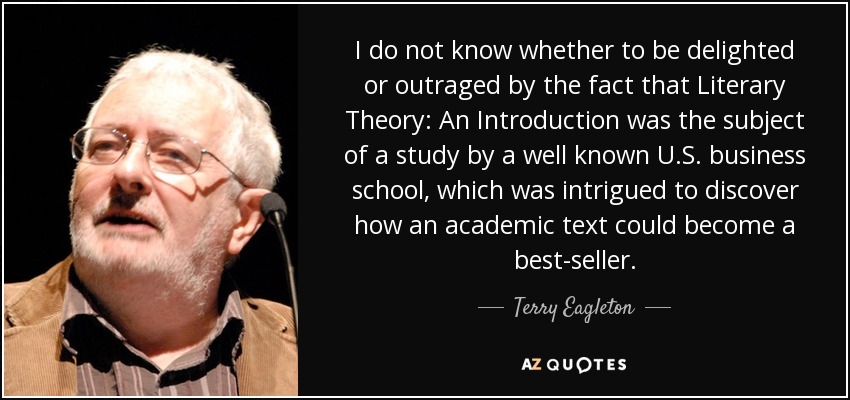
I do not know whether to be delighted or outraged by the fact that Literary Theory: An Introduction was the subject of a study by a well known U.S. business school, which was intrigued to discover how an academic text could become a best-seller.
My introduction into Marvel world was Comic-Con 2014 where I really had to take a step back and go, 'What have I walked into? What is this place? It's wild, and there's all these crazy rockstars walking around - who are all older than me, which was really weird. I was like, 'I feel too old to be in a superhero movie,' and they're like 10 years older than me.
To my mind this makes psychedelics central to any political reconstruction, because these are the only force in nature that actually dissolve linguistics structures; lets the mechanics of syntax to be visible, allows the possibility for rapid introduction and spread of new concepts; gives permission for new ways of seeing; and this is what we have to do, we have to change our minds.
Much later, when I was discussing cosmological problems with Einstein, he remarked that the introduction of the cosmological term was the biggest blunder he ever made in his life.
Now when I speak about Zen, I have a problem, in the sense that the Zen of today has lost the essence, in my estimation, of what I call "old Zen."
Zen has lost its zip, if you will, or its nothingness and has become ritualistic Its established in monastaries with strict codes of koan study.
Old Zen is the way of nothingness, the way of having a good time.
If you're very liberal, then you should go and find a very liberal Zen teacher, a liberal interpretation of the doctrines of the Soto or Rinzai schools.
Zen is a study. It's a discipline. It involves the active use of will to make things happen or not happen. These are the secrets of power.
In Zen you practice zazen, mindfulness and other forms of introspection to find out who you are and what you want, to balance your spirit, develop willpower, increase your sense of humor and gain wisdom.
Zen is the path that focuses the most upon meditation. It is almost exclusively a path of meditation.
You can only conceive of what lies beyond the state of mind you are in from the point of view of the state of mind you are in.
There are ten thousand states of mind. Most people spend their entire lives confined to a few of these states of mind.
In Zen you are learning how to make new realities, to build things inside your mind.
There are ten thousand planes of awareness within the infinite mind of the diamond mind, your deeper mind.
The ten thousand states of mind that we talk about in Zen are all levels of perception. You can think of each of the ten thousand states of mind as a dimensional plane.
Beyond the ten thousand states of mind is the still point. It exists within them all, yet beyond them. It is not affected by them. It gives birth to them. This is the riddle.
We are a people of many races, many faiths, creeds, and religions. I do not think that the men who made the Constitution forbade the establishment of a State church because they were opposed to religion. They knew that the introduction of religious differences into American life would undermine the democratic foundations of this country. What holds for adults holds even more for children, sensitive and conscious of differences. I certainly hope that the Board of Education will think very, very seriously before it introduces this division and antagonism in our public schools.
As women are taking an active part in pressing on the consideration of Congress many narrow sectarian measures, such as more rigid Sunday laws, the stopping of travel, the distribution of the mail on that day, and the introduction of the name of God into the Constitution; and as this action on the part of some women is used as an argument for the disfranchisement of all, I hope this convention will declare that the Woman Suffrage Association is opposed to all union of Church and State, and pledges itself as far as possible to maintain the secular nature of our Government.
A tattered copy of Johnson's large Dictionary was a great delight to me, on account of the specimens of English versifications which I found in the Introduction. I learned them as if they were so many poems. I used to keep this old volume close to my pillow; and I amused myself when I awoke in the morning by reciting its jingling contrasts of iambic and trochaic and dactylic metre, and thinking what a charming occupation it must be to "make up" verses.
There is no rigorous and effective deconstruction without the faithful memory of philosophies and literatures, without the respectful and competent reading of texts of the past, as well as singular works of our own time. Deconstruction is also a certain thinking about tradition and context. Mark Taylor evokes this with great clarity in the course of a remarkable introduction. He reconstitutes a set of premises without which no deconstruction could have seen the light of day.
Morning Glory's introduction to the magical ways of the Goddess, manifest in our time, has enlarged my understanding of Pagan ways, enriching my spirit and imagination.
The museum is full of interesting things. All kinds of paintings are there. And then paintings too thick to put in a frame, that they call sculpture. And then there are spectators. with their scorecards, rooting for culture. And spectators of the spectators, looking for love's introduction. And art students taking notes. And old women trying to remember the past. And old men with too much to forget. And tourists, thinking that a museum represents a city. And loafers so poor, they study their soberness here.
I presume that few who have paid any attention to the history of the Mathematical Analysis, will doubt that it has been developed in a certain order, or that that order has been, to a great extent, necessary -- being determined, either by steps of logical deduction, or by the successive introduction of new ideas and conceptions, when the time for their evolution had arrived.
The introduction of the Christian religion into the world has produced an incalculable change in history. There had previously been only a history of nations--there is now a history of mankind; and the idea of an education of human nature as a whole.--an education the work of Jesus Christ Himself--is become like a compass for the historian, the key of history, and the hope of nations.
Follow AzQuotes on Facebook, Twitter and Google+. Every day we present the best quotes! Improve yourself, find your inspiration, share with friends
or simply: