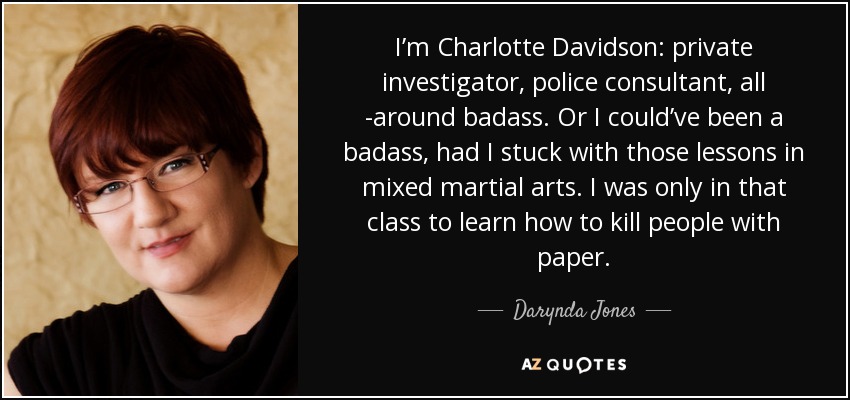
I’m Charlotte Davidson: private investigator, police consultant, all -around badass. Or I could’ve been a badass, had I stuck with those lessons in mixed martial arts. I was only in that class to learn how to kill people with paper.
You're an investigator - can't nobody find stuff out like a woman. Y'all put the police to shame, make the little investigative tricks they show on CSI and Law & Order: SVU look like counting lessons on Sesame Street.
Most investigators don't even know what the word means. You stop the cops from using informants and the only crimes they'd ever solve would be those by deranged postal workers who come to work once too often.
My high school guidance counselor, Mrs. Inverholl, once had me take an aptitude test to figure out my future. The number one job recommendation for my set of skills was an air traffic accident investigator, of which there are fewer than fifty in the world. The number two job was a museum curator for Chinese-American studies. The number three job was a circus clown.
I am fascinated by crime scene investigating. I swear, I wish I was a crime scene investigator sometimes!
It's rather naive, apart from being ethically objectionable, to assume that our investigators travel around the country with bags of money trying to bribe witnesses to lie on the witness stand. We just don't operate that way.
During the time that [Karl] Landsteiner gave me an education in the field of imununology, I discovered that he and I were thinking about the serologic problem in very different ways. He would ask, What do these experiments force us to believe about the nature of the world? I would ask, What is the most. simple and general picture of the world that we can formulate that is not ruled by these experiments? I realized that medical and biological investigators were not attacking their problems the same way that theoretical physicists do, the way I had been in the habit of doing.
The great experimental principle, then, is doubt, that philosophic doubt which leaves to the mind its freedom and initiative, and from which the virtues most valuable to investigators in physiology and medicine are derived.
Time... is an essential requirement for effective research. An investigator may be given a palace to live in, a perfect laboratory to work in, he may be surrounded by all the conveniences money can provide; but if his time is taken from him he will remain sterile.
Free thought means fearless thought. It is not deterred by legal penalties, nor by spiritual consequences. Dissent from the Bible does not alarm the true investigator, who takes truth for authority not authority for truth. The thinker who is really free, is independent; he is under no dread; he yields to no menace; he is not dismayed by law, nor custom, nor pulpits, nor society-whose opinion appals so many. He who has the manly passion of free thought, has no fear of anything, save the fear of error.
The doctrine of the Church cannot be fully understood unless it is tested by mind and feelings, by intellect and emotions, by every power of the investigator. Every Church member is expected to understand the doctrine of the Church intelligently. There is no place in the Church for blind adherence.
Theism tells men that they are the slaves of a God. Atheism assures men that they are the investigators and users of nature.
The scientific method is designed to help investigators overcome the most entrenched human cognitive habit: the confirmation bias, the tendency to notice and remember evidence that confirms our beliefs or decisions, and to ignore, dismiss, or forget evidence that is discrepant. That's why we are all inclined to stick to a hypothesis we believe in. Science is one way of forcing us, kicking and screaming if necessary, to modify our views.
The connection between health and productivity at work is intuitively obvious but has not been demonstrated to the satisfaction of either researchers or corporate financial officers. Ronald Kessler and Paul Stang help to bridge the usual gap between research and the marketplace with the help of a top-notch group of the best 'real-world' investigators obtainable-all in the cause of making the case that employee health should be treated as an investment in business performance-thus creating the new discipline of health and productivity management.
The history of science knows scores of instances where an investigator was in the possession of all the important facts for a new theory but simply failed to ask the right questions.
Do experimental work but keep in mind that other investigators in the same field will consider your discoveries as less than one fourth as important as they seem to you.
An investigator starts research in a new field with faith, a foggy idea, and a few wild experiments. Eventually the interplay of negative and positive results guides the work. By the time the research is completed, he or she knows how it should have been started and conducted.
The present rate of progress [in X-ray crystallography] is determined, not so much by the lack of problems to investigate or the limited power of X-ray analysis, as by the restricted number of investigators who have had a training in the technique of the new science, and by the time it naturally takes for its scientific and technical importance to become widely appreciated.
We do not live in a time when knowledge can be extended along a pathway smooth and free from obstacles, as at the time of the discovery of the infinitesimal calculus, and in a measure also when in the development of projective geometry obstacles were suddenly removed which, having hemmed progress for a long time, permitted a stream of investigators to pour in upon virgin soil. There is no longer any browsing along the beaten paths; and into the primeval forest only those may venture who are equipped with the sharpest tools.
To stop short in any research that bids fair to widen the gates of knowledge, to recoil from fear of difficulty or adverse criticism, is to bring reproach on science. There is nothing for the investigator to do but go straight on, 'to explore up and down, inch by inch, with the taper his reason;' to follow the light wherever it may lead, even should it at times resemble a will-o'-the-wisp.
Measurement has too often been the leitmotif of many investigations rather than the experimental examination of hypotheses. Mounds of data are collected, which are statistically decorous and methodologically unimpeachable, but conclusions are often trivial and rarely useful in decision making. This results from an overly rigorous control of an insignificant variable and a widespread deficiency in the framing of pertinent questions. Investigators seem to have settled for what is measurable instead of measuring what they would really like to know.
As soon as we touch the complex processes that go on in a living thing, be it plant or animal, we are at once forced to use the methods of this science [chemistry]. No longer will the microscope, the kymograph, the scalpel avail for the complete solution of the problem. For the further analysis of these phenomena which are in flux and flow, the investigator must associate himself with those who have labored in fields where molecules and atoms, rather than multicellular tissues or even unicellular organisms, are the units of study.
But at the same time, there must never be the least hesitation in giving up a position the moment it is shown to be untenable. It is not going too far to say that the greatness of a scientific investigator does not rest on the fact of his having never made a mistake, but rather on his readiness to admit that he has done so, whenever the contrary evidence is cogent enough.
We must remain, in a word, in an intellectual disposition which seems paradoxical, but which, in my opinion, represents the true mind of the investigator. We must have a robust faith and yet not believe.
[In the case of research director, Willis R. Whitney, whose style was to give talented investigators as much freedom as possible, you may define "serendipity" as] the art of profiting from unexpected occurrences. When you do things in that way you get unexpected results. Then you do something else and you get unexpected results in another line, and you do that on a third line and then all of a sudden you see that one of these lines has something to do with the other. Then you make a discovery that you never could have made by going on a direct road.
Follow AzQuotes on Facebook, Twitter and Google+. Every day we present the best quotes! Improve yourself, find your inspiration, share with friends
or simply: