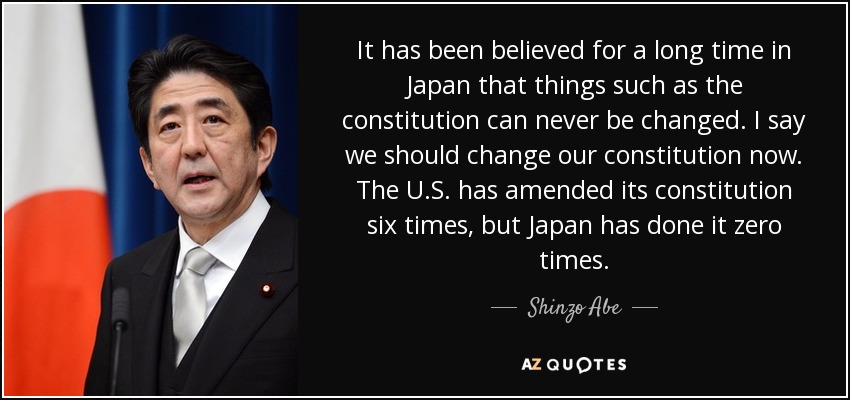
It has been believed for a long time in Japan that things such as the constitution can never be changed. I say we should change our constitution now. The U.S. has amended its constitution six times, but Japan has done it zero times.
The Japanese army is now prepared to use every means within its power to subdue its opponents. The objectives of the Japanese Expeditionary Forces are, as clearly set forth in statements issued by the Japanese Government, not only to protect the vested interests of Japan and the lives and property of the Japanese residents in the affected area, but also to scourge the Chinese Government and army who have een pursuing anti-foreign and anti-Japanese policies in collaboration with Communist influences.
I believe that the civilization India evolved is not to be beaten in the world. Nothing can equal the seeds sown by our ancestors, Rome went, Greece shared the same fate; the might of the Pharaohs was broken; Japan has become Westernized; of China nothing can be said; but India is still, somehow or other, sound at the foundation.
In our time, political speech and writing are largely the defense of the indefensible. Things like the continuance of British rule in India, the Russian purges and deportations, the dropping of the atom bombs on Japan, can indeed be defended, but only by arguments which are too brutal for most people to face, and which do not square with the professed aims of the political parties. Thus political language has to consist largely of euphemism, question-begging and sheer cloudy vagueness.
We're not necessarily the ski boat, we're the skier. There are countries like Japan and Korea and others who are the ski boat at this point, but we're getting pulled right behind them.
I don't really think that audiences are that much different. I think that a fan is the same whether you are from here or from Japan - you come to a show because you like the music. I don't really see much of a difference anywhere.
Starbucks being an extension of peoples home and work. The sense of community, human connection. That appears to be as relevant in Turkey, China, Japan and Spain as it is here in America. And Starbucks I think is creating something for people all over the world that has not existed before.
According to our belief, Japan was founded by the Sun Goddess Amaterasu Omikami, who is revered by the entire nation for her all-pervading virtue, and from whom our Imperial House is descended.
Frivolous thinking is due to foreign thought. Japan must no longer let the impudence of the white peoples go unpunished. It is the duty of Japan to fulfill her natural destiny, to cause China to respect the Japanese, to expel Chinese influence from Manchuria, and to follow the way of imperial destiny.
Let the League of Nations say whatever it pleases, let America offer whatever interference, let China decry Japan's action at the top of her voice, but Japan must adhere to her course unswervingly.
It is Japan's mission to be supreme in Asia, the South Seas and eventually the four corners of the world.
While political and cultural factors are important as explanations for differences in national technology policy and industrial practices, emergent trends in science, engineering and management are leading to new paradigms for high-technology innovation in both Japan and the United States.
The reactors in Japan are stable in the same way that a ticking time bomb is also stable. It wouldn't take much to light the fuse - a 6.6 earthquake, like what happened today in Japan, a pipe break, an over-pressurized containment vessel - anything could set it off, in which case we would have another Chernobyl, three times the magnitude of a Chernobyl accident.
We want to make America great again. We want to bring back our industry, we want to bring back our jobs from China and Japan, and by the way Mexico, which has taken so many of our jobs. And that's what it's about. I have not heard about these incidences.
If you take skinny jeans - skinny jeans didn't just happen in the US, they were happening in Japan, they were happening in the UK, they were happening everywhere. Some places a little faster than others. But, if we look at our best sellers in this store, they're the same best sellers that we have in the States.
People don't put as much of an emphasis in expanding their choices, so that, you know, one of the things that I learned when I was in Japan way back in the 1990's and there were all these quarrels happening between the U.S. and Japan about allowing more American products into the Japanese market.
When Japanese went to Hawaii they would go straight and buy the same thing that they would buy in Japan. They just got it cheaper, which they liked. And so they would still eat the red bean ice cream or the green tea ice cream, but they didn't really take advantage of the variety and it wasn't clear that they cared.
Going there [Japan] in the early 80s was quite a culture shock. I think the bombardment of Shinjuku and all that would have filtered through, which certainly informed things we later filmed.
If you look at China - and frankly, Vietnam now is doing a big number, and you look at Japan and India and Mexico - Mexico's killing us at the border and they're killing us with trade.
When I lived in New York, there wasn't as much TV or film around. I got asked to do a couple of indie films, just based on me being from The Smashing Pumpkins and A Perfect Circle. I did a couple of indie movies from Japan and one from Canada, and I thought it was an exciting, fun thing to do. I had a great time doing it, it was just that, in New York, there really wasn't as much. My studio in New York closed, so I moved out to L.A. and just started looking into composing as another thing to do, as a musician. I like it a lot. It's fun and it's a different way of thinking about music.
I'd entirely forgotten about Pass The Distance, and then I went to Japan in 2000, and was asked to do interviews with all these journalists, who were showing up with bootlegs of this record, asking me to talk about it. I was astonished. It kind of gained momentum.
When I met Akira Kurosawa in Japan, one question he asked me was, "How did you actually make the children act the way they do? I do have children in my films but I find that I reduce and reduce their presence until I have to get rid of them because there's no way that I can direct them." My own thought is that one is very grand, like an emperor on a horse, and it's very hard for a child to relate to that. In order to be able to cooperate with a child, you have to come down to below their level in order to communicate with them.
Climate change has always been sort of my main focus. I think also with [what happened in Fukushima, Japan] there's still a lot to think about in terms of what's coming down the pike into the world's oceans, too.
[Donald Trump] suggestions that the United States should leave the Pacific and let Japan, South Korea, or whoever else wants to develop nuclear weapons. These are incredibly dangerous ideas that need to be confronted.
I was a runner and a soccer player living in Okinawa, Japan and I didn't have recruiters coming in to recruit me for sports. So how many kids out there and planning to go to college are super stud athletes but don't have a chance because they come from some podunk town and no one comes to watch them?
Follow AzQuotes on Facebook, Twitter and Google+. Every day we present the best quotes! Improve yourself, find your inspiration, share with friends
or simply: