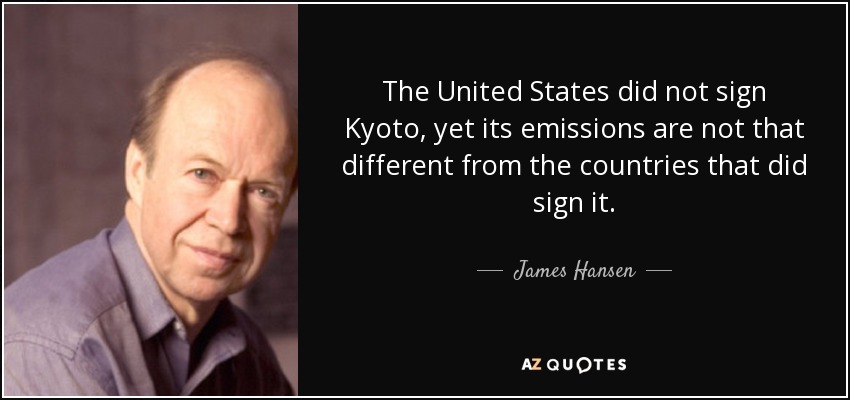
The United States did not sign Kyoto, yet its emissions are not that different from the countries that did sign it.
The challenge now is to renovate the baroque structure that the Kyoto Plan has become—or else scrap it and get ready to start all over.
Attempts to estimate the impacts of climate change continue to be highly speculative.
Globally, emissions may have to be reduced, the scientists are telling us, by as much as 60% or 70%, with developed countries likely to have to make even bigger cuts if we're going to allow the developing world to have their share of growing industrial prosperity...The Kyoto Protocol is only the first rather modest step. Much, much deeper emission reductions will be needed in future. The political implications are mind-blowing.
In developing countries the situation could be even worse because developing countries do not have to count their emissions under the Kyoto Protocol. Private companies from industrialized nations will seek cheap carbon credits for their country in the developing world.
In reality, Kyoto was a huge transfer of resources from the United States to the Third World, under the guise of environmental protection.
The UK is one of the only nations on earth that has actually met and even exceeded its goals under the Kyoto Protocol.
It will be nearly impossible to slow warming appreciably without condemning much of the world to poverty unless energy sources that emit little or no carbon dioxide become competitive with conventional fossil fuels.
Three scenarios for post-Kyoto emissions reductions indicate that ... the long-term consequences are small... The influence of the Protocol would, furthermore, be undetectable for many decades.
The impact of the Kyoto Protocol on global temperature is quite modest, especially for the first century. The reduction in global mean temperature in the Annex I case relative to the reference in 2100 is 0.13ºC; this compares with a difference of 0.17ºC from the Kyoto Protocol calculated by Wigley. The temperature reduction in the optimal run is essentially the same as the Kyoto runs by the 22nd century.
It is possible that, post-Kyoto, the developed countries will recognise the requirements of the developing world.
For the first time, humanity is instituting a genuine instrument Kyoto Protocol of global governance,"..."By acting together, by building this unprecedented instrument, the first component of an authentic global governance, we are working for dialogue and peace.
Ideology on which the Kyoto Protocol is based, is a new form of totalitarian ideology, along with Marxism, Communism and socialism.
Just as there are many more Californians now to be found in the temples of Kyoto or the villages of Bali or the mountains of the Himalayas than ever before, what is also exciting is that one can just go downtown Santa Barbara and find ayurvedic medicine, Thai restaurants, and Japanese cars in abundance.
This treaty [Kyoto] is, in our opinion, based upon flawed ideas. Research data on climate change do not show that human use of hydrocarbons is harmful. To the contrary, there is good evidence that increased atmospheric carbon dioxide is environmentally helpful...agreement would have very negative effects upon the technology of nations throughout the world, especially those that are currently attempting to lift from poverty and provide opportunities to the over 4 billion people in technologically underdeveloped countries.
The Kyoto theorists have put the cart before the horse. It is global warming that triggers higher levels of carbon dioxide in the atmosphere, not the other way round.
Kyoto protocol is not a simple environmental issue, where you can say scientists are not unanimous. This is about international relations, this is about the economy, about trying to create a level playing field for big businesses throughout the world. You have to understand what is at stake, and that is why it is serious.
The Kyoto treaty ... has no scientific foundation
The majority of humankind does not accept this system, despite claims of worldwide support. Even with Russia's ratification, 75% of the world's CO2 is emitted by, 68% of the world's GDP is produced in, and 89% of the world's population live in countries that are not handcuffed by Kyoto's restrictions. Like fascism and communism, Kyotoism is an attack on basic human freedoms behind a smokescreen of propaganda. Like those ideologies of human hatred, it will be exposed and defeated.
The Kyoto Protocol...the first component of an authentic global governance.
But we are almost certainly going to miss our [global warming] deadline. We cannot get the 10 lost years back, and by the time a new global agreement to replace the Kyoto accord is negotiated and put into effect, there will probably not be enough time left to stop the warming short of the point where we must not go.
The laws of physics are not about to change. Set your agenda by what’s happening in the atmosphere, not by what is happening in the artificial world of Kyoto.
The danger is that the compromises and special interests inherent in Kyoto-style targets and cap-and-trade will be accepted because of bureaucratic momentum.
We are close to a consensus that the Kyoto Protocol does huge economic, political, social and ecological damage to the Russian Federation. In addition, it certainly violates the rights and freedoms of Russian citizens, and well as the rights and freedoms of citizens in those countries which signed and ratified it.
Not only is the Kyoto approach to global warming wrong-headed, the climate change establishment's suppression of dissent and criticism is little short of a scandal. The IPCC should be shut down.
Follow AzQuotes on Facebook, Twitter and Google+. Every day we present the best quotes! Improve yourself, find your inspiration, share with friends
or simply: