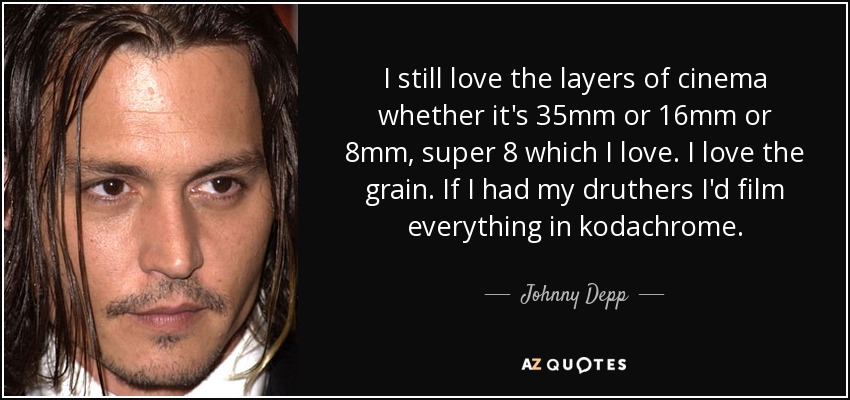
I still love the layers of cinema whether it's 35mm or 16mm or 8mm, super 8 which I love. I love the grain. If I had my druthers I'd film everything in kodachrome.
Audiences will see what they want to see. Some will come out, hopefully enjoying two hours of action. Some people will find themselves gravitating towards the emotional dilemma that the characters find themselves in. Other people will see that there is some layer of subversions to the storytelling aspect of poking a finger of judgment at certain governments to the idea of foreign invasion, others maybe false pretenses.
And I felt more like me than I ever had, as if the years I'd lived so far had formed layers of skin and muscle over myself that others saw as me when the real one had been underneath all along, and I knew writing- even writing badly- had peeled away those layers, and I knew then that if I wanted to stay awake and alive, if I wanted to stay me, I would have to keep writing.
I could also distinguish the glint of a special puddle (the one Krug had somehow perceived through the layer of his own life), an oblong puddle invariably acquiring the same form after every shower because of the constant spatulate shape of a depression in the ground. Possibly something of the kind may be said to occur in regard to the imprint we leave in the intimate texture of space. Twang. A good night for nothing.
I write, and I feel how the correct and precise use of words is sometimes like a remedy to an illness. Like a contraption for purifying the air, I breathe in and exhale the murkiness and manipulations of linguistic scoundrels and language rapists of all shades and colors. I write and I feel how the tenderness and intimacy I maintain with language, with its different layers, its eroticism and humor and soul, give me back the person I used to be, me, before my self became nationalized and confiscated by the conflict, by governments and armies, by despair and tragedy.
The body is the outermost layer of the mind.
In the case of composite colour, an infinity of systems must be obtained for maxima infinitely slight and with an infinity of interval values separating them - that is to say, the whole thickness of the sensitive layer is occupied in continuous manner by these maxima.
The most complicated character I have ever played - she has many, many, many layers that even I'm not fully aware of.
There's dozens of unrelated policy provisions tucked inside of it. I'll give you a sense of a handful of them. One is a visa waiver program change. It's going to make it harder for people who've traveled to places with terrorist activity to get into the U.S. They're going to have to go through an added layer of security.
Even though I was painted, even though I had on seven layers of paint - to the point that I got a tan, it was as thick as a fabric - I think I felt the most naked because I couldn't cover myself at all. I didn't have to, so I had to be much more open and relaxed.
When you're working on a game that has a budget of tens of millions of dollars and you have to sell millions and millions and millions of copies to break even, you have a lot more layers between you and the audience. You have a marketing department, and there's a different marketing department for every continent, and the parent company has stockholders, and all that kind of stuff.
In uncertainty I am certain that underneath their topmost layers of frailty men want to be good and want to be loved.
If you have to control people, you have to have an administrative force that does it. So in U.S. industry, even more than elsewhere, there's layer after layer of management - a kind of economic waste, but useful for control and domination. And the same is true in universities.
I always feel that a viewer has an expectation about every moment of the film and where it's going, so if I act against that, I've created a twist. In fact it becomes a kind of game with the expectations of the viewer. This is the superficial appearance. In the layer beneath there is a hidden theme. The result of each twist is that the judgment of the audience member is challenged.
For a woman to direct a movie in Hollywood, she has to go through so many layers of rejection by the powers that be - I suppose including myself - that it is harder to get to that point. So you can't just create something. And I think there is a whole unconscious mountain.
As a young filmmaker, I shot a lot of stuff because I wanted to make sure that I got everything, but now I've gotten much more precise with my shooting. Editing is a whole other layer because then, sometimes you realize characters don't even need to say this or that. It becomes an issue of exposition, and over-explaining something. In the script, I'd reinforce certain things about what I wanted people to know two or three times, but in the editing room, I'd be like, "I only need to say this once, maybe twice."
Dance has always been a really important thing for me, so being able to physically express the characters through music and dance is like another layer to things.
There is a definite difference between live shows and the recordings. The recordings are for all time, hopefully, so you do want to bring across layers of subtlety. But the live show is this primal experience that everybody's having at the same time, that the recording can at best try to imitate or duplicate.
The Fed should make a clear commitment to stable money to reduce the swings in interest rates and inflation. Instead, it champions and flaunts unstable money. This encourages momentum trading and the growth of derivatives. Meanwhile, layers of financial regulation make Washington bigger and more powerful but dont fix the underlying problems.
I'm not somebody who takes stuff home with them, that if I shoot a scene and I'm personally impacted for days or something. I mean it certainly is affecting and everything, but it doesn't penetrate to some deeper layer. I'm in it when I'm in it.
I believe that if we would carefully apply the distinction between transparency and opacity to the different layers of the human self-model, looking at self-consciousness in a much more careful and fine-grained manner, then we might also arrive at a new answer to your original question: What a "first-person perspective" really is.
It was a lot to carry out of a childhood--all those textured layers of thwarted dreams rumbling under the fifties patina--but a lot of us did it. In those manicured lives and choreographed marriages there was an often-pronounced loneliness, an emptiness that we would try to fill with our own accomplishments. And our role, the one we would have so much trouble trying to shed later, was simply to be the best little girls in the world, the high- achieving, make-no-waves, properly behaved little kittens.
I tell young girls, "The world is going to exploit and manipulate your sexuality. If you benefit from that financially, then you are part of the problem." That said, I thought all those parents flipping out over the Video Music Awards were ridiculous - women have been twerking in clubs for 20, 30 years. There's a real lack of awareness about what's going on across many layers of our culture.
Whenever I start working on a song, I immediately try to forget everything, to empty my head. I try to approach it like,“This is the first time I've ever played a guitar. What am I going to do?”. That's one way of getting straight through the conscious mind into the subconscious layer where the true creative spirit lies.
What we get in punk these days is the "anti-anti": Someone comes up with something, then the next generation is against that, and then the next generation is against that, and then that thing becomes a problem. There's these layers of anti-, and so many of them are just so self-serving. It's not about larger freedom.
Follow AzQuotes on Facebook, Twitter and Google+. Every day we present the best quotes! Improve yourself, find your inspiration, share with friends
or simply: