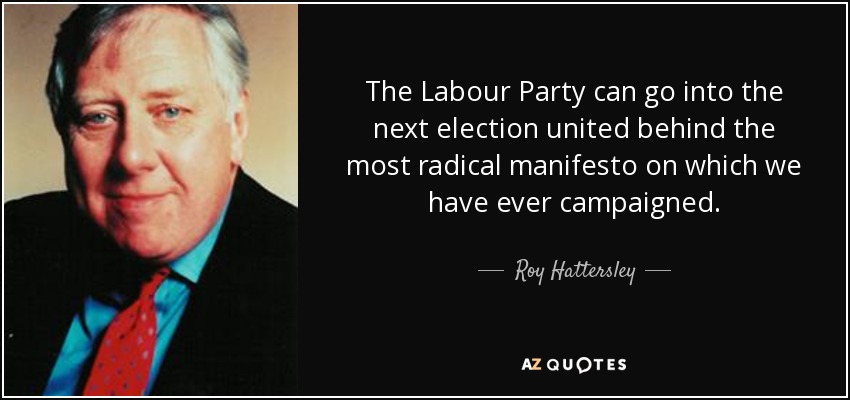
The Labour Party can go into the next election united behind the most radical manifesto on which we have ever campaigned.
The so-called materialistic conception of history, with the crude elements of genius of the early form which appeared, for instance, in the Communist Manifesto, still prevails only in the minds of laymen and dilettantes.
We went back on a very similar manifesto to things I believe in. The difference is that after eighteen months to two years he did the biggest U-turn on policy of all time and started to go the wrong way. In the end, that cost us the next election.
I keep telling my Tory colleagues: don't have any policies. A manifesto that has policies alienates people. In 1979 the manifesto said nothing which was brilliant.
I, Charles W. Penrose, wrote the Manifesto with the assistance of Frank J. Cannon and John White... Wilford Woodruff signed it to beat the devil at his own game.
In our election manifesto is: we keep the right to create money and to bring in circulation, for the cause of the government ... Those who do not share this view, reply us to the issue of paper money is for the banks, the government should stay out of the banking business. I agree with Jefferson's opinion ... and just like him I say again: the issue of money is a matter for the government and the banks should stay out of government activity.
I urge you to read the Occupy Manifesto, written by the New York City General Assembly. It is unavoidably clear. This is not directionless action. If it were, the media would have moved on.
Mr. Speaker, in 1848, Karl Marx said, a progressive income tax is needed to transfer wealth and power to the state. Thus, Marx's Communist Manifesto had as its major economic tenet a progressive income tax. Think about it, 1848 Karl Marx, Communism.... I say it is time to replace the progressive income tax with a national retail sales tax, and it is time to abolish the IRS, my colleagues. I yield back all the rules, regulations, fear, and intimidation of our current system.
The enormous dynamic and creative, as well as destructive energy of capitalism... is written up with more praise and more respect by Marx and Engels in the 1848 Communist Manifesto than probably by anyone since. I don't think anyone has ever said so precisely and with such awed admiration how great capitalism is, how inventive, how innovative, how dynamic, how much force of creativity it unleashes.
Those mutually opposed manifestos are written with the same eloquence, they breathe the same virtuous indignation, and one is just as sincere as the other; that is to say both of them are equally brazen in their lies, and it is only fools who are deceived by them. Sensible persons, all those who have had some political experience, do not even take the trouble of reading such manifestos.
If literature or music can make you think or become aware, then it's done something. That's what we've always wanted to do, just ignite sparks in people's minds. We can't offer a manifesto of how to make your life better.
Most people who read "The Communist Manifesto" probably have no idea that it was written by a couple of young men who had never worked a day in their lives, and who nevertheless spoke boldly in the name of "the workers". Thomas Sowell .
The American presidency will demand more than ringing manifestos issued from the rear of the battle. It will demand that the President place himself in the very thick of the fight; that he care passionately about the fate of the people he leads .
The manifesto of the dealmaker is simple: Reality is negotiable.
Consider this: there is not a single word in [the Sermon on the Mount] about what to believe, only words about what to do. It is a behavioral manifesto, not a propositional one. Yet three centuries later, when the Nicene Creed became the official oath of Christendom, there was not a single word in it about what to do, only words about what to believe!
A crucial contribution to the ideological argument ...it provides a vital part of the intellectual manifesto on which the battle for a better society can be fought
When we turn the Bible into an adjective and stick it in front of another loaded word, we tend to ignore or downplay the parts of the Bible that don’t quite fit our preferences and presuppositions. In an attempt to simplify, we force the Bible’s cacophony of voices into a single tone and turn a complicated, beautiful, and diverse holy text into a list of bullet points we can put in a manifesto or creed. More often than not, we end up more committed to what we want the Bible to say than what it actually says.
The general election of 1983 has produced one important result that has passed virtually without comment in the media. It is that, for the first time since 1945, a political party with an openly socialist policy has received the support of over eight and a half million people. This is a remarkable development by any standards and it deserves some analysis ... the 1983 Labour manifesto commanded the loyalty of millions of voters and a democratic socialist bridge-head in public understanding and support can be made.
...the book is a manifesto to make the Web atone for the sins of computers and regain a level of simplicity that can put humanity at peace with its tools once again.
In the first manifesto that we launched on the 8th of March, 1910, from the stage of the Chiarella Theater in Turin,1 we expressed our deep-rooted disgust with, our proud contempt for, and our happy rebellion against vulgarity, mediocrity, the fanatical and snobbish worship of all that is old, attitudes which are suffocating Art in our Country.
On the surface the avant garde as a whole seems united primarily in terms of what they are against: the rejection of social institutions and established artistic conventions, or antagonism towards the public (as representative of the existing order). By contrast any positive programme tends to be claimed as exclusive property by isolated and even mutually antagonistic sub-groups. So modern art appears fragmented and sectarian, defined as much by manifestos as imaginative work.
This manifesto only refers to future marriages, and does not affect past conditions.
The Manifesto was a cowardly proceeding, the more I thought of it the less I liked it.
The Manifesto was not a divine production but something manufactured to outwit the church's enemies.
Joseph F. Smith probably authorized Apostles Clawson and Cowley to marry their plural wives after the second Manifesto of 1904, since he did authorize a close friend to perform one plural marriage as late as 1906, and o.k.'d another one that occurred in 1907.
Follow AzQuotes on Facebook, Twitter and Google+. Every day we present the best quotes! Improve yourself, find your inspiration, share with friends
or simply: