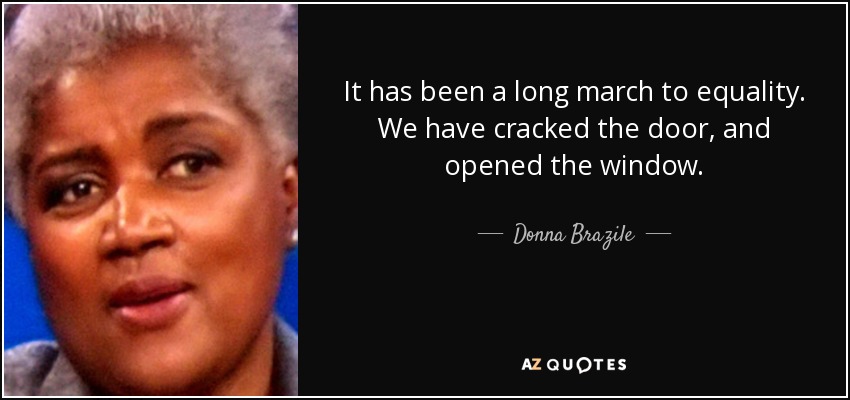
It has been a long march to equality. We have cracked the door, and opened the window.
So March: Book One was the first book I ever wrote. And it was the most terrifying process I've ever been through.
I think people who agree with Donald Trump have repeatedly made the case that he should be able to say whatever he wants to say, it's time someone did that. But as we go and speak to the kids, the young people who are reading March, we see the fear, we hear them tell us how scared they are.
It is our hope that when people read "March" - Book One, Book Two, and Book Three - that they will understand that another generation of people, especially young people, were deeply inspired by the work of Rosa Parks, Martin Luther King Jr. and many others.
This book [March], in my estimation, is a road map. It is a change agent. It is saying to people, "This is a way".
['March'] is a path you must take if you want to move from one point to another point. If you want to make it down this very long and troublesome road, follow this path. Follow this message. Follow this map. And you will get there some day.
One of our priorities when doing "March" is to sort of undo what we feel is the disservice done by what we call the Nine Words Problem. Which is that most American kids, whatever they do learn about the movement, especially in school, is usually limited to Rosa Parks, Martin Luther King, "I Have a Dream." And so there's sort of a layer of unreality; there's not a sense of continuity.
It's important to realize that the series actually grows with the reader. "March: Book One" is a great introduction for kids as young as eight or nine years old. But then they grow with the reader. Book Two is bigger, Book Three is even bigger. And they grow more violent and more confrontational.
"March" was inspired by "Martin Luther King and the Montgomery Story." I actually first heard about that comic from John Lewis, who told me that it played an important role in the movement. And so once he told me about that, it made me start thinking, "Well, why doesn't John Lewis write his own comic book?".
We chose to frame "March" around the inauguration of Barack Obama because it was such an important moment in the story of the Civil Rights Movement. It wasn't the fulfillment of Dr. [Martin Luther] King's dream, but it was a major down payment.
I think this ['March']is essential reading to understand the Black Lives Matter movement. I think it's also essential reading for the Black Lives Matter movement, so that they understand the political context that they're engaging in.
I think ['March'] is not just for the Black Lives Matter movement. It's for everyone. We all have to understand what happened then, so we can understand what's happening now.
I spent almost two years working on this book ['March'] before we ever had a publisher, before we ever had a title. And when you're reading it, and you're writing it, and you're ingesting it, sometimes a single word just comes up over and over and over again. And if you're trying to capture the essence of what it is you're trying to tell, you don't have a whole lot of space.
I must always march on in my life. What's done is done.
We would like to participate in manifestations, in Occupies and things like that. We would like to be involved in a march. But we don't actually see the very hard work that goes to build confidence towards those events. And we don't have a shared discussion.
People of every age group have connected strongly with the story [the March], identifying with different components of it. A sense of fairness and recognition of injustice seem to be hardwired into kids - I know it was for me, even as an elementary school kid - and I kept that in mind throughout the creation process.
My four-year-old daughter regularly requests reading Book One [the March] at bedtime; the methods of reading, delivering, and processing the book's content vary according to a kid's age and developmental level, but she's deeply affected by the story, asking follow-up questions for days.
I hope March is a guide for today's activists. It took raw courage for young people to volunteer to go to Mississippi in the summer of 1964, and unrelenting faith in the power of democracy to organize such a massive campaign.
Dr. [Martin Luther] King led a very historic march here in Washington, D.C. It was a march for jobs and freedom. It was a march to raise expectations that this country could live up to its ideals. I have watched this debate, this conversation [betwin Hillary Clinton and Donald Trump] about bigotry, about racism, I find it all misplaced.
The problem is that our whole tribe - if you will, the larger community of humanity itself - is on a death march ecologically and in terms of the intensification of violence and conflict.
If we have access to nuclear energy, that adds to our maneuverability in ensuring energy security as India marches on, on the path to accelerated development.
Many times we ask people to march outwardly, when we haven't yet spent the needed time inwardly.
Not everyone can march, but everyone can talk. And everyone can reach out, and everyone can vote.
In March of 2001, I revisited the short story, and found that thought it did not work well as a short story, it might work much better as a longer one. The novel [The Kite Runner] came about as an expansion of that original, unpublished short story.
It was headquartered in Michigan City, a long way off. I never saw Ku Klux Klan march.
Follow AzQuotes on Facebook, Twitter and Google+. Every day we present the best quotes! Improve yourself, find your inspiration, share with friends
or simply: