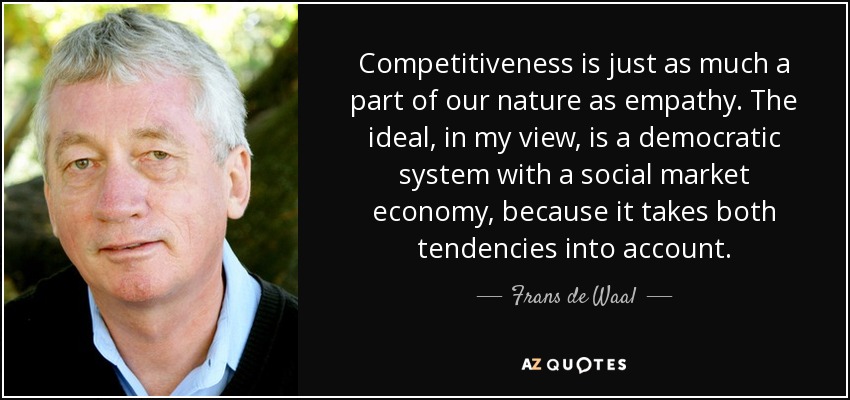
Competitiveness is just as much a part of our nature as empathy. The ideal, in my view, is a democratic system with a social market economy, because it takes both tendencies into account.
If we didn't have greed, market economies wouldn't be as innovative as they are. But in my view, greed has to be contained by the fear of losses, so there has to be a system where, if you take too much risk, you go into bankruptcy. You don't systematically bail out people who take excessive risks.
Keynes tried to show that market economies could settle in equilibrium states in which the labour market did not clear, and in which the level of unemployment was high. He believed that this was due to a particular example of market failure, developed in his concept of effective demand.
So I think one can say on empirical grounds - not because of some philosophical principle - that you can't have democracy unless you have a market economy.
In a true free market economy, you can't make yourself rich without enriching your community.
The market economy as such does not respect political frontiers. Its field is the world.
The New Finance focused on the market's major systematic mistake. In failing to appreciate the strength of competitive forces in a market economy, it over estimates the length of the short run. In doing so, it overreacts to records of success and failure for individual companies, driving the prices of successful firms too high and their unsuccessful counterparts too low.
Economic activity, especially the activity of a market economy, cannot be conducted in an institutional, juridical or political vacuum. On the contrary, it presupposes sure guarantees of individual freedom and private property, as well as a stable currency and efficient public services.
It remains to be seen, for example whether China can continue to develop as a market economy while still retaining an authoritarian communist political system.
The first principle of the market economy is that it is comprised of many small buyers and sellers, which implies a substantial degree of equity. Another fundamental market principle is that costs are internalized in the producer's price.
Yes, I think India's economy always has been a mixed economy, and by Western standards we are much more of a market economy than a public sector-driven economy.
The market economy succeeds not because some people's interests are suppressed and other people are kept out of the market, but because people gain individual advantage from it.
Money has to undergo a metamorphosis again, it has to relinquish its role in the market economy and engage in an economy of capacities. Then we would be concerned with human creative productivity. And we would come full circle, since each human being can then act within his company as co-creator of the future, can - in full dignity - contribute to shaping this future.
A fundamental contradiction does not exist between socialism and a market economy.
In the past six months, our federal government has devised a dozen strategies to save America's financial markets. Each plan has been more costly, more risky, and less aligned with the principles of our country's free market economy than the last. I am disappointed to say that this latest plan puts all the rest of them to shame.
The trouble with a free market economy is that it requires so many policemen to make it work.
A famous, very often quoted phrase says: "That government is best, which governs least." I do not believe this to be a correct description of of the functions of a good government. Government ought to do all the things for which it is needed and for which it is established. Government ought to protect the individuals within the country against the violent and fraudulent attacks of gangsters, and it should defend the country against foreign enemies. These are the functions of government within a free system, within the system of the market economy.
To speak of 'limits to growth' under a capitalistic market economy is as meaningless as to speak of limits of warfare under a warrior society.
It has been true in Western societies and it seems to be true elsewhere that you do not find democratic systems apart from capitalism, or apart from a market economy, if you prefer that term
I would consider myself simply a critic of the market economy. My standard isn't primarily political. First of all, it's ecological. And then I get to matters that are social and cultural.
Yes to market economy, no to market society.
Three-quarters of India lives on the edge of the market economy. You can't tell them that only those who can afford water can have it.
Here's what I do believe very strongly: that once capitalism comes into existence, once it creates this mythology of a stingy nature, then that myth has to be exorcised. In other words, we have to get out of people's heads the idea that without a market economy, without egotism, competition, rivalry and self-interest, without all the technological advances that [Karl] Marx imputed to capitalism, we have to eliminate the feeling that we would sink into some kind of barbarism.
I believe that any attempt on the part of a libertarian communist society to abridge the rights of a community - for example, to operate on the basis of a market economy of the kind that you describe - would be unforgivable, and I would oppose the practices of such a society as militantly as I think any reader of your publication would.
I think that people don't realize that the sky will not fall when we legalize marijuana. My contention all along has been use will not go up when it's legalized. We'll just take the crime out of it. It's already a huge black market economy.
Follow AzQuotes on Facebook, Twitter and Google+. Every day we present the best quotes! Improve yourself, find your inspiration, share with friends
or simply: