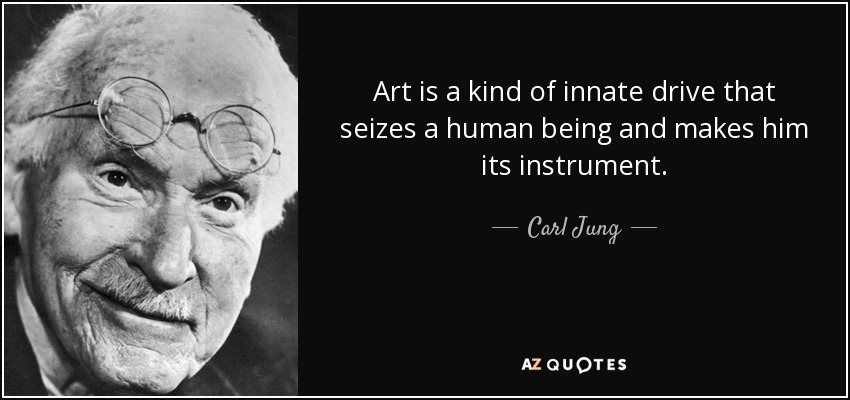
Art is a kind of innate drive that seizes a human being and makes him its instrument.
The decisive question for man is: Is he related to something infinite or not? That is the telling question of his life.
One could say, with a little exaggeration, that the persona is that which in reality one is not, but which oneself as well as others think one is.
The conscious mind allows itself to be trained like a parrot, but the unconscious does not — which is why St. Augustine thanked God for not making him responsible for his dreams.
Even a happy life cannot be without a measure of darkness.
The great problems of life — sexuality, of course, among others — are always related to the primordial images of the collective unconscious. These images are really balancing or compensating factors which correspond with the problems life presents in actuality. This is not to be marveled at, since these images are deposits representing the accumulated experience of thousands of years of struggle for adaptation and existence.
We have forgotten the age-old fact that God speaks chiefly through dreams and visions.
The most terrifying thing is to accept oneself completely.
The decisive question for man is: Is he related to something infinite or not? That is the telling question of his life. Only if we know that the thing which truly matters is the infinite can we avoid fixing our interest upon futilities, and upon all kinds of goals which are not of real importance.
If you should see people in a room, you would not think that you had made those people, or that you were responsible for them.
The unconscious is not just evil by nature, it is also the source of the highest good: not only dark but also light, not only bestial, semihuman, and demonic but superhuman, spiritual, and, in the classical sense of the word, "divine."
The dream is the small hidden door in the deepest and most intimate sanctum of the soul.
Seldom, or perhaps never, does a marriage develop into an individual relationship smoothly and without crises; there is no coming to consciousness without pain.
In actual life it requires the greatest discipline to be simple, and the acceptance of oneself is the essence of the moral problem and the epitome of a whole outlook upon life.
Nobody, as long as he moves about among the chaotic currents of life, is without trouble.
It all depends on how we look at things, and not how they are in themselves.
I had always been impressed by the fact that there are surprisingly many individuals who never use their minds if they can avoid it, and yet are not stupid, and an equal number who obviously do use their minds but in an amazingly stupid way.
No one can flatter himself that he is immune to the spirit of his own epoch, or even that he possesses a full understanding of it. Irrespective of our conscious convictions, each one of us, without exception, being a particle of the general mass, is somewhere attached to, colored by, or even undermined by the spirit which goes through the mass. Freedom stretches only as far as the limits of our consciousness.
Midlife is the time to let go of an overdominant ego and to contemplate the deeper significance of human existence.
Knowing your own darkness is the best method for dealing with the darkness's of other people. One does not become enlightened by imagining figures of light, but by making the darkness conscious. The most terrifying thing is to accept oneself completely. Your visions will become clear only when you can look into your own heart. Who looks outside, dreams; who looks inside, awakes.
Dreams are impartial, spontaneous products of the unconscious psyche, outside the control of the will. They are pure nature; they show us the unvarnished, natural truth, and are therefore fitted, as nothing else is, to give us back an attitude that accords with our basic human nature when our consciousness has strayed too far from its foundations and run into an impasse.
The creation of something new is not accomplished by the intellect but by the play instinct acting from inner necessity. The creative mind plays with the objects it loves.
It is the individual's task to differentiate himself from all the others and stand on his own feet. All collective identities . . . interfere with the fulfillment of this task. Such collective identities are crutches for the lame, shields for the timid, beds for the lazy, nurseries for the irresponsible. . . .
Observance of customs and laws can very easily be a cloak for a lie so subtle that our fellow human beings are unable to detect it. It may help us to escape all criticism, we may even be able to deceive ourselves in the belief of our obvious righteousness. But deep down, below the surface of the average man's conscience, he hears a voice whispering, 'There is something not right,' no matter how much his rightness is supported by public opinion or by the moral code.
Nothing has a stronger influence psychologically on their environment and especially on their children than the unlived life of the parent.
Follow AzQuotes on Facebook, Twitter and Google+. Every day we present the best quotes! Improve yourself, find your inspiration, share with friends
or simply: