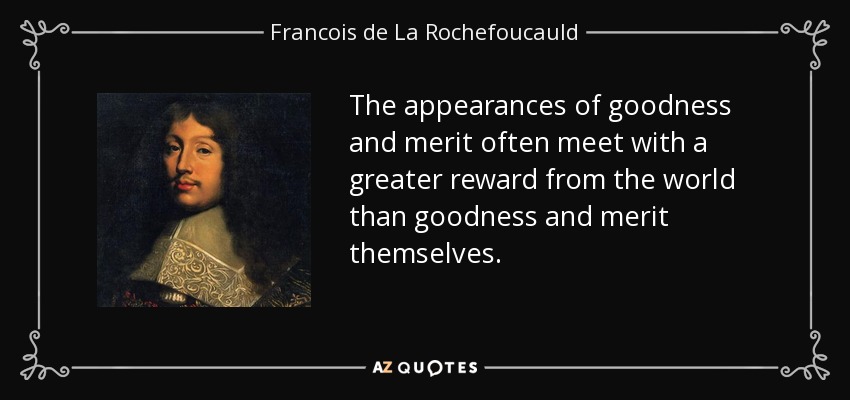
The appearances of goodness and merit often meet with a greater reward from the world than goodness and merit themselves.
Salvation has absolutely nothing to do with human merit and absolutely everything to do with divine mercy.
Our age is one in which usefulness is thought to be the chief merit of nature; in which the attainment of power, the utilization of its resources is taken to be the chief purpose of man in God's creation. Man has indeed become primarily a tool-making animal, and the world is now a gigantic tool box for the satisfaction of his needs.
What do I see in the God of that infamous sect if not an inconsistent and barbarous being, today the creator of a world of destruction he repents of tomorrow; what do I see there but a frail being forever unable to bring man to heel and force him to bend a knee. This creature, although emanated from him, dominates him, knows how to offend him and thereby merit torments eternally! What a weak fellow, this God!
I had an idea for a medical conspiracy thriller. Since it was non-horror, I didn't want the publishers and editors bringing a lot of baggage - my history as a genre writer in the SF and horror fields, for instance - to the novel when they read it. I wanted them to consider the book solely on its own merits. So I called myself Colin Andrews. I was tired of seeing my books at floor level. Not that Herman Wouk and Phyllis Whitney and William Wharton are bad company, but I wanted to be up at eye level for a change, where people with bad backs could get a chance to see my books.
I was always interested in science, truth, goodness and fairness. I have always been strongly individualistic and merit-oriented. This is probably because I was adopted and thus have always tended to cavalierly dismiss the importance of "blood ties" and any inherited or "unearned" group characteristics.
The West has given us the liberal miracle of individual rights, individual responsibility, merit, and human satisfaction.
I do not like the late resurrection of the Jesuits. . . . If ever any congregation of men could merit eternal perdition on earth, and in hell, according to these historians, though, like Pascal, true Catholics, it is this company of Loyolas.
By Christ's purchasing redemption, two things are intended: his satisfaction and his merit; the one pays our debt, and so satisfies; the other procures our title, and so merits. The satisfaction of Christ is to free us from misery; the merit of Christ is to purchase happiness for us.
There is this notion that the lives of the comfortable-off middle class don't merit being treated seriously and with compassion.
Merit and good works is the end of man's motion; and conscience of the same is the accomplishment of man's rest; for if a man can be partaker of God's theatre, he shall likewise be partaker of God's rest.
There can be no merit in believing something which you can neither explain nor understand.
Whatever in Christ had the nature of satisfaction, was by virtue of the suffering or humiliation that was in it; but whatever had the nature of merit, was by virtue of the obedience or righteousness there was in it.
There are remuneration packages that will no longer be tolerated because they bear no relation to merit. That those who create jobs and wealth may earn a lot of money is not shocking. But that those who contribute to destroying jobs and wealth also earn a lot of money is morally indefensible.
To be out of harmony with one's surroundings is of course a misfortune, but it is not always a misfortune to be avoided at all costs. Where the environment is stupid or prejudiced or cruel, it is a sign of merit to be out of harmony with it.
A task, any task, undertaken in an adventurous spirit acquires the merit of romance.
It is no merit in the sorrowful that they weep, or to the oppressed and smothering that they gasp and struggle, not to me, that I must speak for the oppressed - who cannot speak for themselves.
More glorious to merit a sceptre than to possess one.
I would suppose I learned how to write when I was very young indeed. When I read a child's book about the Trojan War and decided that the Greeks were really a bunch of frauds with their tricky horses and the terrible things they did, stealing one another's wives, and so on, so at that very early age, I re-wrote the ending of the Iliad so that the Trojans won. And boy, Achilles and Ajax got what they wanted, believe me. And thereafter, at frequent intervals, I would write something. It was really quite extraordinary. Never of very high merit, but the daringness of it was.
Science is nothing more than a method of inquiry. The method says an assertion is valid - and will be universally accepted - only if it can be reproduced by others, and thereby independently verified. The impersonal rigor of the method has produced enormously powerful results for 400 years. The scientific method is utterly apolitical. A truth in science is verifiable whether you are black or white, male or female, old or young. It’s verifiable whether you know the experimenter, or whether you don’t.
Do you realize this? That if you were to somehow purpose to, from this day on, perfectly please God and succeed in doing it, that that perfect obedience, from this moment, would not acquire in the remainder of your life, enough merit to atone for one past sin, because God exacts and God demands perfect obedience and there's no merit for giving him the minimal requirement.
Begin with bodhicitta, do the main practice without concepts,Conclude by dedicating the merit. These, together and complete,Are the three vital supports for progressing on the path to liberation.
America... Cherishes no purpose save to merit the favor of Almighty God.
Horsemanship is the one art for which it seems one needs only practice. However, practice without true principles is nothing other than routine, the fruit of which is a strained and unsure execution, a false diamond which dazzles semi-connoisseurs often more impressed by the accomplishments of the horse than the merit of the horseman.
High-class kitsch may well be "perfect" in its form and and composition: the academic painters were often masters of their craft. Thus, the accusation that a work of kitsch is based not on lack of for or aesthetic merit but on the presence of a particularly provocative emotional content. (The best art, by contrast, eschews emotional content altogether.)
Follow AzQuotes on Facebook, Twitter and Google+. Every day we present the best quotes! Improve yourself, find your inspiration, share with friends
or simply: