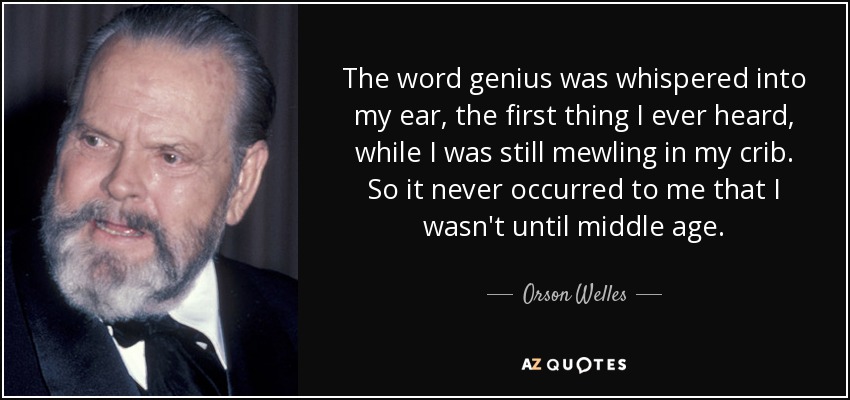
The word genius was whispered into my ear, the first thing I ever heard, while I was still mewling in my crib. So it never occurred to me that I wasn't until middle age.
My mother had demonstrated that the best way to defeat the numbing ambivalence of middle age is to surprise yourself - by pulling off some cartwheel of thought or action never even imagined at a younger age.
Had the Hebrews not been disturbed in their progress a thousand and more years ago, they would have solved all the great problems of civilization which are being solved now under all the difficulties imposed by the spirit of the Middle Ages.
In the Middle Ages, everything bad was the work of the devil, everything good, the work of God. Today, the French see everything in reverse and blame the Germans for it.
The middle age of buggers is not to be contemplated without horror.
Book burning is a charming old custom, hallowed by antiquity. It has been practiced for centuries by fascists, communists, atheists, school children, rival authors, and tired librarians. Like everything of importance since the invention of the cloak and the shroud, its origins are cloaked in mystery and shrouded in secrecy. Some scholars believe that the first instance of book burning occurred in the Middle Ages, when a monk was trying to illuminate a manuscript. All agree that book burning was almost non-existent during the period when books were made of stone.
In the Middle Ages, the troubadour poets invented the concept of courtly love--a fantasy love, a noble passion, which was also extra-marital and thus inevitably thwarted, illicit, adulterous. One of the medieval terms for it was amour honestus (honest love). I've always wondered why this passionate ideal--masochistic, spiritual-travelled with such wildfire throughout Europe. My poem, a ghazal, takes up the subject.
I started to shed the monstrous aesthetic affectation of my youth so as to make room for the monstrous philistine postures of middle age, but it was some years before I was bold enough to decline an invitation to "Hamlet" on the grounds that I knew who won.
That conflict between the reach for the divine and the lure of earthly things was to be the central problem of the Middle Ages.
The ills and disorders of the 14th century could not be without consequence. Times were to grow worse over the next fifty-odd years until at some imperceptible moment, by the some mysterious chemistry, energies were refreshed, ideas broke out of the mold of the Middle Ages into new realms, and humanity found itself redirected.
I lived, particularly in childhood but with lessening intensity right on to middle age, in a world that was peculiarly and intimately my own, scarcely to be shared with others or even made plausible to them. I habitually read special meanings into things, scenes and places qualities of wonder, beauty, promise, or horror for which there was no external evidence visible or plausible to others. My world was peopled with mysteries, seductive hints, vague menaces, "intimations of immortality.
Those who professed themselves unable to believe in the reality of human progress ought to cheer themselves up, as the students under examination had conceivably been cheered up, by a short study of the Middle Ages. The hydrogen bomb, the South African Government, Chioang Kaidick, Senator McCarthy himself, would then seem a light price to pay for no longer being in the Middle Ages.
And what, for instance, would have happened had Romeo and Juliet lived to middle age, their silhouettes broadened by pasta?
Like it or not, to reach middle age with less money or less prestige than our father had is somewhat to lose face. Stupid of course, when put like that, but who is prepared to argue that we are not stupid in several important ways?
He [Paolo Sarpi] was one of the two foremost Italian statesmen since the Middle Ages, the other being Cavour.
If the feudal knight was the clearest embodiment of society in the early Middle Ages, and the "bourgeois" under Capitalism, the educated person will represent society in the post-capitalist society in which knowledge has become the central resource.
It was in 1590--winter. Austria was far away from the world, and asleep; it was still the Middle Ages in Austria, and promised to remain so forever. Some even set it away back centuries upon centuries and said that by the mental and spiritual clock it was still the Age of Belief in Austria. But they meant it as a compliment, not a slur, and it was so taken, and we were all proud of it. I remember it well, although I was only a boy; and I remember, too, the pleasure it gave me.
Gardening is one of the rewards of middle age, when one is ready for an impersonal passion, a passion that demands patience, acute awareness of a world outside oneself, and the power to keep on growing through all the times of drought, through the cold snows, towards those moments of pure joy when all failures are forgotten and the plum tree flowers.
Never have I enjoyed youth so thoroughly as I have in my old age. In writing Dialogues in Limbo, The Last Puritan, and now all these descriptions of the friends of my youth and the young friends of my middle age, I have drunk the pleasure of life more pure, more joyful than it ever was when mingled with all the hidden anxieties and little annoyances of actual living. Nothing is inherently and invincibly young except spirit. And spirit can enter a human being perhaps better in the quiet of old age and dwell there more undisturbed than in the turmoil of adventure.
In tribal times, there were the medicine men. In the Middle Ages, there were the priests. Today, there are the lawyers. For every age, a group of bright boys, learned in their trades and jealous of their learning, who blend technical competence with plain and fancy hocus-pocus to make themselves masters of their fellow men. For every age, a pseudo-intellectual autocracy, guarding the tricks of the trade from the uninitiated, and running, after its own pattern, the civilization of its day.
Now the code of life of the High Middle Ages said something entirely opposite to this: that it was precisely lack of leisure, an inability to be at leisure, that went together with idleness; that the restlessness of work-for-work's sake arose from nothing other than idleness. There is a curious connection in the fact that the restlessness of a self-destructive work-fanatacism should take its rise from the absence of a will to accomplish something.
Respect for woman, the much lauded chivalry of the Middle Ages, meant what I fear it still means to some men in our own day - respect for the elect few among whom they expect to consort.
By May, 1st, 1937, there should not be one single church left within the borders of Soviet Russia, and the idea of God will have been banished from the Soviet Union as a remnant of the Middle Ages, which has been used for the purpose of oppressing the working classes.
For is it not possible that middle age can be looked upon as a period of second flowering, second growth, even a kind of second adolescence? It is true that society in general does not help one accept this interpretation of the second half of life.
Under the old philosophy which had governed the high Middle Ages things had been everywhere towards a condition of Society in which property was well distributed throughout the community, and thus the family rendered independent.
Follow AzQuotes on Facebook, Twitter and Google+. Every day we present the best quotes! Improve yourself, find your inspiration, share with friends
or simply: