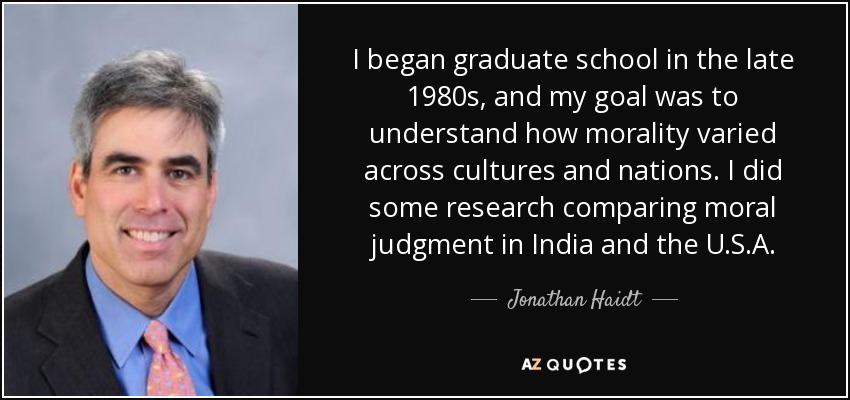
I began graduate school in the late 1980s, and my goal was to understand how morality varied across cultures and nations. I did some research comparing moral judgment in India and the U.S.A.
The change began with John Stuart Mill and the Utopians . When Mill pointed out that economics had no ultimate solution to the problem of distribution , that society might do with the fruits of its toil as it saw fit, he introduced into the mechanical calculus of the market a conflicting calculus of moral judgment.
Let's just call things what they are. When a man's love of finery clouds his moral judgment, that is vanity. When he lets a demanding palate make his moral choices, that is gluttony. When he ascribes the divine will to his own whims, that is pride. And when he gets angry at being reminded of animal suffering that his own daily choices might help avoid, that is moral cowardice.
In all good westerns, the good guy is always a little bit questionable because he kind-of has to make moral judgments.
That's his definition of mercy. This is the year of the Mercy Jubilee of the pope. I know that he's against abortion, but he talks about Christ's emphasis on mercy instead of his emphasis on judgment. He talks about the lack of Christian charity and the pride that are afloat in our world these days in terms of making moral judgments on other people. That's really it for Willie. He's really a missionary.
Indiscriminate tolerance and indiscriminate condemnation are not two opposites: they are two variants of the same evasion. To declare that “everybody is white” or “everybody is black” or “everybody is neither white nor black, but gray,” is not a moral judgment, but an escape from the responsibility of moral judgment.
One must never fail to pronounce moral judgment.
The fundamental question for the United States is how it can cooperate to help meet the basic needs of the people of the hemisphere despite the philosophical disagreements it may have with the nature of particular regimes. It must seek pragmatic ways to help people without necessarily embracing their governments. It should recognize that diplomatic relations are merely practical conveniences and not measures of moral judgment.
I like moral judgment to emerge from the reader. We are being sold a very simplistic morality by our leaders at a time when nuance and understanding are at a premium.
I don't believe there is any such definition, there is no such thing as evil, only moral judgments based on what society believes to be wrong behavior.
Imagine a person who comes in here tonight and argues 'no air exists' but continues to breathe air while he argues. Now intellectually, atheists continue to breathe - they continue to use reason and draw scientific conclusions [which assumes an orderly universe], to make moral judgments [which assumes absolute values] - but the atheistic view of things would in theory make such 'breathing' impossible. They are breathing God's air all the time they are arguing against him.
Character - We describe the character of a person in reference to moral judgments about the worthiness of a person. Thus, to have a strong, great or honorable character is to be a person of merit, worthy of admiration and honor.
The Constitution exists precisely so that opinions and judgments, including esthetic and moral judgments about art and literature, can be formed, tested, and expressed. What the Constitution says is that these judgments are for the individual to make, not for the Government to decree, even with the mandate or approval of a majority. Technology expands the capacity to choose; and it denies the potential of this revolution if we assume the Government is best positioned to make these choices for us.
All the particular moral judgments we intuitively make are likely to derive from discarded religious systems, from warped views of sex and bodily functions, or from customs necessary for the survival of the group in social and economic circumstances that now lie in the distant past.
Somehow it must be made plain that the lawyer's moral judgment is not for hire, that there are occasions when the lawyer . . . is under a duty to act as a person of independent ethical concern with obligations not only to his client's interests but also to fairness and justice in the management of affairs.
Real morality is not the product of fearing a spanking. But what does fundamentalist hell-belief encourage? It retards any developing moral judgment by freezing moral maturity right at the most primitive, most childish, stage: the fear of retribution-and fundamentalism threatens one hell of a spanking.
If there is no absolute moral standard, then one cannot say in a final sense that anything is right or wrong. By absolute we mean that which always applies, that which provides a final or ultimate standard. There must be an absolute if there are to be morals, and there must be an absolute if there are to be real values. If there is no absolute beyond man's ideas, then there is no final appeal to judge between individuals and groups whose moral judgments conflict. We are merely left with conflicting opinions.
Do we, as humans, having an ability to reason and to communicate abstract ideas verbally and in writing, and to form ethical and moral judgments using the accumulated knowledge of the ages, have the right to take the lives of other sentient organisms, particularly when we are not forced to do so by hunger or dietary need, but rather do so for the somewhat frivolous reason that we like the taste of meat? In essence, should we know better?
[W]omen's magazines know that more than two thirds of women pray each day so they tend to promote "spirituality" which is warm, soft, fuzzy, and "me-centered, " rather than religion, which is definitely not. Shot with a soft-focus lens, spirituality in women's media has morphed into another method of stress reduction. Lulling and inoffensive, spirituality is more about taking long walks and buying $65 Jo Malone scented candles than making ethical decisions or moral judgments. It's another way to calm ourselves, refresh ourselves, or applaud ourselves.
The only difference between the narrator of contemporary affairs and the ordinary historian is that moral judgments about the present provoke fiercer reactions and have more immediately practical implications than moral judgments about the past.
I have confronted theoretical positions whose protagonists claim that what I take to be historically produced characteristics of what is specifically modern are in fact the timelessly necessary characteristics of all and any moral judgment, of all and any selfhood.
There is no Christian Gospel if history simply unwinds into a meaningless puddle, if the cosmos simply escapes into a cataclysmic black hole, or if the universe finally dies of exhausted energy. Without belief in a biblical eschatology, there is no Christian hope. Without a sense of perfect moral judgment in the end, the human heart is homeless.
Historical explanation is not identical with moral judgment.
A perverted moral judgment belongs to the dogmatic system.
Self-righteousness and presumptive moral judgments pose a great danger in the political arena. To become convinced of the divine infallibility of one's personal predilections on a secular political issue is to play God, to assume to oneself the attributes of deity. It cultivates an arrogant intolerance of dissenting viewpoints and relegates one's political adversaries to the category of evil per se.
Follow AzQuotes on Facebook, Twitter and Google+. Every day we present the best quotes! Improve yourself, find your inspiration, share with friends
or simply: