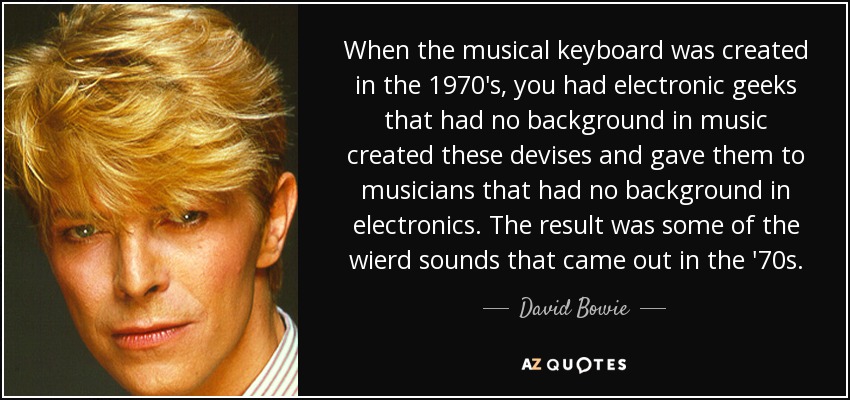
When the musical keyboard was created in the 1970's, you had electronic geeks that had no background in music created these devises and gave them to musicians that had no background in electronics. The result was some of the wierd sounds that came out in the '70s.
I go down to New York, do the project, and leave. I have no interest in participating in the rat race down there. Hip jazz fans know who I am. There's a generation of musicians in New York who know my records better than I do.
I don't really have a career as a jazz musician. I don't really have a career as a classical musician. I don't really have a career as a college professor, and yet I did all those things and I did them well. I put out some records in the 1980's and 1990's that changed the way some trumpet players played.
I started off playing by ear, and being around a bunch of musicians and playing in the streets and in the different parades and, then, I got accepted to go to New Orleans Center for Creative Artists ... it's where Wynton Marsalis, Harry Connick, Jr. and all those guys went out.
One thing about Kurt [Cobain] is before he was a musician, and before he was a rock star, he was an artist, and an artist with a capital A. What that means is that he had to create. It wasn't something that he chose to do - it chose him.
To date, [Wynton] Marsalis has received a total of nine Grammy Awards; a Pulitzer Prize (the first ever awarded to a jazz musician)... and twenty-nine honorary degrees, including Columbia, Brown, Princeton and Yale; the National Medal of Arts; and numerous awards from other countries.
Being an American musician means being adventurous.
I have seen so many bands and musicians fade away, especially the ones in my early days that treated me and my bands with contempt for no other reason than that they were headlining the show, not all though, with great exceptions such as Slade and Vinegar Joe.
I think my biggest musical hero growing up was probably Ian MacKaye he set a great example for all of us local musicians. Still to this day I see him as the best example of a right-on musician.
The most sophisticated pop musician that I knew of and liked was Paul McCartney.
There's times I've been quite nervous doing session work, such as when I'm asked to play the violin in a 'country and western' style or a 'gypsy' style. I'm not very good at that sort of playing at all. I think it's important as a session musician to have your own voice.
My father was a psychiatrist and a social worker but he was a very talented painter and musician and writer on the side.
My family were all musicians. I really wasn't interested in school or anything.
I don't really like to call myself a brand, and I don't like to think of myself as a brand. I'm a singer, a songwriter, a musician and a performer. And an actress, and all the other things that I do. When you add it all together, some might call it a brand, but that's not my focus.
Usually people think that it is the musicians who create the music, but in fact it is music who creates the musicians.
I think playing night after night is when you get a lot better as a musician because you need to add different levels of intensity and experiment a little bit with the existing songs just to keep everything interesting.
Once you lose that musician part -not just the playing, I'm talking about musician attitude- then you're lost, man. Especially if you started out that way. It feels so good to be back, starting from the ground up.
The biggest reward from that record was the enthusiasm everyone had to sing on it. The Grammy nominations and the chart positions are great, but ultimately the way you interact with other musicians is the most important thing to me.
Being a musician, you want to be able to do the hardest stuff there is. People would think it's classical, but in classical, it's all on the page and the difficulty is keeping up with the music.
I went to high school right outside Dallas, and (songwriter and performer) Michael Martin Murphey was a senior there when I was a sophomore or junior, really into folk and acoustic music. Larry Gross, who's the host of "Mountain Stage" on public radio, and B.W. Stevenson, also a musician, were there at the same time, too. Michael was a big inspiration -- through him I discovered Woody Guthrie, Dylan, Jimmy Rogers. Then I ran into Jerry Jeff Walker there in Dallas back when he was just a folk singer. Those are my earliest influences.
The second album was like being on a completely different planet compared to when we were making the first album. ... Even though it was the same musicians, the same artist, the same studio, the same producer, - it felt like a completely different piece of a puzzle.
I like the communication and trust that comes from a long-term relationship. When you really know people as musicians and as people, you feel you can really count on them. That frees you to take more chances and ... it takes the music to a higher level. It translates into a better product for audiences. There are two levels to these relationships. The first level is being with guys for the first few years, you're getting used to guys - he's got this to offer, he's got that to offer, I don't like this, I do like this. You both praise them and are critical as you get to know one another.
It is just that heavy metal musicians write in minor keys, and when you do that, you frighten people.
I only say this because a lot of people seem to think that if you're a musician you want to be a celebrity. But most musicians in the world aren't celebrities, and pretty much everything about the concept of 'celebrity' is a complete load of bollocks anyhow.
That was an idea of the record company, and also that was my first album after MCA and we wanted to come back with a strong album that would be noticed. If we put the vocals by very talented people and very meaningful songs, then the vocals would be a platform so that I could be noticed again. All of the MCA albums were just loaded with problems -- you know, the right musicians, the engineers. The record company would say 'You have to make music for black radio, you can't do what you have been doing with The Crusaders.' Everybody was telling me that was over, finished, done.
Follow AzQuotes on Facebook, Twitter and Google+. Every day we present the best quotes! Improve yourself, find your inspiration, share with friends
or simply: