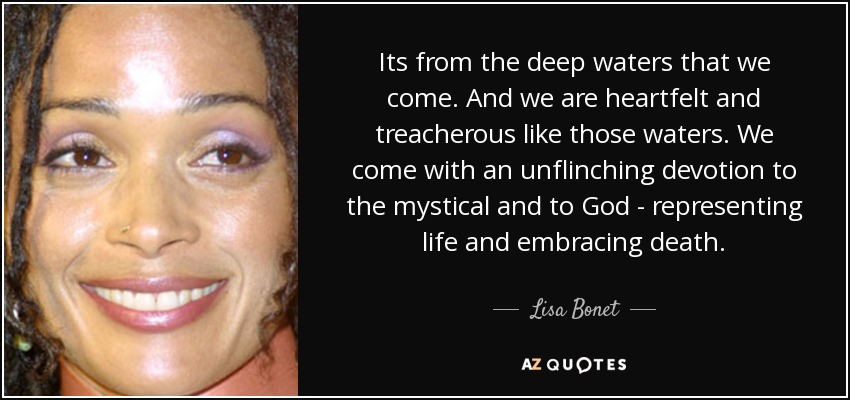
Its from the deep waters that we come. And we are heartfelt and treacherous like those waters. We come with an unflinching devotion to the mystical and to God - representing life and embracing death.
Our music has depth, and attempts philosophical thought and meaning with discussions of infinity, eternity and mortality. There is a line which people cross that turns it into some magical, mystical realm, for which I dont claim responsibility and dont hold any great truck with.
Moshe Sluhovsky's fascinating study links spirit possession, exorcism, and mystical practice in early modern Europe. Women and men, healers and priestly exorcisers are caught up in a new quest for truth and introspection as they try to figure out whether these dramas of body and soul come from the devil or God. A stunning feat of scholarship and interpretation.
When all the archetypes burst out shamelessly, we plumb the depths of Homeric profundity. Two clichés make us laugh but a hundred clichés moves us because we sense dimly that the clichés are talking among themselves, celebrating a reunion. . . . Just as the extreme of pain meets sensual pleasure, and the extreme of perversion borders on mystical energy, so too the extreme of banality allows us to catch a glimpse of the Sublime.
I can't verbalize the internal meaning of pictures whatsoever. Some of my friends can at very mystical levels, but I prefer to say that, if I feel something strongly, I would make a photograph, that would be the equivalent of what I saw and felt.
There is a German word, Sehnsucht, which has no English equivalent; it means 'the longing for something'. It has Romantic and mystical connotations; C.S. Lewis defined it as the 'inconsolable longing' in the human heart for 'we know not what'. It seems rather German to be able to specify the unspecifiable. The longing for something - or, in our case, for someone.
To my mind the most poignant mystical exhoration ever written is "Be still and know that I am God."
What you find I think in the mystical strain of Catholicism is that you're put in relationship with God, and you have many opportunities not only of talking with God in petitionary prayer, but also of listening to God, being attentive to God, as happens in contemplation.
The mystical perception (which is only "mystical" if reality is limited to what can be measured by the intellect and senses) is remarkably consistent in all ages and all places. All phenomena are processes, connections, all is in flux...have the mind screens knocked away to see there is no real edge to anything, that in the endless interpenetration of the universe, a molecular flow, a cosmic energy shimmers in all stone and steel as well as flesh.
Here in America, marriage still has a mystical, intangible power: It is a passport to adulthood and respectability and to a certain extent citizenship. Any relationship less than "married" is considered temporary and not worthy of honor.
Catholicism is the big house of Christianity. It's got many, many rooms in it. And I've always been attracted to the rooms which are to do with prayer. The mystical strain is the strain whereby the whole day can be given over to prayer through what we call lectio divina, prayerful reading of Scripture, through practice of meditation of when one uses the imagination and the intellect with respect to images, and then finally, and most difficult of all, contemplation, where one empties the mind of all images and all ideas, all concepts, in order to be completely attentive to God.
The love of nature is a passion for those in whom it once lodges. It can never be quenched. It cannot change. It is a furious, burning, physical greed, as well as a state of mystical exaltation. It will have its own.
I have often admired the mystical way of Pythagoras, and the secret magick of numbers.
Music is one of the only inanimate things we have left. It can still be mystical, magical and awe-inspiring
It takes mystical insight to see the beauty and innocence in each other, even when that is not what we are showing to the world. That is why God is needed in intimate relationships, to move us beyond the perceptions that can so often poison love.
You draw the mystical kundalini from the earth. Earth is an element. Fire, air, earth, water, and ether - the mystical kundalini comes through them all.
The mystical kundalini energy has some, I don't know if you'd call them limitations, but there are certain operational factors which you should understand about it.
Neither is detrimental, but the mystical kundalini is a bit more raucous.
Chakras are mystical energy centers that exist within the human aura. Tremendous occult power resides in a person's chakras. Siddha masters draw upon that power during meditation, store it within themselves, and later use it to perform miracles.
If you expound the teaching of the Logos from the standpoint of the moral life, using materialistic words and examples which correspond to the capacity of your hearers, you make the Logos flesh. Conversely, if you elucidate mystical theology by means of the higher forms of contemplation you make the Logos spirit.
Our rational minds often attempt to minimise or negate the mystical encounters. We forget the power of our experiences. We must embrace the reality of that event, which is a miracle.
Not all teachers utilize both forms of light.In certain circles, those teachers who can manifest the light of samadhi but not the mystical light have put down the mystical light.
Community is another such phenomenon. Like electricity, it is profoundly lawful. Yet there remains something about it that is inherently mysterious, miraculous, unfathomable. Thus there is no adequate one-sentence definition of genuine community. Community is something more than the sum of its parts, its individual members. What is this "something more?" Even to begin to answer that, we enter a realm that is not so much abstract as almost mystical. It is a realm where words are never fully suitable and language itself falls short.
By inner experience I understand that which one usually calls mystical experience: the states of ecstasy, of rapture, at least of meditated emotion. But I am thinking less of confessional experience, to which one has had to adhere up to now, that of an experience laid bare, free of ties, even of an origin, of any confession whatever. This is why I don't like the word mystical.
As Eastern thought has begun to interest a significant number of people, and meditation is no longer viewed with ridicule or suspicion, mysticism is being taken seriously even within the scientific community. An increasing number of scientists are aware that mystical thought provides a consistent and relevant philosophical background to the theories of Contemporary science, a conception of the world in which the scientific discoveries of men and women can be in perfect harmony with their spiritual aims and religious beliefs.
Follow AzQuotes on Facebook, Twitter and Google+. Every day we present the best quotes! Improve yourself, find your inspiration, share with friends
or simply: