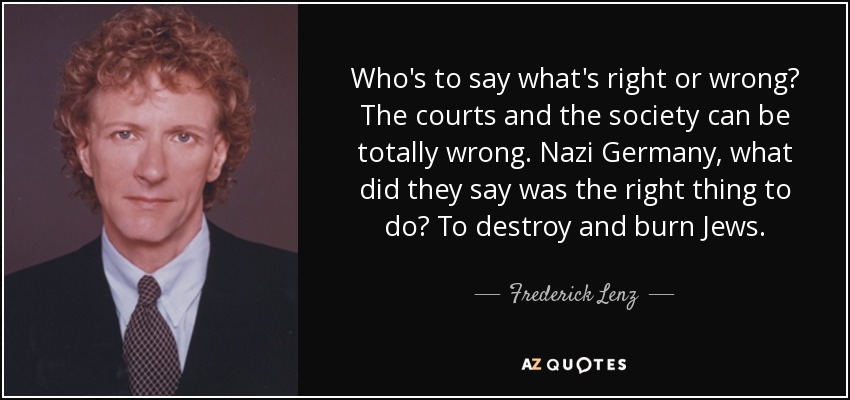
Who's to say what's right or wrong? The courts and the society can be totally wrong. Nazi Germany, what did they say was the right thing to do? To destroy and burn Jews.
If the day should ever come when we must go, if some day we are compelled to leave the scene of history, we will slam the door so hard that the universe will shake and mankind will stand back in stupefaction.
I joined the party because I was a revolutionary, not because of any ideological nonsense.
Just like what Nazi Germany did to the Jews, so liberal America is now doing to the evangelical Christians. It's no different... More terrible than anything suffered by any minority in history!
My father left Nazi Germany a year after Dr. Kissinger, and so in my household he was very much an icon. He was a kind of immigrant success story, a refugee success story.
I would say, on the basis of having observe a thousand people in the experiment and having my own intuition shaped and informed by these experiments, that if a system of death camps were set up in the United States of the sort we had seen in Nazi Germany, one would find sufficient personnel for those camps in any medium-sized American town.
The road to the Olympics, leads to no city, no country. It goes far beyond New York or Moscow, ancient Greece or Nazi Germany. The road to the Olympics leads — in the end — to the best within us.
All of us, who are members of the Germanic peoples, can be happy and thankful that once in thousands of years fate has given us, from among the Germanic peoples, such a genius, a leader, our Fuehrer Adolf Hitler, and you should be happy to be allowed to work with us.
Within the Nazi Party, the beginnings of a personality cult around Hitler go back to the year before the [Munich] putsch... Outside these small groups of fanatical Bavarian Nazis, Hitler's image and reputation at this time - so far as the wider German public took any notice of him at all - was little more than that of a vulgar demagogue, capable of drumming up passionate opposition to the government among the Munich mob, but of little else.
Chamberlain's stubborn, fanatical insistence on giving Hitler what he wanted, his trips to Berchtesgaden and Godesberg and finally the fateful journey to Munich rescued Hitler from his limb and strengthened his position in Europe, in Germany, in the Army, beyond anything that could have been imagined a few weeks before. It also added immeasurably to the power of the Third Reich vis-a-vis the Western democracies and the Soviet Union.
Although eugenics flourished in Nazi Germany, the ideal of a blond-haired, blue-eyed master race wasn’t Adolf Hitler’s. It may surprise many to know that, in Mein Kampf, Hitler credited America with helping formulate his ideas on eugenics, and he admitted he’d studied the laws of US states to familiarize himself with selective reproduction and other eugenics issues.
And, with much of Europe occupied by Nazi Germany, and Mussolini's armies in Albania, on the Greek frontier, one wasn't sure what came next. So, don't trust the telephone. Or the newspapers. Or the radio. Or tomorrow.
If there had been a strong democratic sentiment in Germany, Hitler would never have come to power . [Germans] deserved what they got when they went round crying for a hero.
Without the changed conditions, the product of a lost war, a revolution and a pervasive sense of national humiliation, Hitler would have remained a nobody. His main ability by far, as he came to realise during the course of 1919, was that in the prevailing circumstances he could inspire an audience which shared his basic political feelings, by the way he spoke, by the force of his rhetoric, by the very power of his prejudice, by the conviction he conveyed that there was a way out of Germany's plight.
A 'Hitler myth' was cultivated which built on people's desire for strong leadership, and presented Hitler as an almost God-like figure. Hitler's image was laboured over in a manner not dissimilar to that of pop stars today. What he wore, what he said, what postures he adopted during speeches were all worked out carefully... Many people began to separate Hitler from the Nazi Party, enabling Hitler's popularity to remain high whilst the popularity of the Nazi Party fell.
Hitler's oratory moved people and appealed to their hopes and dreams. But his speeches malevolently twisted hope into some gnarled ghastly entities, and appealed to the latent, darkest prejudices of Germans.
All Germany was in turmoil. Revolutionaries seized power in the cities of Munich, Hanover and Cologne. One regional German government after another was toppled by workers' and soldiers' councils. Adolf Hitler, recuperating in a military hospital, reacted violently to this news. "It became impossible for me to sit still one minute more," he wrote in Mein Kampf.
Eugenics was central to the entire Nazi enterprise, joined with romantic nativist and racist myths of the pure-bred Nordic. The emphasis on 'blood' called for a purifying of the nation's gene pool, so that Germans could regain the nobility and greatness of their genetically pure forebears.
As socialists, we are opponents of the Jews, because we see in the Hebrews the incarnation of capitalism, of the misuse of the nation's goods.
The goal of female education must invariably be the future mother.
Certainly I shall use the police, and most ruthlessly, whenever the German people are hurt. But I refuse the notion that the police are protective troops for Jewish stores. No, the police protect whoever comes into Germany legitimately, but it does not exist for the purpose of protecting Jewish money-lenders.
In the election campaign of 1930, Hitler seldom spoke explicitly of Jews. The crude tirades of the early 1920s were missing altogether. 'Living-space' figured more prominently, posed against the alternative international competition for markets ... The key theme now was the collapse of Germany under parliamentary democracy and party government into a divided people with separate and conflicting interests, which only the NSDAP could overcome by creating a new unity of the nation, transcending class, estate and profession.
Though anti-Semitism had been only one of several sources of Nazi voting strength, after 1933 Hitler placed anti-Semitic ideologues, the most important of whom were Joseph Goebbels, Otto Dietrich and Alfred Rosenberg, at the top of the key opinion-shaping institutions. In a dictatorship resting on the 'leadership principle', Hitler's anti-Semitic convictions defined policy.
The SA is, and remains, Germany's destiny.
A state does not simply fall apart as a result of depression... [Weimar Germany] was not destroyed by economic depression or widespread unemployment, though these naturally contributed to the atmosphere of doom, but because the Weimar Right was resolved to abolish the parliamentary state in favour of a vaguely conceived authoritarian state.
Follow AzQuotes on Facebook, Twitter and Google+. Every day we present the best quotes! Improve yourself, find your inspiration, share with friends
or simply: