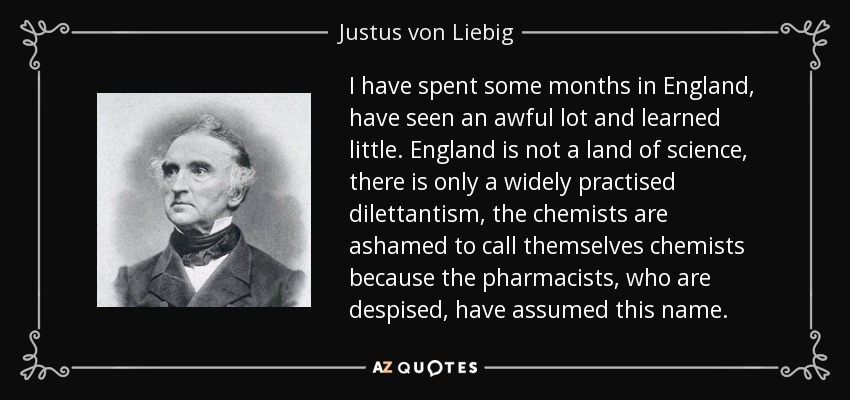
I have spent some months in England, have seen an awful lot and learned little. England is not a land of science, there is only a widely practised dilettantism, the chemists are ashamed to call themselves chemists because the pharmacists, who are despised, have assumed this name.
There is a reference in Aristotle to a gnat produced by larvae engendered in the slime of vinegar. This must have been Drosophila.
The mathematics clearly called for a set of underlying elementary objects-at that time we needed three types of them-elementary objects that could be combined three at a time in different ways to make all the heavy particles we knew. ... I needed a name for them and called them quarks, after the taunting cry of the gulls, "Three quarks for Muster mark," from Finnegan's Wake by the Irish writer James Joyce.
My amateur interest in astronomy brought out the term "magnitude," which is used for the brightness of a star.
There is always the danger in scientific work that some word or phrase will be used by different authors to express so many ideas and surmises that, unless redefined, it loses all real significance.
This constitution we designate by the word genotype. The word is entirely independent of any hypothesis; it is fact, not hypothesis that different zygotes arising by fertilisation can thereby have different qualities, that, even under quite similar conditions of life, phenotypically diverse individuals can develop.
If the hand be held between the discharge-tube and the screen, the darker shadow of the bones is seen within the slightly dark shadow-image of the hand itself... For brevity's sake I shall use the expression 'rays'; and to distinguish them from others of this name I shall call them 'X-rays'.
It really is worth the trouble to invent a new symbol if we can thus remove not a few logical difficulties and ensure the rigour of the proofs. But many mathematicians seem to have so little feeling for logical purity and accuracy that they will use a word to mean three or four different things, sooner than make the frightful decision to invent a new word.
Natural history is not equivalent to biology. Biology is the study of life. Natural history is the study of animals and plants-of organisms. Biology thus includes natural history, and much else besides.
One dictionary that I consulted remarks that "natural history" now commonly means the study of animals and plants "in a popular and superficial way," meaning popular and superficial to be equally damning adjectives. This is related to the current tendency in the biological sciences to label every subdivision of science with a name derived from the Greek. "Ecology" is erudite and profound; while "natural history" is popular and superficial. Though, as far as I can see, both labels apply to just about the same package of goods.
Wherefore no name can be found for a new fossil [element] which indicates its peculiar and characteristic properties (in which position I find myself at present), I think it is best to choose such a denomination as means nothing of itself and thus can give no rise to any erroneous ideas. In consequence of this, as I did in the case of Uranium, I shall borrow the name for this metallic substance from mythology, and in particular from the Titans, the first sons of the earth. I therefore call this metallic genus TITANIUM.
Phylogeny and ontogeny are, therefore, the two coordinated branches of morphology. Phylogeny is the developmental history [Entwickelungsgeschichte] of the abstract, genealogical individual; ontogeny, on the other hand, is the developmental history of the concrete, morphological individual.
Laplace considers astronomy a science of observation, because we can only observe the movements of the planets; we cannot reach them, indeed, to alter their course and to experiment with them. "On earth," said Laplace, "we make phenomena vary by experiments; in the sky, we carefully define all the phenomena presented to us by celestial motion." Certain physicians call medicine a science of observations, because they wrongly think that experimentation is inapplicable to it.
The advantages of a uniform statistical nomenclature, however im- perfect, are so obvious, that it is surprising no attention has been paid to its enforcement in bills of mortality. Each disease has in many instances been denoted by three or four terms, and each term has been applied to as many different diseases ; vague, inconvenient names have been employed, or complications have been registered, instead of primary diseases. The nomenclature is of as much importance in this depart- ment of inquiry as weights and measures in the physical sciences, and should be settled without delay.
Earlier theories ... were based on the hypothesis that all the matter in the universe was created in one big bang at a particular time in the remote past. [Coining the "big bang" expression.]
One [idea] was that the Universe started its life a finite time ago in a single huge explosion, and that the present expansion is a relic of the violence of this explosion. This big bang idea seemed to me to be unsatisfactory even before detailed examination showed that it leads to serious difficulties.
We need a name for the new replicator, a noun that conveys the idea of a unit of cultural transmission, or a unit of imitation. 'Mimeme' comes from a suitable Greek root, but I want a monosyllable that sounds a bit like 'gene'. I hope my classicist friends will forgive me if I abbreviate mimeme to meme. If it is any consolation, it could alternatively be thought of as being related to 'memory', or to the French word même. It should be pronounced to rhyme with 'cream'.
I conceived and developed a new geometry of nature and implemented its use in a number of diverse fields. It describes many of the irregular and fragmented patterns around us, and leads to full-fledged theories, by identifying a family of shapes I call fractals.
The combination of such characters, some, as the sacral ones, altogether peculiar among Reptiles, others borrowed, as it were, from groups now distinct from each other, and all manifested by creatures far surpassing in size the largest of existing reptiles, will, it is presumed, be deemed sufficient ground for establishing a distinct tribe or sub-order of Saurian Reptiles, for which I would propose the name of Dinosauria.
Reagents are regarded as acting by virtue of a constitutional affinity either for electrons or for nuclei... the terms electrophilic (electron-seeking) and nucleophilic (nucleus-seeking) are suggested... and the organic molecule, in the activation necessary for reaction, is therefore required to develop at the seat of attack either a high or low electron density as the case may be.
It was a reaction from the old idea of "protoplasm", a name which was a mere repository of ignorance.
Homologue. The same organ in different animals under every variety of form and function.
I must admit that when I chose the name, "vitamine," I was well aware that these substances might later prove not to be of an amine nature. However, it was necessary for me to choose a name that would sound well and serve as a catchword, since I had already at that time no doubt about the importance and the future popularity of the new field.
These microscopic organisms form an entire world composed of species, families and varieties whose history, which has barely begun to be written, is already fertile in prospects and findings of the highest importance. The names of these organisms are very numerous and will have to be defined and in part discarded. The word microbe which has the advantage of being shorter and carrying a more general meaning, and of having been approved by my illustrious friend, M. Littré, the most competent linguist in France, is one we will adopt.
I will remark in the way of general information, that in California, that land of felicitous nomenclature, the literary name of this sort of stuff is "hogwash"
Follow AzQuotes on Facebook, Twitter and Google+. Every day we present the best quotes! Improve yourself, find your inspiration, share with friends
or simply: