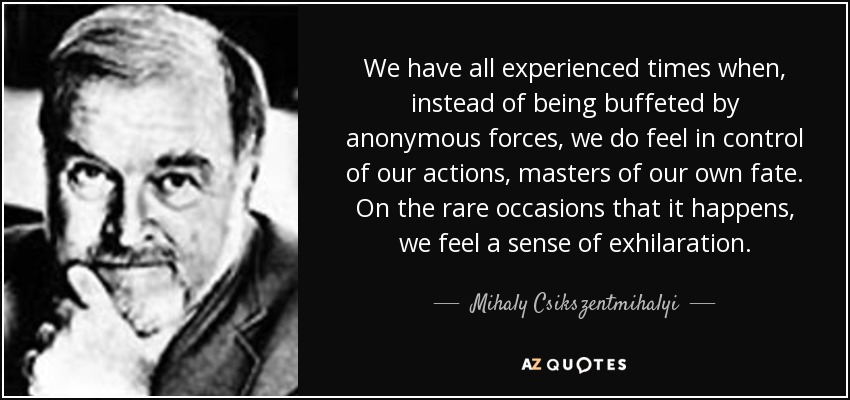
We have all experienced times when, instead of being buffeted by anonymous forces, we do feel in control of our actions, masters of our own fate. On the rare occasions that it happens, we feel a sense of exhilaration.
Man, like the universe, is a machine. Nothing enters our minds or determines our actions which is not directly or indirectly a response to stimuli beating upon our sense organs from without.
Our actions today will protect children from the adverse effects of exposure to pesticides commonly used on foods. The agency also is on schedule to meet all deadlines for ensuring safer pesticides use under the new Food Quality Protection Act.
It is Israel that must recognize Palestine's rights. We cannot believe in empty statements, twiddle our thumbs and watch our children getting killed. Israel must end occupation and aggression, and our actions won't take much longer after that.
In all our actions, God considers the intention: whether we act for Him or for some other motive.
We don't have enough time to premeditate our actions.
Throughout human history, our greatest leaders and thinkers have used the power of words to transform our emotions, to enlist us in their causes, and to shape the course of destiny. Words can not only create emotions, they create actions. And from our actions flow the results of our lives.
Our mind is the foundation of all our actions, whether they are actions of body, speech, or mind, i.e., thinking. Whatever we think, say, or do arises from our mind. What our consciousness consumes becomes the substance of our life, so we have to be very careful which nutriments we ingest.
In Zen we study the will. We learn how to cultivate it, to accumulate will. We use it to direct our actions, and we don't overuse it or abuse it - that's a waste.
We have learned that beneath the surface of an ordinary everyday normal casual conscious existence there lies a vast dynamic world of impulse and dream, a hinterland of energy which has an independent existence of its own and laws of its own: laws which motivate all our thoughts and our actions.
Wealth is also defined by family, connection to our ancestry, and our best vision of the future. All of these find their inner spirit, their constancy, and their strength in the values that shape our thinking and our actions.
We have long struggles with ourself, of which the outcome is one of our actions; they are, as it were, the inner side of human nature. This inner side is God's; the outer side belongs to men.
God is inexhaustibly attainable in the totality of our action.
There is another component that makes us who we are. It is a fantasy comprising all of our actions and thoughts. It’s called an opinion. And we will die for our opinion
The Buddha’s last words instructed us to be heedful—to see our actions as important and to keep that importance in mind at all times.
I also came to see that liberalism's superficial optimism concerning human nature caused it to overlook the fact that reason is darkened by sin. The more I thought about human nature the more I saw how our tragic inclination for sin causes us to use our minds to rationalize our actions. Liberalism failed to see that reason by itself is little more than an instrument to justify man's defensive ways of thinking. Reason, devoid of the purifying power of faith, can never free itself from distortions and rationalizations.
Our actions are like blank rhymes, to which everyone applies what sense he pleases.
There is a difference between happiness, the supreme good, and the final end or goal toward which our actions ought to tend. For happiness is not the supreme good, but presupposes it, being the contentment or satisfaction of the mind which results from possessing it.
The motive for our actions doesn't lie ahead of us. It's something behind us that we're trying to escape.
How do we define, how do we describe, how do we explain and/or understand ourselves? What sort of creatures do we take ourselves to be? What are we? Who are we? Why are we? How do we come to be what or who we are or take ourselves to be? How do we give an account of ourselves? How do we account for ourselves, our actions, interactions, transactions (praxis), our biologic processes? Our specific human existence?
I consider morals and aesthetics one and the same, for they cover only one impulse, one drive inherent in our consciousness - to bring our life and all our actions into a satisfactory relationship with the events of the world as our consciousness wants it to be, in harmony with our life and according to the laws of consciousness itself.
The right word is always a power, and communicates its definiteness to our action.
The only justifiable stopping place for for the expansion of altruism is the point at which all whose welfare can be affected by our actions are included within the circle of altruism. This means that all beings with the capacity to feel pleasure or pain should be included; we can improve their welfare by increasing their pleasures and diminishing their pains.
We are masters of our actions from the beginning up to the very end. But, in the case of our habits, we are only masters of their commencement - each particular little increase being as imperceptible as in the case of bodily infirmities. But yet our habits are voluntary, in that it was once in our power to adopt or not to adopt such or such a course of conduct.
There is a Destiny which has the control of our actions, not to be resisted by the strongest efforts of Human Nature.
Follow AzQuotes on Facebook, Twitter and Google+. Every day we present the best quotes! Improve yourself, find your inspiration, share with friends
or simply: