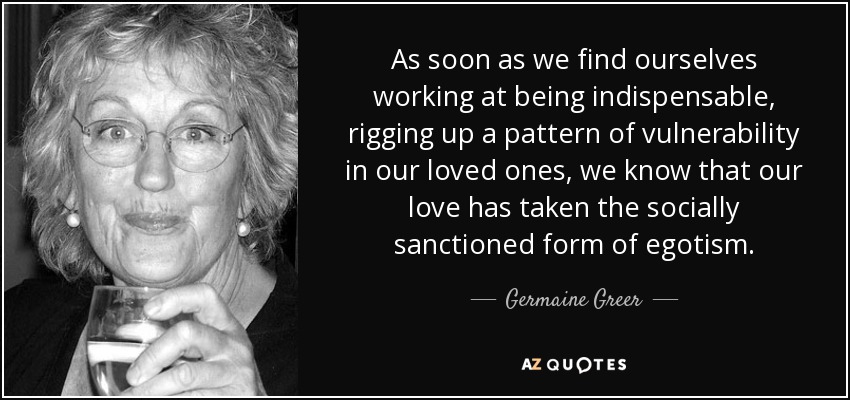
As soon as we find ourselves working at being indispensable, rigging up a pattern of vulnerability in our loved ones, we know that our love has taken the socially sanctioned form of egotism.
The whole universe appears as a dynamic web of inseparable energy patterns... Thus we are not separated parts of a whole. We are a Whole.
But novels are never about what they are about; that is, there is always deeper, or more general, significance. The author may not be aware of this till she is pretty far along with it. A novel's whole pattern is rarely apparent at the outset of writing, or even at the end; that is when the writer finds out what a novel is about, and the job becomes one of understanding and deepening or sharpening what is already written. That is finding the theme.
Do you check it when you travel, do you check it when you're just at home? They'd be able to tell something called your 'pattern of life.' When are you doing these kind of activities? When do you wake up? When do you go to sleep? What other phones are around you when you wake up and go to sleep? Are you with someone who's not your wife?
A diverse ecosystem will also be resilient, because it contains many species with overlapping ecological functions that can partially replace one another. When a particular species is destroyed by a severe disturbance so that a link in the network is broken, a diverse community will be able to survive and reorganize itself... In other words, the more complex the network is, the more complex its pattern of interconnections, the more resilient it will be.
What little wilderness remains displays the patterns we must return to, if our species and as many others as now remain are to persist here a while. Ideally this would call for a broad cultural rapprochment with the wild, a long overdue armistice in civilization's war upon it.
We must look towards societies that set a high value on nonaggression and noncompetitive ness, and therefore handle conflicts by nonviolent means. We can see how child rearing patterns produce nurturing adult behaviors.
Those who sniff decay in every shift of sense or alteration of usage do the language no service. Too often for such people the notion of good English has less to do with expressing ideas clearly than with making words conform to some arbitrary pattern.
Though the structures and patterns of mathematics reflect the structure of, and resonate in, the human mind every bit as much as do the structures and patterns of music, human beings have developed no mathematical equivalent to a pair of ears. Mathematics can only be "seen" with the "eyes of the mind". It is as if we had no sense of hearing, so that only someone able to sight read music would be able to appreciate its patterns and harmonies.
In mathematics, if a pattern occurs, we can go on to ask, Why does it occur? What does it signify? And we can find answers to these questions. In fact, for every pattern that appears, a mathematician feels he ought to know why it appears.
Mathematics, in the common lay view, is a static discipline based on formulas...But outside the public view, mathematics continues to grow at a rapid rate...the guid to this growth is not calculation and formulas, but an open ended search for pattern.
What humans do with the language of mathematics is to describe patterns... To grow mathematically children must be exposed to a rich variety of patterns appropriate to their own lives through which they can see variety, regularity, and interconnections.
When subject matter is forced to fit into preconceived patterns, there can be no freshness of vision. Following rules of composition can only lead to a tedious repetition of pictorial cliches.
We cut nature up, organize it into concepts, and ascribe significances as we do, largely because we are parties to an agreement to organize it in this way - an agreement that holds through our speech community and is codified in the patterns of our language.
For if we are observed in all matters, we are constantly under threat of correction, judgment, criticism, even plagiarism of our own uniqueness. We become children, fettered under watchful eyes, constantly fearful that-either now or in the uncertain future-patterns we leave behind will be brought back to implicate us, by whatever authority has now become focused upon our once-private and innocent acts. We lose our individuality, because everything we do is observable and recordable.
I am convinced that there is no simple formula or technique that I could give you or that you could give your students that would immediately facilitate mastering the ability to be guided by the Holy Spirit. Nor do I believe that the Lord will ever allow someone to conceive a pattern that would invariably and immediately open the channels of spiritual communication. We grow when we labor to recognize the guidance of the Holy Ghost as we struggle to communicate our needs to our Father in Heaven in moments of dire need or overflowing gratitude.
The study of economics has been again and again led astray by the vain idea that economics must proceed according to the pattern of other sciences.
Some individuals are better able than others to draw the right conclusions about the world about them and act accordingly. These individuals will be more likely to survive and reproduce so their pattern of behaviour and thought will become dominant
Given the complexity of interpersonal relationships and institutions and the complexity of co-ordination of the actions of many people, it is enormously unlikely that, even if there were one ideal pattern for society, it could be arrived at in an a priori fashion. And even supposing that some great genius did come along with a blueprint, who could have the confidence that it could work
The modern joint stock firm is the outcome of innumerable decisions made by individual entrepreneurs, owners and managers. For these decision makers the choices among alternatives were limited and the outcomes uncertain, but almost always there were choices. Despite the variability of these individual decisions, taken cumulatively they produced clear patterns of institutional change
All across the world, ...increasingly dangerous weather patterns and devastating storms are abruptly putting an end to the long-running debate over whether or not climate change is real. Not only is it real, it's here, and its effects are giving rise to a frighteningly new global phenomenon: the man-made natural disaster.
A massive campaign must be launched to restore a high-quality environment in North America and to de-develop the United States...De-development means bringing our economic system (especially patterns of consumption) into line with the realities of ecology and the global resource situation...Redistribution of wealth both within and among nations is absolutely essential, if a decent life is to be provided for every human being.
Current lifestyles and consumption patterns of the affluent middle class…involving high meat intake, consumption of large amounts of frozen and convenience foods, ownership of motor vehicles, golf courses, small electric appliances, home and work place air-conditioning, and suburban housing are not sustainable...
Variable behaviour of the sun is an obvious explanation, and there is increasing evidence that Earth's climate responds to changing patterns of solarmagnetic activity. ... If you look back into the sun's past, you find that we live in a period of abnormally high solar activity. ... It's a boom-bust system, and I would expect a crash soon. ... Having a crash would certainly allow us to pin down the sun's true level of influence on the Earth's climate. Then we will be able to act on fact, rather than from fear.
The most profound and serious indication of the moral implications underlying the ecological problem is the lack of respect for life evident in many of the patterns of environmental pollution.
Follow AzQuotes on Facebook, Twitter and Google+. Every day we present the best quotes! Improve yourself, find your inspiration, share with friends
or simply: