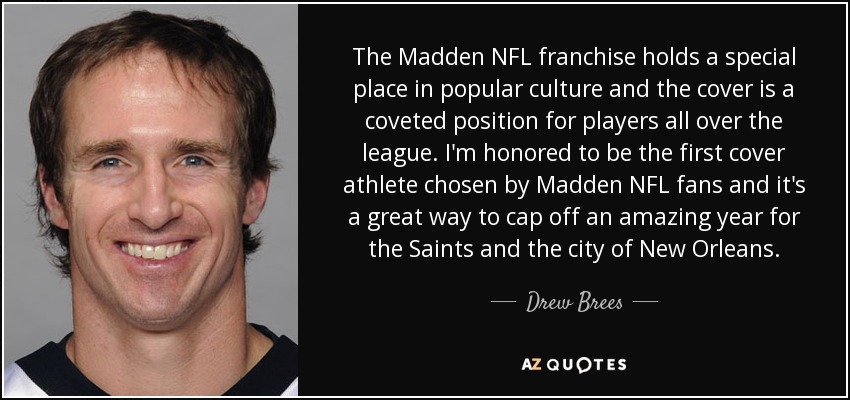
The Madden NFL franchise holds a special place in popular culture and the cover is a coveted position for players all over the league. I'm honored to be the first cover athlete chosen by Madden NFL fans and it's a great way to cap off an amazing year for the Saints and the city of New Orleans.
We are living in a popular culture where everything is overexposed.
I hate these questions - I don't like talking about this stuff [popular culture], because it's so... to me, it's so ordinary.
I remember when Langston Hughes used to write a column in black newspapers around this character Jesse B. Semple. He always used that as a voice, sometimes in comic ways, of having everyday people's voice come through this common folk hero, who was an ordinary working guy. He would talk about anything from police brutality to the Korean War. Those kinds of expression and identification are no longer prevalent in our popular culture.
For example, we have developed an artistic and a literary culture. Nevertheless, the ideals of technological culture remain underdeveloped and therefore outside of popular culture and the practical ideals of democracy.
The ideals of technological culture remain underdeveloped and therefore outside of popular culture and the practical ideals of democracy. This is also why society as a whole has no control over technological developments. And this is one of the gravest threats to democracy in the near future. It is, then, imperative to develop a democratic technological culture.
Popular culture does a lot to shape attitudes. You can't compare different communities to each other, but in my lifetime the gay and lesbian community has become much more mainstream in society. I would venture to say it's in part because people began to feel more comfortable when they saw that group on TV.
[Buzzing at the Sill] deals with the margins of America, a lot of parts unseen. Well, parts that are seen and familiar to a lot of the populace, but unseen when it comes to the parameters of what mainstream news and popular culture and Hollywood reflects.
I'm pretty much out of popular culture altogether.
I'm just so amazed by people who are willing to share things that, in the past, no one would have ever talked about. Folks in popular culture being willing to take on issues, I think that is such a key part of having a culture shift and an institutional shift.
A visionary is someone who sees the future with both insight and foresight: Insight into the deeper causes and meaning of events in the world, and foresight, or an intuitive grasp of the big picture, such as the trajectory of politics and popular culture.
While we have a very strong popular culture, the roots of American culture are very shallow, and we put emphasis on how a movie does as far as the box office goes. Many years ago, it would have been vulgar to print box - office grosses in the paper. Now The New York Times does it, and it's the big story for people interested in arts and entertainment on Monday. Which is why emphasis has shifted away from filmmakers and fallen on movie stars and business people.
A belief in God may not be fully within me anymore, but there's still a belief in belief. The high drama and power of the Church has stayed with me. As a child in church, I saw grown men at the altar crying out for God's mercy. And the idea of someone doing that has become a joke in the popular culture, but when you are there and you see it, you experience - for a moment - an incredibly raw, honest, strange insight into what it means to be a human being. Those experiences don't leave you. Whatever you think of them, they are powerful experiences.
Popular culture, on average, has been growing more cognitively challenging over the past thirty years, not less. Despite everything you hear about declining standards and dumbing-down, you have to do more intellectual work to make sense of today's television or games - much less the internet - than you did a few decades ago.
I am trying to encourage kids to do something that isn’t yet on their mind because it is not in popular culture. Popular culture tells you 'music, music, sports, sports.' It neglects the importance of a STEM education.
I love memoirs. They are probably my favorite literary form, along with biographies. The more confessional, the better. There is so, so, so little truth in the popular culture, and I am starved and grateful for any I can find.
I'm somebody who's really contributed to culture. Popular culture.
Yeah, I was a child of American popular culture.
I'm interested in youth culture and popular culture.
I think that popular culture takes a long time to catch up to what's actually happening in the world. Women have had to take care of themselves for quite a while. Actually, not had to take of themselves, but have wanted to take care of themselves, so I think it's a big transition that our country and our society has been going through a long time.
The nineties as a pop cultural sphere was a really fertile time for feminism that was grounded and located in popular culture. I'm talking about before the Spice Girls - Sassy Magazine, riot grrrl, the Beastie Boys, Nirvana. You had this alternative culture that was very much speaking up on behalf of women and in favor of women.
Pretty much up until The West Wing, our leaders had always been portrayed in popular culture as either Machiavellian or dolts. But I thought, "What if we show a group of people who are highly competent, they're going to lose as much as they win, but we're going to understand that they wake up every morning wanting to do good?" That was really the spirit behind The West Wing.
Follow AzQuotes on Facebook, Twitter and Google+. Every day we present the best quotes! Improve yourself, find your inspiration, share with friends
or simply: