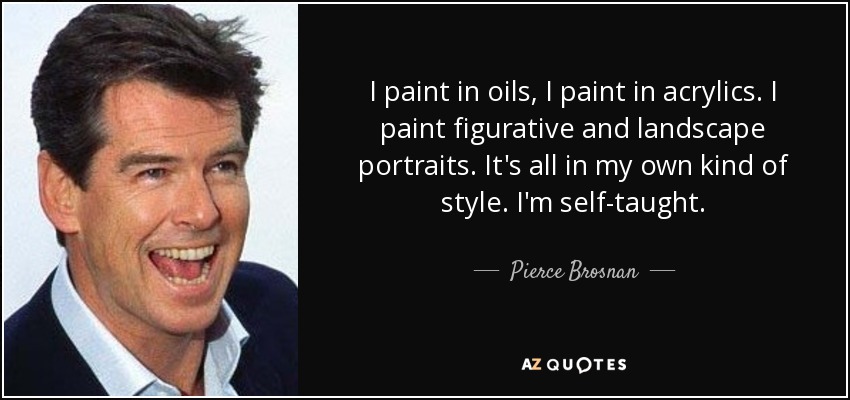
I paint in oils, I paint in acrylics. I paint figurative and landscape portraits. It's all in my own kind of style. I'm self-taught.
My movies are film-paintings - moving portraits captured on celluloid. I'll layer that with sound to create a unique mood -- like if the Mona Lisa opened her mouth, and there would be a wind, and she'd turn back and smile. It would be strange and beautiful.
I do not care about my own appearance, but I would hope that people could see into my soul, and that is presented better in these photographs than in others. (On his self-portraits)
The best portraits are perhaps those in which there is a slight mixture of caricature; and we are not certain that the best histories are not those in which a little of the exaggeration of fictitious narrative is judiciously employed. Something is lost in accuracy; but much is gained in effect. The fainter lines are neglected; but the great characteristic features are imprinted on the mind forever.
Nothing in a portrait is a matter of indifference. Gesture, grimace, clothing, decor even - all must combine to realize a character.
Cassius and Brutus were the more distinguished for that very circumstance that their portraits were absent. [Lat., Praefulgebant Cassius atque Brutus eo ipso, quod effigies eorum non videbantur.]
You know how you feel somebody looking at you, and you turn, and somebody actually is? It's the same at an art gallery. You're looking at one portrait, turn around, and there is a work of art directly behind you. Because it's all energy. Every single thing has energy.
From the first shock of the contemplation of a face depends the principal sensation which guides me throughout the entire execution of a portrait.
Most portraits are lies. People are rarely what they appear to be, especially in front of a camera. You might know me your entire lifetime and never reveal yourself to me. To interpret wrinkles as character is insult not insight.
But a Book is only the Heart's Portrait- every Page a Pulse.
I never wanted to make portraits - to photograph celebrities, beautiful people, beautiful landscapes, beautiful buildings, or people in distressing situations.... I have always been interested in everyman - average, ordinary people in everyday situations.
Both Proust and Joyce record the ways in which human perspectives can be transformed. In Portrait, Stephen Dedalus is constantly undergoing epiphanies, but their effects are transitory: the new synthetic complex quickly falls apart. Proust's characters, by contrast, often achieve lasting changes of perspective.
The portrait is the subject matter in photography where the problems of the media are the most visible.
What I really do is make portraits of the soul.
You will never see a portrait of my love, for miracles are never seen.
I never can pass by the Metropolitan Museum of Art in New York without thinking of it not as a gallery of living portraits but as a cemetery of tax-deductible wealth.
I collect old portraits. They're all just interesting pictures of people, and you just kind of wonder who they were and what they were. There's a guy - I don't know who he is, but he's wearing a suit. He's got his arms folded, and he looks like he sold insurance or something. I'm just wondering why someone painted him.
When I look in the mirror, I am slightly reminded of self-portraits by Durer and by Rembrandt, because they both show a degree of introspection. I see some element of disappointment; I see a sense of humour, but also something that is faintly ridiculous; and I see somebody who is frightened of being found out and thought lightweight.
Each of us chooses the tone for telling his or her own story. I would like to choose the durable clarity of a platinum print, but nothing in my destiny possesses the luminosity. I live among diffuse shadings, veiled mysteries, uncertainties; the tone of telling my life is closer to that of a portrait in sepia.
You wouldn't take a portrait of a human being from a hundred feet away and expect to capture their spirit; you'd move in close.
Dreams are like portraits; and we find they please because they are confessed resemblances.
Age continually alters the faces of those who think or study, and so their portraits differ from one another and don't even resemble them for very long. I dream so much and live so little that I'm sometimes only three years old. But the next day I'm three hundred, if the dream has been sombre.
In The Moon, Come to Earth Philip Graham takes us on the best kind of journey, as he simultaneously reveals the fascinating city of Lisbon--its neighborhoods, its writers, its customs, its cuisine--and offers an intimate portrait of his beloved family. With his far-reaching intellect Graham is the ideal travelling companion, and The Moon, Come to Earth is a beautiful and surprising book.
I think of all the choices I never knew. And those I let be made for me - to please, from fear, for love. Where did they disappear to, those choices that I never made? They are all part of who I am. They are the legacy I leave behind, they are the finished portrait of myself I cannot change.
That moment when the person actually dictates the way I do the portrait is when the intimacy arrives.
Follow AzQuotes on Facebook, Twitter and Google+. Every day we present the best quotes! Improve yourself, find your inspiration, share with friends
or simply: