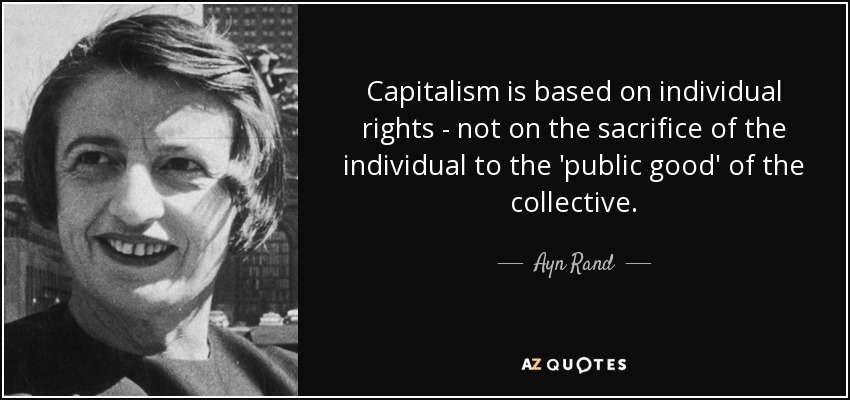
Capitalism is based on individual rights - not on the sacrifice of the individual to the 'public good' of the collective.
As a society we can't live without moral considerations. We do have to protect the public good. And markets are not designed to do that, so we need a political process.
Higher education isn't just a personal investment. It's a public good that pays off in a more competitive workforce and better-informed and engaged citizens. Every year, we spend nearly $100 billion on corporate welfare, and more than $500 billion on defense spending. Surely ensuring the next generation can compete in the global economy is at least as important as subsidies for big business and military adventures around the globe. In fact, I think we can and must go further - not just making public higher education tuition-free, but reinventing education in America as we know it.
Complaints are everywhere heard from our most considerate and virtuous citizens, equally the friends of public and private faith, and of public and personal liberty, that our governments are too unstable, that the public good is disregarded in the conflicts of rival parties, and that measures are too often decided, not according to the rules of justice and the rights of the minor party, but by the superior force of an interested and overbearing majority.
To be interested in the public good we must be disinterested, that is, not interested in goods in which our personal selves are wrapped up.
Out of politics comes more uproar than progress. It is indeed surprising how little, comparatively, this noisy department of human affairs contributes to the world's prosperity. Political commotions upon the grandest scale, political events of astounding suddenness, political characters of the greatest ability, abound, but still, permanent results are rare, and we look in vain for a measure of public good corresponding in extent to the hideous rout which ushers it in. Progress but turns upon its pillow, and goes to sleep again.
The demise of higher education as a public good is also evident in light of the election of a number of right-wing politicians who are cutting funds for state universities and doing everything they can to turn them in training centers to fill the needs of corporations. This new and intense attack on both the social state and higher education completely undermines the public nature of what education is all about.
Ultimately, the current argument is "not having net neutrality will hurt innovation," and you can make that argument, but I would rather make the public good argument, which is not just about innovation or nurturing new companies that will add to the nation's GDP, it's actually about creating a democratic public sphere.
A vibrant, rich, growing corpus of public-domain books is a vital public good - similar to parks, the infrastructure of basic services, and other hallmarks of any advanced society.
The trade of advertising is now so near to perfection that it is not easy to propose any improvement. But as every art ought to be exercized in due subordination to the public good, I cannot but propose it as a moral question to these masters of the public ear, whether they do not sometimes play too wantonly with our passions.
People are so docile right now. It is almost as if good government means when the politicians lie to us for our own good, for the public good, and bad government is when politicians lie for their own selfish interests.
Leadership is for those who love the public good and are endowed and trained to administer it.
The most powerful force possessed by the individual citizen is her own government. ... Government is the only organized mechanism that makes possible that level of shared disinterest known as the public good.
Baseball, like some other sports, poses as a sacred institution dedicated to the public good, but it is actually a big, selfish business with a ruthlessness that many big businesses would never think of displaying.
Many faculty retreated into academic specializations and an arcane language that made them irrelevant to the task of defending the university as a public good, except for in some cases a very small audience. This has become more and more clear in the last few years as academics have become so insular, often unwilling or unable to defend the university as a public good, in spite of the widespread attacks on academic freedom, the role of the university as a democratic public sphere, and the increasing reduction of knowledge to a saleable commodity, and students to customers.
Many university presidents assume the language and behavior of CEOs and in doing so they are completely reneging on the public mission of the universities. The state is radically defunding public universities and university presidents, for the most part, rather than defending higher education as a public good, are trying to privatize their institutions in order to remove them from the political control of state governments. This is not a worthy or productive strategy.
University presidents should be loud and forceful in defending the university as a social good, essential to the democratic culture and economy of a nation. They should be criticizing the prioritizing of funds for military and prison expenditures over funds for higher education. And this argument should be made as a defense of education, as a crucial public good, and it should be taken seriously. But they aren't making these arguments.
We need to figure how to defend higher education as a public good. If we can't do that, we're in trouble.
I feel like we're stuck in the former mode of reacting because that's what gains traction in Washington. But I really believe we need a robust public good argument. Net neutrality is not just about creating the next Instagram or Farmville or whatever.
Against the tyranny of forgetting, educators, young people, social activists, public intellectuals, workers and others can work to make visible and oppose the long legacy and current reality of state violence and the rise of the punishing state. Such a struggle suggests not only reclaiming, for instance, education as a public good but also reforming the criminal justice system and removing the police from schools.
We like to have a point of view in our stories, not an obvious moral, but a worthwhile theme. ... All we are trying to do is give the public good entertainment. That is all they want.
The fantastical idea of virtue and the public good being a sufficient security to the state against the commission of crimes, which you say you have heard insisted on by some, I assure you was never mine.
Follow AzQuotes on Facebook, Twitter and Google+. Every day we present the best quotes! Improve yourself, find your inspiration, share with friends
or simply: