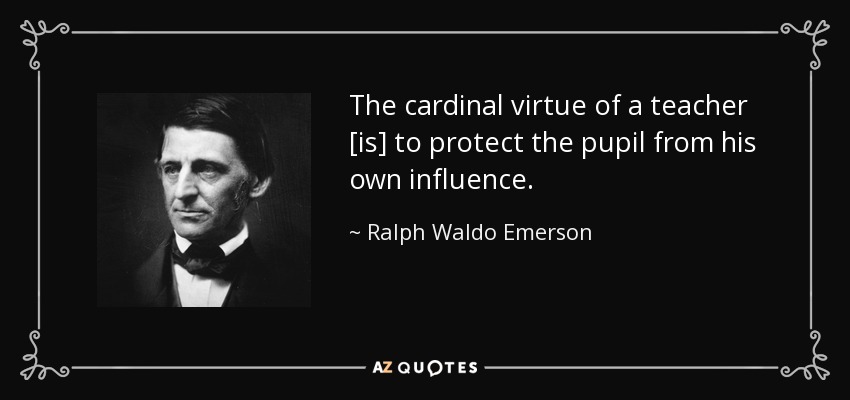
The cardinal virtue of a teacher [is] to protect the pupil from his own influence.
Scientific societies are as yet in their infancy. It is to be expected that advances in physiology and psychology will give governments much more control over individual mentality than they now have even in totalitarian countries. Fitche laid it down that education should aim at destroying free will, so that, after pupils have left school, they shall be incapable, throughout the rest of their lives, of thinking or acting otherwise than as their schoolmasters would have wished.
Communists should set an example in study; at all times they should be pupils of the masses as well as their teachers.
A Dominican monk, Father Henri Didon, used it as a watchword for his pupils in sports at Arcueil College in Paris. Baron Pierre De Coubertin, founder of the modern Olympics, made it the Olympic Games ideal adopted at the Antwerp Games in 1920. I never mentioned winning to my players. I mentioned constantly that all I wanted them to do was the best they could. If they're good enough, the score will be to their liking; if they're not, it won't be but that's nothing to hang their head about. Sometimes the other fellow is just better than you are.
There is, I think, no point in the philosophy of progressive education which is sounder than its emphasis upon the importance of the participation of the learner in the formation of the purposes which direct his [sic] activities in the learning process, just as there is no defect in traditional education greater than its failure to secure the active cooperation of the pupil in construction of the purposes involved in his studying.
Twentieth pupil of the centuries knows its stuff and bird-changed this century like Jesus climbs the sky.
The secret of sound education is to get each pupil to learn for himself, instead of instructing him by driving knowledge into him on a stereotyped system.
Philosophers have very justly remarked that the only solid instruction is that which the pupil brings from his own depths; that the true instruction is not that which transmits notions wholly formed, but that which renders him capable of forming for himself good opinions. That which they have said in regard to the intellectual faculties applies equally to the moral faculties. There is for the soul a spontaneous culture, on which depends all the real progress in perfection.
Teaching, I find, is not the most amusing thing on earth; in fact, with a stupid lump for a Pupil, it is about the most irksome.
The way in which modern German poetry follows theories reminds me of pupils who, scolded by their teacher for their insubordination, justify themselves by saying that they invented new rules of propriety according to which they are quite well- behaved.
It makes little sense to spend a month teaching decimal fractions to fourth-grade pupils when they can be taught in a week, and better understood and retained, by sixth-grade students. Child-centeredness does not mean lack of rigor or standards; it does mean finding the best match between curricula and children's developing interests and abilities.
The most valuable thing a teacher can impart to children is not knowledge and understanding per se but a longing for knowledge and understanding, and an appreciation for intellectual values, whether they be artistic, scientific, or moral. It is the supreme art of the teacher to awaken joy in creative expression and knowledge. Most teachers waste their time by asking questions that are intended to discover what a pupil does not know, whereas the true art of questioning is to discover what the pupil does know or is capable of knowing.
Our task as we grow older in a rapidly advancing science, is to retain the capacity of joy in discoveries which correct older ideas, and to learn from our pupils as we teach them.
I believe that our own experience instructs us that the secret of Education lies in respecting the pupil.
Nothing can be done about it: every master has but a single pupil--and he will not stay loyal to him--for he is also destined to become a master.
Pedagogical romances leave the mentor disgruntled, the pupil confused.
The good pupils are often brilliant, and they keep you on your toes and take you to the limits of your knowledge. The worst pupils provide a unique insight into the criminal mind.
Tutors should behave reverently before their pupils.
Teachers should be very careful not to spoil their pupils' taste for poetry for all time by making it a task and an imposition.
If a teacher have any opinion which he wishes to conceal, his pupils will become as fully indoctrinated into that as into any which he publishes.
The enthusiast always finds the master, the masters, whom he seeks. Always genius seeks genius, desires nothing so much as to be a pupil and to find those who can lend it aid to perfect itself.
We should, if possible, prove a teacher to posterity, instead of being the pupil of by-gone generations. More shall come after us than have gone before; the world is not yet middle-aged.
A young man had become possessed by a devil. The thing within him burst into loud lamentation and departed from the man. At once the youth's eye fell out on his cheek, and the whole of the pupil which had been black became white.
The very first step toward success in any occupation is to become interested in it. Locke put this in a very happy way when he said, give a pupil "a relish of knowledge" and you put life into his work.
Of course there is matter for remark in poems. Nobody denies that. But it must be solemnly laid on everybody in this world to make his own observations and remarks. That's what we mean by thinking, and that's about all we mean. A teacher says to a pupil "Watch me notice a few things in the next few months: let's see you notice a few things too."
Follow AzQuotes on Facebook, Twitter and Google+. Every day we present the best quotes! Improve yourself, find your inspiration, share with friends
or simply: