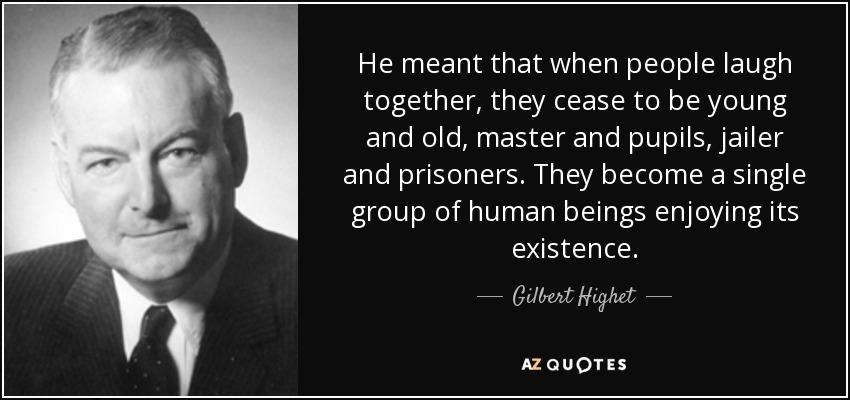
He meant that when people laugh together, they cease to be young and old, master and pupils, jailer and prisoners. They become a single group of human beings enjoying its existence.
In Randori we teach the pupil to act on the fundamental principles of Judo, no matter how physically inferior his opponent may seem to him, and even if by sheer strength he can easily overcome him; because if he acts contrary to principle his opponent will never be convinced of defeat, no matter what brute strength he may have used.
There is no teaching until the pupil is brought into the same state or principle in which you are; a transfusion takes place; he is you, and you are he; then is a teaching; and by no unfriendly chance or bad company can he ever lose the benefit.
To me the worst thing seems to be a school principally to work with methods of fear, force and artificial authority. Such treatment destroys the sound sentiments, the sincerity and the self-confidence of pupils and produces a subservient subject.
A good teacher protects his pupils from his own influence.
The pupil who is never required to do what he cannot do, never does what he can do.
No man can be a good teacher unless he has feelings of warm affection toward his pupils and a genuine desire to impart to them what he believes to be of value.
If, then, you wish to insure the interest of your pupils, there is only one way to do it; and that is to make certain that they have something in their minds to attend with, when you begin to talk. That something can consist in nothing but a previous lot of ideas already interesting in themselves, and of such a nature that the incoming novel objects which you present can dovetail into them and form with them some kind of a logically associated or systematic whole.
I would have the studies elective. Scholarship is to be created not by compulsion, but by awakening a pure interest in knowledge. The wise instructor accomplishes this by opening to his pupils precisely the attractions the study has for himself. The marking is a system for schools, not for the college; for boys, not for men; and it is an ungracious work to put on a professor.
I would have things as they were in all the days of my life, and in the days of my longfathers before me: to be the Lord of this City in peace, and leave my chair to a son after me, who would be his own master and no wizard's pupil.
I must try to remember that a boy's heart is not a man's, and perhaps a teacher must learn from his pupil, too, eh?
Let our pupil be taught that he does not belong to himself, but that he is public property. Let him be taught to love his family, but let him be taught at the same time that he must forsake and even forget them when the welfare of his country requires it.
Since Pawlow [Pavlov] and his pupils have succeeded in causing the secretion of saliva in the dog by means of optic and acoustic signals, it no longer seems strange to us that what the philosopher terms an 'idea' is a process which can cause chemical changes in the body.
In his wretched life of less than twenty-seven years Abel accomplished so much of the highest order that one of the leading mathematicians of the Nineteenth Century could say without exaggeration, "Abel has left mathematicians enough to keep them busy for five hundred years." Asked how he had done all this in the six or seven years of his working life, Abel replied, "By studying the masters, not the pupils."
As for our pupils talk, let his virtue and his sense of right and wrong shine through it and have no guide but reason. Make him understand that confessing an error which he discovers in his own argument even when he alone has noticed it is an act of justice and integrity, which are the main qualities he pursues; stubbornness and rancour are vulgar qualities, visible in common souls whereas to think again, to change one's mind and to give up a bad case on the heat of the argument are rare qualities showing strength and wisdom.
Socrates and then Archesilaus used to make their pupils speak first; they spoke afterwards. 'Obest plerumque iss discere volunt authoritas eorum qui docent.' [For those who want to learn, the obstacle can often be the authority of those who teach]
We should never pretend to know what we don't know, we should not feel ashamed to ask and learn from people below, and we should listen carefully to the views of the cadres at the lowest levels. Be a pupil before you become a teacher; learn from the cadres at the lower levels before you issue orders.
Liebig was not a teacher in the ordinary sense of the word. Scientifically productive himself in an unusual degree, and rich in chemical ideas, he imparted the latter to his advanced pupils, to be put by them to experimental proof; he thus brought his pupils gradually to think for themselves, besides showing and explaining to them the methods by which chemical problems might be solved experimentally.
Wherever there are beginners and experts, old and young, there is some kind of learning going on, some kind of teaching. We are all pupils and we are all teachers.
We must learn to be honest with ourselves, and know our shortcomings. We will acquire cohesion but we will pay dearly for being a slow pupil.
We should seek to be fellow students with the pupil, and should learn of, as well as with him, if we would be most helpful to him.
Their pupils and their little charges are not nourished and fed by what they learn: the learning is passed from hand to hand with only one end in view: to show it off, to put into our accounts to entertain others with it, as though it were merely counters, useful for totting up and producing statements, but having no other use or currency. 'Apud alios loqui didicerunt, non ipsi secum' [They have learned how to talk with others, not with themselves]
A teacher who establishes rapport with the taught, becomes one with them, learns more from them than he teaches them. He who learns nothing from his disciples is, in my opinion, worthless. Whenever I talk with someone I learn from him. I take from him more than I give him.
Reason must approach nature with the view, indeed, of receiving information from it, not, however, in the character of a pupil, who listens to all that his master chooses to tell him, but in that of a judge, who compels the witnesses to reply to those questions which he himself thinks fit to propose. To this single idea must the revolution be ascribed, by which, after groping in the dark for so many centuries, natural science was at length conducted into the path of certain progress.
TEACHER seeks pupil. Must have an earnest desire to save the world. Apply in person.
Follow AzQuotes on Facebook, Twitter and Google+. Every day we present the best quotes! Improve yourself, find your inspiration, share with friends
or simply: