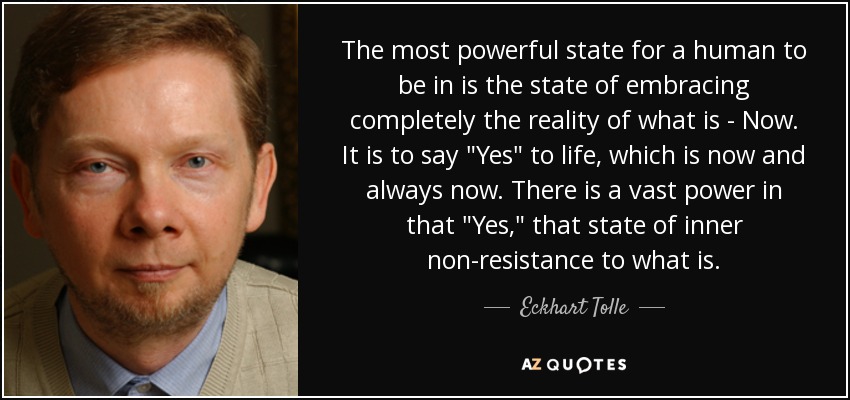
The most powerful state for a human to be in is the state of embracing completely the reality of what is - Now. It is to say "Yes" to life, which is now and always now. There is a vast power in that "Yes," that state of inner non-resistance to what is.
You don't need to suffer anymore. You've suffered enough to take you to this point where you hear the words, "You don't need to suffer anymore," and you understand them. You recognize their truth and you then see that you do have a choice that you can surrender to the suchness of now, which means every moment to relinquish resistance and if it still arises, to recognize it.
Resistance keeps you stuck. Surrender immediately opens you to the greater intelligence that is vaster than the human mind, and it can then express itself through you. So through surrender often you find circumstances changing.
I don't think there's any way that war can have a place in peace. I think that peace is the active and difficult resistance to the temptation of war; it is the prerogative and the obligation of the injured. Peace is something that has to be vigilantly maintained; it is a vigilance, and it involves temptation, and it does not mean we as human beings are not aggressive. This is a mistaken way of understanding non-violence.
Production of identity is a resistance element, an aggressive element. Both a refusal and an affirmation and an assertion, and certainly, we in Jamaica were talking about black art. And the idea that there is a role for art in the civil rights revolution and in the successor to the civil rights revolution.
'Normal Life' looks at the current moment in trans politics, understanding that it is often assumed that trans resistance strategies should mimic the lesbian and gay legal rights frameworks that have become so visible in recent decades.
I argue that legal equality has failed resistance movements aimed at transforming material conditions of violence, and that trans activists should take a decidedly different approach.
I wrote Normal Life using concepts that have been helpful to me, and hoping to offer those as accessible tools for thinking differently about the pitfalls trans resistance faces, in particular the temptation to focus on legal equality and the limitations of that approach, and the alternative approaches being taken by racial and economic justice focused trans activists.
Many people who are drawn to work about racism and transphobia may be new to thinking deeply about colonialism and indigenous resistance in their North America.
Violence is part of the resistance to occupation. The basic fact is not the violence; the basic fact is the occupation. Violence is a symptom; the occupation is the disease - a mortal disease for everybody concerned, the occupied and the occupiers.
They are, in a sense, two sides of the same coin: women are, on the one hand, subjects of an extremely real and abject (as Julia Kristeva put it) body and denigrated sexuality; on the other, the proliferation of images, and their digitalisation produces more and more abstract and air-brushed representations of impossible female bodies. Both indicate, certainly, a "lack of progress." But, one hopes, discussions and resistance are emerging in response.
Spirituality has to play an important role, particularly in resistance movements. The institutions we are fighting against - corporations and governments - use alienation as one of their primary weapons. A big part of their messaging is intended to make people feel separated from each other, which disempowers them, which makes them ever easier to exploit. This is really a spiritual weapon they are using. It isolates people and breaks their spirit.
Stress is caused by our resistance to what already is. Even our difficulties we need to accept. My greatest wish is to do God's will.
It is no accident that this homeplace, as fragile and as transitional as it may be, a makeshift shed, a small bit of earth where one rests, is always subject to violation and destruction. For when a people no longer have the space to construct homeplace, we cannot build a meaningful community of resistance.
There is no movement without our own resistance.
Human interaction is the key force in overcoming resistance and speeding change.
Nations, like families, have great men only in spite of themselves. They do everything in their power not to have any. And therefore, the great man, in order to exist, must possess a force of attack which is greater than the force of resistance developed by millions of people.
The final goal of physical education is to make strong beings. In the purely physical sense, the Natural Method promotes the qualities of organic resistance, muscularity and speed, towards being able to walk, run, jump, move on all fours, to climb, to keep balance, to throw, lift, defend yourself and to swim.
The cause of Sense, is the External Body, or Object, which presseth the organ proper to each Sense, either immediately, as in theTaste and Touch; or mediately, as in Seeing, Hearing, and Smelling: which pressure, by the mediation of Nerves, and other strings, and membranes of the body, continued inwards to the Brain, and Heart, causeth there a resistance, or counter- pressure, or endeavor of the heart, to deliver it self: which endeavor because Outward, seemeth to be some matter without.
An uprising would punish only the country, and that is out of the question. But there is yet another approach, the most effectiveform of resistance: contemptuous compliance.
The ultimate authority resides in the people, and that if the federal government got too powerful and overstepped its authority, then the people would develop plans of resistance and resort to arms.
[O]ne of the most vital ways we sustain ourselves is by building communities of resistance, places where we know we are not alone.
Nobody likes to change. There will always be resistance to change, and there always will be change. And the quicker you get to that, the easier it is. It's not such a difficult thing. If you entrench yourself and go, "By God, I will not change. I will not have this." Then, you're a dead man. We're great at adaptability. It's our strongest suit.
Most change initiatives either fail or fall far short of original (perhaps unrealistic) expectations. More often than not, resistance is cultural in nature, the result of what James O'Toole so aptly characterizes as "the ideology of comfort and the tyranny of custom."
Trying to maintain a pleasant state and avoid an unpleasant state is actually the cause of sorrow. When you stop resisting, you see that what seems frightening is actually the absolute beauty of reality. When you see that everything is a momentary display of reality, then you stop resisting it. Resistance hurts, only every single time. Love is the state of nonresistance.
Follow AzQuotes on Facebook, Twitter and Google+. Every day we present the best quotes! Improve yourself, find your inspiration, share with friends
or simply: