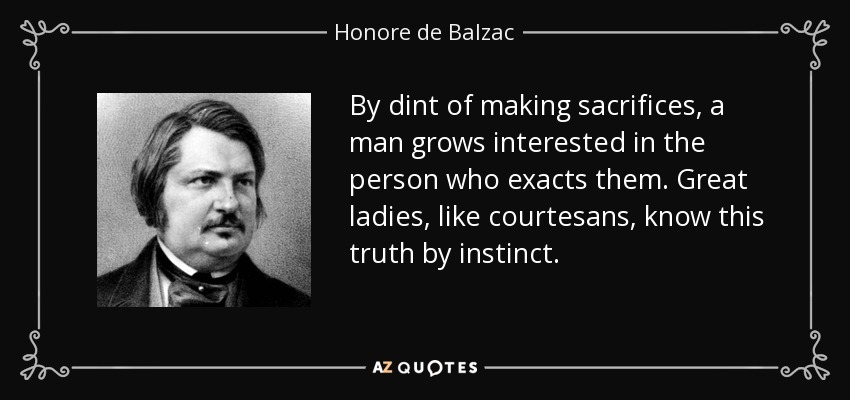
By dint of making sacrifices, a man grows interested in the person who exacts them. Great ladies, like courtesans, know this truth by instinct.
Sacrifice is the first element of religion, and resolves itself in theological language into the love of God.
Adults look upon a child as something empty that is to be filled through their own efforts, as something inert and helpless for which they must do everything, as something lacking an inner guide and in constant need of inner direction. . . . An adult who acts in this way, even though he may be convinced that he is filled with zeal, love, and a spirit of sacrifice on behalf of his child, unconsciously suppresses the development of the child's own personality.
That which especially distinguishes a high order of man from a low order of man, that which constitutes human goodness, human nobleness, is surely not the degree of enlightenment with which men pursue their own advantage; but it is self-forgetfulness; it is self-sacrifice; it is the disregard of personal pleasure, personal indulgence, personal advantage, remote or present, because some other line of conduct is more right.
In its primary signification, all vice, that is, all excess, brings on its own punishment, even here. By certain fixed, settled and established laws of Him who is the God of nature, excess of every kind destroys that constitution which temperance would preserve. The debauchee offers up his body a "living sacrifice to sin.
No man can produce great things who is not thoroughly sincere in dealing with himself, who would not exchange the finest show for the poorest reality, who does not so love his work that he is not only glad to give himself for it, but finds rather a gain than a sacrifice in the surrender.
Complaisance, though in itself it be scarce reckoned in the number of moral virtues, is that which gives a lustre to every talent a man can be possessed of. It was Plato's advice to an unpolished writer that he should sacrifice to the graces. In the same manner I would advise every man of learning, who would not appear in the world a mere scholar or philosopher, to make himself master of the social virtue which I have here mentioned.
It's odd how a person always arouses admiration for his moral qualities among the relatives of another with whom he has sexual relations. Physical love, so unjustifiably decried, makes everyone show, down to the least detail, all he has of goodness and self-sacrifice, so that he shines even in the eyes of those nearest to him.
Every fancy that we would substitute for a reality is, if we saw aright, and saw the whole, not only false, but every way less beautiful and excellent than that which we sacrifice to it.
Every apartment devoted to the circulation of the glass, may be regarded as a temple set apart for the performance of human sacrifices. And they ought to be fitted up like the ancient temples in Egypt, in a manner to show the real atrocity of the superstition that is carried on within their walls.
self-sacrifice is one of a woman's seven deadly sins (along with self-abuse, self-loathing, self-deception, self-pity, self-serving, and self-immolation).
We sacrifice to dress till household joys and comforts cease. Dress drains our cellar dry, and keeps our larder lean.
it is true that nothing is gained without something being lost: everyone knows that in fulfilling oneself one necessarily sacrifices some possibilities.
Above all, we know that although Americans can be led to make great sacrifices, they do not like to be driven.
Pride counterbalances all our miseries, for it either hides them, or, if it discloses them, boasts of that disclosure. Pride has such a thorough possession of us, even in the midst of our miseries and faults, that we are prepared to sacrifice life with joy, if it may but be talked of.
The essence of patriotism lies in a willingness to sacrifice for one's country, just as true greatness finds expression, not in blessings enjoyed, but in good bestowed.
I never know why self-sacrifice is noble. Why is it better to sacrifice oneself than someone else?
It is not the church we want, but the sacrifice; not the emotion of admiration, but the act of adoration; not the gift, but the giving.
Superstition, in all times and among all nations, is the fear of a spirit whose passions are those of a man, whose acts are the acts of a man; who is present in some places, not in others; who makes no places holy and not others; who is kind to one person, unkind to another; who is pleased or angry according to the degree of attention you pay him, or praise you refuse to him; who is hostile generally to human pleasure, but may be bribed by sacrifice of a part of that pleasure into permitting the rest. This, whatever form of faith it colors, is the essence of superstition.
The childhood of the individual and the race is full of fears, and panic-stricken attempts to avert what is feared by placating the gods with painful sacrifices.
a self-made martyr is a poor thing.
I doubt if we nuns are really as self-sacrificing as we must seem to be to you who live in the world. We don't give everything for nothing, you know. The mystery plays fair.
The secret heart is fair devotion's temple; there the saint, even on that living altar, lights the flame of purest sacrifice, which burns unseen, not unaccepted.
There is no hope for the world unless and until we formulate, accept and state publicly a true moral code of individualism, based on man's inalienable right to live for himself. Neither to hurt nor to serve his brothers, but to be independent of them in his function and in his motive. Neither to sacrifice them for himself nor to sacrifice himself for them.
In all proper relationships there is no sacrifice of anyone to anyone.
Follow AzQuotes on Facebook, Twitter and Google+. Every day we present the best quotes! Improve yourself, find your inspiration, share with friends
or simply: