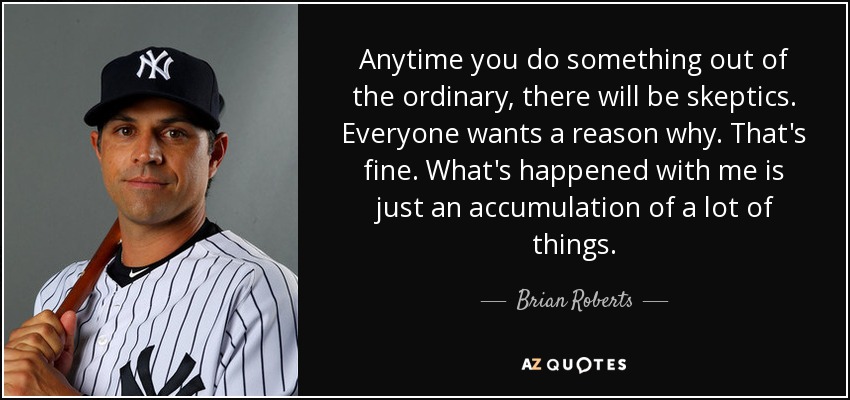
Anytime you do something out of the ordinary, there will be skeptics. Everyone wants a reason why. That's fine. What's happened with me is just an accumulation of a lot of things.
No sceptical philosopher can ask any questions that may not equally be asked by a tired child on a hot afternoon.
The sceptics, like bees, give their one sting and die.
It is quite an old-fashioned fallacy to suppose that our objection to scepticism is that it removes the discipline from life. Our objection to scepticism is that it removes the motive power. Materialism is not a thing which destroys mere restraint. Materialism itself is the great restraint.
Liberty has produced scepticism, and scepticism has destroyed liberty. The lovers of liberty thought they were leaving it unlimited, when they were only leaving it undefined. They thought they were only leaving it undefined, when they were really leaving it undefended.
The sceptic ultimately undermines democracy (1) because he can see no significance in death and such things of a literal equality; (2) because he introduces different first principles, making debate impossible: and debate is the life of democracy; (3) because the fading of the images of sacred persons leaves a man too prone to be a respecter of earthly persons; (4) because there will be more, not less, respect for human rights if they can be treated as divine rights.
A skeptic is one who is willing to question any truth claim, asking for clarity in definition, consistency in logic, and adequacy of evidence.
When on life's journey it becomes our lot to travel with criticism of skeptics, the hate of some, the rejection of others, the impatience of many, or a friend's betrayal, we must be able to pray in such a manner that an abiding faith and a strong testimony that the Lord will be with us to the end, will compel us to say, "Nevertheless, Father, Thy will be done, and with Thy help, in patience I will follow firmly on the path that takes me back to Thee."
Even David Hume, one of history most famous skeptics, said it's just barely possible that God exists.
Suppose we wonder whether we should trust the deliverances of our basic epistemic competences. If those are indeed our basic competences, then in order properly to satisfy our curiosity we will inevitably rely on one or more of them. So, either we squelch our curiosity or we will have to fall into the circularity or regress to which the skeptic objects.
Accordingly, France Had Voltaire, and his school of negative thinkers, and England (or rather Scotland) had the profoundest negative thinker on record, David Hume: a man, the peculiarities of whose mind qualified him to detect failure of proof, and want of logical consistency, at a depth which French skeptics, with their comparatively feeble powers of analysis and abstractions stop far short of, and which German subtlety alone could thoroughly appreciate, or hope to rival.
When I began my humanitarian work, I understood that in order to gain credibility I needed patience, commitment and unwavering perseverance. I needed to ignore the skeptics.
[This approach] displays the characteristic philosophical lust to vanquish the skeptic by arguing him out of his skepticism, without appeal to moral and political considerations or to the facts of everyday life. [...] But more often than not, if you give the skeptic everything he wants, then he will be successful in repulsing your attacks and terrorizing your position.
If you're uncertain and a [Donald] Trump skeptic, you think you know what, this administration is going to be better than I expected.
In my experience, some of the biggest obstacles to becoming a successful entrepreneur aren't financial or structural - they are internal and psychological. It's important for dreamers to believe in themselves and their ideas, to fend off the skeptics and find others who will share in their dreams. Once you understand that being called "crazy" is a compliment, you realize that you can get beyond other people's opinions and zig when others zag.
There are always going to be skeptics. Prove them wrong.
There are people who are wired to be skeptics and there are people who are wired to be optimists. And I can tell you, at least from the last 20 years, if you bet on the side of the optimists, generally you’re right.
I take notice of those who have argued consistently for the modernisation of the E.U., but so many of the skeptics in Britain are just hostile to the whole European idea.
There are skeptics who do not come to their view because they have a source of income from carbon polluters. I don't mean to imply that they're all in that category at all. There are also those who are also not motivated by ideological resistance for any role of government. But I don't know of any arguments or any presenters of arguments that overturn the consensus that I think have gained any legitimacy.
As for me, I am unfortunate enough not to posses a happy temperament like Najdorf, who views every happening in a rosy light and avoids any possibility of self-criticism. I am one of those unlucky skeptics who never overlook the dark side of even the happiest experience.
The governor of Texas was a real climate change, well, "skeptic" would be a nice way of phrasing it. Still, though, Texas is a leader in renewables. So, what I care about is what politicians are actually doing, not what they are saying.
The president elect [Donald Trump] says that will lead to more investment and growth. Skeptics say the tax plan would explode deficits.
Too many are not willing to give the Gospel a fair trial. They are too ignorant to speak wisely but not wise enough to speak ignorantly. A man is not a sinner because he is a skeptic; he is a skeptic because he is a sinner.
For me, DJ culture - with its obsession with collecting records and archiving everything - predated the "cloud" concept with primitive material like the mixtape. Now we would call it "collaborative filtering" or something technical, but the impulse is the same - gather fragments, make something new. That is how you will bypass the climate-change skeptics: render them totally obsolete.
When Edison first started out with his "crazy" idea for the light bulb, skeptics were unmoved. They called Thomas Edison a con man and taunted him to prove his bulb could really work. Despite the naysayers, Edison pushed on, demonstrating the importance of sticking with his "crazy" idea which would go on to turn him into one of the world's most well-known entrepreneurs. The key here is to fan the foolish fire no matter what!
Follow AzQuotes on Facebook, Twitter and Google+. Every day we present the best quotes! Improve yourself, find your inspiration, share with friends
or simply: