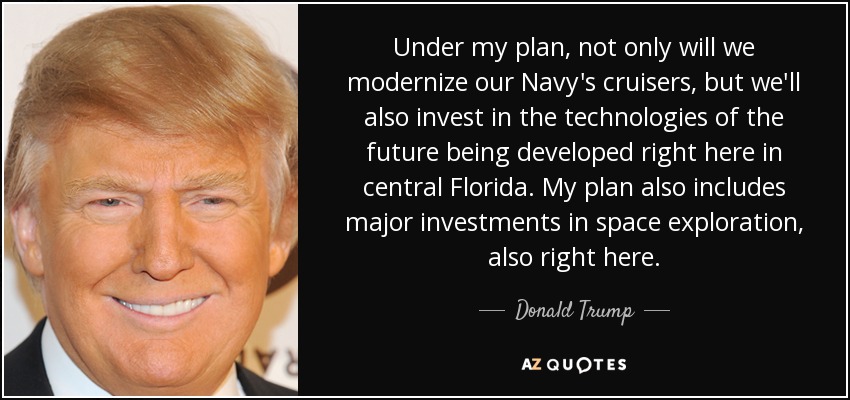
Under my plan, not only will we modernize our Navy's cruisers, but we'll also invest in the technologies of the future being developed right here in central Florida. My plan also includes major investments in space exploration, also right here.
I grew up in California. I was outside of the city, not directly in it. So I did have an experience of the sky, but for me, it was the idea of space exploration that fueled my interest. I grew up in that age of the astronauts, and I was fascinated that we could leave the Earth.
When NASA makes discoveries they are profound and they make headlines, everyone takes notice. It drives dialogue and, today, it would drive the blogosphere. It would drive the projects the kids do in school. So you wouldn't even need programs to try and stimulate curiosity. You wouldn't need programs to try to convince people that science literacy is good. Because they're going to want to participate on this epic adventure that we call space exploration.
Everyone who's been in space would, I'm sure, welcome the opportunity for a return to the exhilarating experiences there. For me, a flight in a shuttle, though most satisfying, would be anticlimactic after my flight to the moon. Plus, if I pursued a flight myself, people would think that was the reason I am trying to generate interest in public spaceflight. And that's not the purpose - I want to generate interest in long-range space exploration.
We should explore new ways to drive down the cost of space travel. instead of costly booster rockets, maybe we should think of laser/microwave driven rockets, or space elevators. Until then, the cost of space exploration will limit our ability to explore the universe.
I believe that, by taking an extreme approach, you really get the public to actively engage with a cause or a research ,and that is what motivates me with space exploration.
Today, we are on a path of decay. We are seeing the book close on five decades of accomplishment as the leader in human space exploration.
I hope that China will continue with space exploration. It would be logical to have international co-operation. I hope that it will come about and that I can be involved in it.
As the romance of manned space exploration has waned, the drive today is to find our living, thinking counterparts in the universe. For all the excitement, however, the search betrays a profound melancholy - a lonely species in a merciless universe anxiously awaits an answering voice amid utter silence.
After Apollo 17, America stopped looking towards the next horizon. The United States had become a space-faring nation, but threw it away. We have sacrificed space exploration for space exploitation, which is interesting but scarcely visionary.
To most people in the UK, indeed throughout Western Europe, space exploration is primarily perceived as 'what NASA does'. This perception is - in many respects - a valid one. Superpower rivalry during the Cold War ramped up US and Soviet space efforts to a scale that Western Europe had no motive to match.
Ever since there have been people, there have been explorers, looking in places where other hadn't been before. Not everyone does it, but we are part of a species where some members of the species do, to the benefit of us all.
The news media reported the $250 million as an unthinkably huge waste of money and proclaimed that something was wrong with NASA. The result was an investigation and a congressional hearing. Not to defend failure, but $250 million is not much more than the cost to produce Kevin Costner's film flop Waterworld.
When provoked, the itsy-bitsy invertebrates known as tardigrades can suspend their metabolism. In that state, they can survive temperatures of... 73 K for days on end, making them hardy enough to endure being stranded on Neptune. So the next time you need space travelers with the right stuff, you might want to choose yeast and tardigrades, and leave your astronauts, cosmonauts, and taikonauts at home.
If somebody'd said before the flight, 'Are you going to get carried away looking at the Earth from the Moon?' I would have say, 'No, no way.' But yet when I first looked back at the Earth, standing on the Moon, I cried.
The view of the Earth from the Moon fascinated me -- a small disk, 240,000 miles away. . . . Raging nationalistic interests, famines, wars, pestilence, don't show from that distance.
Although as a boy I had dreamed about going into space, I had completely forgotten about that until one day I received a call from an astronaut, who suggested that I should join the program.
India has no dearth of brave young men and women and if they get the opportunity and help then we can compete with other nations in space exploration and one of them will fulfil her dreams.
The Earth was small, light blue, and so touchingly alone, our home that must be defended like a holy relic. The Earth was absolutely round. I believe I never knew what the word round meant until I saw Earth from space.
Looking outward to the blackness of space, sprinkled with the glory of a universe of lights, I saw majesty-but no welcome. Below was a welcoming planet. There, contained in the thin, moving, incredibly fragile shell of the biosphere is everything that is dear to you, all the human drama and comedy. That's where life is; that's were all the good stuff is.
No one, it has been said, will ever look at the Moon in the same way again. More significantly can one say that no one will ever look at the earth in the same way. Man had to free himself from earth to perceive both its diminutive place in a solar system and its inestimable value as a life -fostering planet. As earthmen, we may have taken another step into adulthood. We can see our planet earth with detachment, with tenderness, with some shame and pity, but at last also with love.
The world looks marvelous from up here, so peaceful, so wonderful and so fragile. Everybody, all of us down there, not only in Israel, have to keep it clean and good.
The colors are stunning. In a single view, I see - looking out at the edge of the earth: red at the horizon line, blending to orange and yellow, followed by a thin white line, then light blue, gradually turning to dark blue and various gradually darker shades of gray, then black and a million stars above. It's breathtaking.
As I looked down, I saw a large river meandering slowly along for miles, passing from one country to another without stopping. I also saw huge forests, extending along several borders. And I watched the extent of one ocean touch the shores of separate continents. Two words leaped to mind as I looked down on all this: commonality and interdependence. We are one world.
NASA's annual budget for space exploration could fund NOAA's budget for ocean exploration for 1600 years.
Follow AzQuotes on Facebook, Twitter and Google+. Every day we present the best quotes! Improve yourself, find your inspiration, share with friends
or simply: