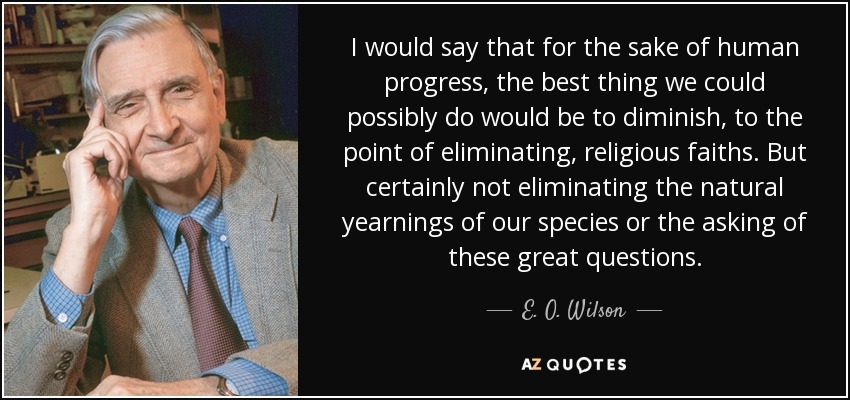
I would say that for the sake of human progress, the best thing we could possibly do would be to diminish, to the point of eliminating, religious faiths. But certainly not eliminating the natural yearnings of our species or the asking of these great questions.
I certainly look at the modern guys and think they are a different species to when we played. They are fitter and their conditioning is extraordinary.
There has always been a tendency to classify children almost as a distinct species.
A race is what zoologists term a variety or subdivision of a species.
Deconstructing the concept of race not only conflicts with people's tendency to classify and build family histories according to common descent but also ignores the work of biologists studying non-human species.
Darwin's book, On the Origin of Species, was published in 1859. It is perhaps the most influential book that has ever been published, because it was read by scientist and non- scientist alike, and it aroused violent controversy. Religious people disliked it because it appeared to dispense with God; scientists liked it because it seemed to solve the most important problem in the universe-the existence of living matter. In fact, evolution became in a sense a scientific religion; almost all scientists have accepted it and many are prepared to 'bend' their observations to fit in with it.
Dr. S. Dillon Ripley, secretary of the Smithsonian Institute, believes that in 25 years, somewhere between 75 and 80 percent of all the species of living animals will be extinct.
I think we must ask ourselves if this is really what we want to do to God's creation, to drive it to extinction? Because extinction really is irreversible; species that go extinct are lost forever. This is not like Jurassic Park. We can't bring them back.
Spiritually, trees play a unique role in the Jewish and Christian scriptures, from the Garden of Eden to the Cross of Christ. Biologically, in great forest communities, they help sustain life on our planet, giving off oxygen, anchoring soil, keeping stream and rivers clear, and providing habitation for thousands of species. How can religious persons not care about the widespread destruction of these creatures of God? We need to love them as our very selves, as neighbors in earth's community of life.
'Extinction' issue. Save the species for whom??? Humans' convenience, of course! Individuals of the species are snatched from their homes/family/habitat/held in captivity/forced to mate at great physical/ spiritual pain. When the right numbers are reached, their holocaust starts all over again! Another merry-go-round/ bu$ine$$ a$ u$ual!!! Protectionists/welfarists find it a profitable issue: no controversy/ easy donations! I'd rather see an entire species extinct than in the hands of the humans!
It is a species of coquetry to make a parade of never practising it.
It is the acquisition of skills in particular, irrespective of their utility, that is potent in making life meaningful. Since man has no inborn skills, the survival of the species has depended on the ability to acquire and perfect skills. Hence the mastery of skills is a uniquely human activity and yields deep satisfaction.
Unlike the pattern which seems to prevail in the rest of life, in the human species the weak not only survive but often triumph over the strong. The self-hatred inherent in the weak unlocks energies far more formidable then those mobilized by an ordinary struggle for existence.
The continuous disasters of man's history are mainly due to his excessive capacity and urge to become identified with a tribe, nation, church or cause, and to espouse its credo uncritically and enthusiastically, even if its tenets are contrary to reason, devoid of self-interest and detrimental to the claims of self-preservation.We are thus driven to the unfashionable conclusion that the trouble with our species is not an excess of aggression, but an excess capacity for fanatical devotion.
To talk about the need for perfection in man is to talk about the need for another species.
The way we see the world shapes the way we treat it. If a mountain is a deity, not a pile of ore; if a river is one of the veins of the land, not potential irrigation water; if a forest is a sacred grove, not timber; if other species are biological kin, not resources; or if the planet is our mother, not an opportunity -- then we will treat each other with greater respect. Thus is the challenge, to look at the world from a different perspective.
Man may be considered as a superior species of animal that produces philosophies and poems in about the same way a silkworm produces their cocoons and bees their hives.
The human species, although happily ridiculous at times, is still reaching for the stars.
There is a species of moral, legal, and social modernism which we condemn, no less decidedly than we condemn theological modernism.
Do not despise the fish because they are absolutely unable to speak or to reason, but fear lest you may be even more unreasonable than they by resisting the command of the Creator. Listen to the fish, who through their actions all but utter this word: 'We set out on this long journey for the perpetuation of our species.
A species divided against itself will eventually fall.
If all the misfortunes of mankind were cast into a public stack in order to be equally distributed among the whole species, those who now think themselves the most unhappy would prefer the share they are already possessed of before that which would fall to them by such a division.
I've been told that certain species of fish will grow according to the size of their environment. Put them in a tiny aquarium, and they remain small even at adulthood. Release them into a huge natural body of water, and they grow into their intended size. People are similar. If they live in a harsh and limiting environment, they stay small. But put them someplace that encourages growth, and they will expand to reach their potential.
In the end, this is a difficult story to sum up. The making of the atomic bomb is one of history's most amazing examples of teamwork and genius and poise under pressure. But it's also the story of how humans created a weapon capable of wiping our species off the planet. It's a story with no end in sight. And, like it or not, you're in it.
We live in this irreparably broken world, and I don't wish to deny reality, but the amazing thing to me is not that we refuse to relinquish hope as a species. The amazing thing is that we're right to hold on to hope. The world may be broken, but hope is not crazy. ... Obviously not all stories end happily. We don't always have good fortune, but hope gives us, as a species and as individuals, what we otherwise wouldn't have: A chance.
Follow AzQuotes on Facebook, Twitter and Google+. Every day we present the best quotes! Improve yourself, find your inspiration, share with friends
or simply: