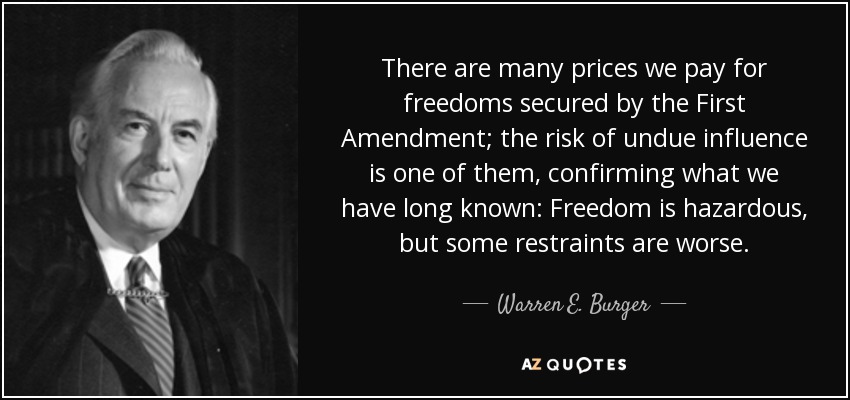
There are many prices we pay for freedoms secured by the First Amendment; the risk of undue influence is one of them, confirming what we have long known: Freedom is hazardous, but some restraints are worse.
The virtue of a democratic system with a [constitutionally guaranteed right to free speech] is that it readily enables the people, over time, to be persuaded that what they took for granted is not so, and to change their laws accordingly.
Allegory dwells in a transparent palace.
True silence is the speech of lovers.
The principle of free speech is no new doctrine born of the Constitution of the United States. It is a heritage of English-speaking peoples, which has been won by incalculable sacrifice, and which they must preserve so long as they hope to live as free men.
Where there is a great deal of free speech there is always a certain amount of foolish speech.
The right to enjoy property without unlawful deprivation, no less that the right to speak out or the right to travel is, in truth, a "personal" right.
No danger flowing from speech can be deemed clear and present unless the incidence of the evil apprehended is so imminent that it may befall before there is an opportunity for full discussion. Only an emergency can justify repression.
Consider in silence whatever any one says: speech both conceals and reveals the inner soul of man.
Speak briefly and to the point.
Beautiful eyes in the face of a handsome woman are like eloquence to speech.
Prayer has a right to the word "ineffable." It is an hour of outpourings which words cannot express,--of that interior speech which we do not articulate, even when we employ it.
It was not by accident or coincidence that the rights to freedom in speech and press were coupled in a single guaranty with the rights of the people peaceably to assemble and to petition for redress of grievances. All these, though not identical, are inseparable. They are cognate rights, and therefore are united in the First Article's assurance.
The practice of Zen is to eat, breathe, cook, carry water, and scrub the toilet — to infuse every act of body, speech, and mind — with mindfulness, to illuminate every leaf and pebble, every heap of garbage, every path that leads to our mind's return home.
To dine, drink champagne, raise a racket and make speeches about the people's consciousness, the people's conscience, freedom andso forth while servants in tails are scurrying around your table, just like serfs, and out in the severe cold on the street await coachmen--this is the same as lying to the holy spirit.
So I am hoping my second outing to your wonderful university turns out differently, because it would be highly embarrassing if I said, “Good evening Yaleites” or “Yalers”, or whatever you guys are called, and got stuck at Yaaaaa…. That wouldn’t make for much of a speech.
After watching the State of the Union address the other night [1994], I'm reminded of the old adage that imitation is the sincerest form of flattery. Only in this case, it's not flattery, but grand larceny: the intellectual theft of ideas that you and I recognize as our own. Speech delivery counts for little on the world stage unless you have convictions, and, yes, the vision to see beyond the front row seats.
Dare to declare who you are. It is not far from the shores of silence to the boundaries of speech. The path is not long, but the way is deep. You must not only walk there, you must be prepared to leap.
Abstruse and mystic thoughts you must express With painful care, but seeming easiness; For truth shines brightest thro' the plainest dress.
The most familiar quotations are the most likely to be misquoted. Some misquotations are still variable, some have settled down to false versions that have obscured the true ones. They have passed over from literature into speech.
Truth lies in a small compass! The Aristotelians say, all truth is contained in Aristotle, in one place or another. Galileo makes Simplicius say so, but shows the absurdity of that speech by answering all truth is contained in a lesser compass, namely, in the alphabet.
The first rule for speaking well is to think well.
He that would speak Divine things in a language which living men of to-day can comprehend, must keep up with the researches and discoveries of men who study nature, and put her words into the speech of the present.
When a man sought knowledge, it would not be long before it could be seen in his humbleness, his sight, upon his tongue and his hands, in his prayer, in his speech and in his disinterest (zuhd) in worldly allurements. And a man would acquire a portion of knowledge and put it into practice, and it would be better for him than the world and all it contains - if he owned it he would give it in exchange for the hereafter.
It is amazing how much a thought expands and refines by being put into speech: I should think it could hardly know itself.
Follow AzQuotes on Facebook, Twitter and Google+. Every day we present the best quotes! Improve yourself, find your inspiration, share with friends
or simply: