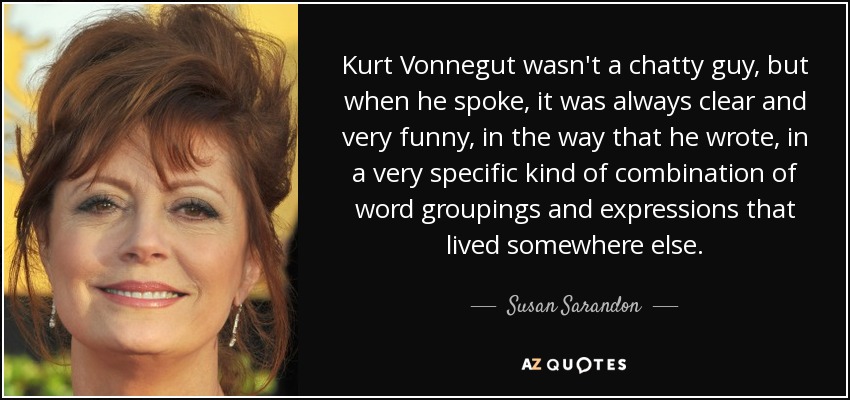
Kurt Vonnegut wasn't a chatty guy, but when he spoke, it was always clear and very funny, in the way that he wrote, in a very specific kind of combination of word groupings and expressions that lived somewhere else.
I was always creatively stubborn, adverse to editing by others, and wanted to use the kind of Ukrainian we spoke among ourselves rather than the more artificial prescribed literary Ukrainian. The problem was the greatest in prose, where editors would change my language because "it sounded better this way." My poetry they left alone probably out of deference to that hallowed genre.
I then spoke to chancellor (Angela) Merkel of Germany and we agreed that the United States and our European allies will work closely together in the weeks and months ahead.
When I was a child of six or seven my father would show me the chapter in the prophet Isaiah where the name Immanuel is found; more than once he spoke to me of the faith he put in me.
One of my Miss America judges called me a "God-clutcher" way back when because I spoke about my faith being an important part of my life during my interview.
Nelson Mandela also spoke about how, as a human being, he's made mistakes.
As a young man, Yeats spoke to me in a way I could understand. Shakespeare I couldn't understand, but Yeats I could. It was his subject matter and also I really admired the way he put his personal life on the line.
It took us three years to build the NeXT computer. If we'd given customers what they said they wanted, we'd have built a computer they'd have been happy with a year after we spoke to them - not something they'd want now.
And all that we built, and all that we breathed And all that we spilled or pulled up like weeds Is piled up in back and it burns irrevocably And we spoke up in turns 'til the silence crept over me.
The first time I spoke publicly about the Stanford Prison Experiment, Stanley Milgram told me: "Your study is going to take all the ethical heat off of my back. People are now going to say yours is the most unethical study ever, and not mine.
When I was young I once found a book in a Dutch translation, 'The leaves of Grass'. It was the first time a book touched me by its feeling of freedom and open spaces, the way the poet spoke of the ocean by describing a drop of water in his hand. Walt Whitman was offering the world an open hand (now we call it democracy) and my 'Monument for Walt Whitman' became this open hand with mirrors, so you can see inside yourself.
With a cold"--she spoke evenly, lowering her eyes a little--"now is the hardest time. Maybe even harder than dying. But this is probably as bad as it can get. You might come to fear the next time you get a cold; it will be as bad as this, but if you just hold steady, it won't be. For the rest of your life. That's how it works. You could take the negative view and live in fear: Will it happen again? But it won't hurt so much if you just accept it as a part of life." With that she looked up at me, smiling.
And as he spoke, I was thinking, 'the kind of stories that people turn life into, the kind of lives people turn stories into.
And the Top spoke no more of his old love; for that dies away when the beloved objects has lain for five years in a roof gutter and got wet through; yes, one does not know her again when one meets her in the dust box.
Because by now Elinor had understood this, too: A longing for books was nothing compared with what you could feel for human beings. The books told you about that feeling. The books spoke of love, and it was wonderful to listen to them, but they were no substitute for love itself. They couldn't kiss her like Meggie, they couldn't hug her like Resa, they couldn't laugh like Mortimer. Poor books, poor Elinor.
Did you see that dress?” "I saw the dress.” "Did you like it?” He didn't answer. I took that as a yes. "Am I going to endanger my reputation if I wear it to the dance?” When he spoke, I could barely hear him. "You'll endanger the school.” I smiled and fell asleep.
Spirit is matter seen in a stronger light. What else did Malebranche mean when he spoke of "seeing all things in God"? Existence is a mystery because the light of it is inexhaustible.
In our time ... a man whose enemies are faceless bureaucrats almost never wins. It is our equivalent to the anger of the gods in ancient times. But those gods you must understand were far more imaginative than our tiny bureaucrats. They spoke from mountaintops not from tiny airless offices. They rode clouds. They were possessed of passion. They had voices and names. Six thousand years of civilization have brought us to this.
Cowardice was undoubtedly one of the most terrible vices - thus spoke Yeshua Ha-Nozri. 'No, philosopher, I disagree with you: it is the most terrible vice!
[Comics] were viewed as the literary equivalent of bubblegum cards, meant to be poked into the spokes of a young mind where they would produce a satisfying but entirely bogus rumble of pleasure.
Donald Judd spoke of a 'neutral' surface, but what is meant? Neutrality must involve some relationship (to other ways of painting, thinking?) He would have to include these in his work to establish the neutrality of that surface. He also used 'non' or 'not' - expressive - this is an early problem - a negative solution or - expression of new sense - which can help one into - what one has not known. 'Neutral' expresses an intention.
Without thinking, [Will] spoke. 'Halt? Are you awake?' 'No.' The ill humor in the one-word reply was unmistakable. 'Oh. Sorry.' 'Shut up.' He pondered whether to apologize again and decided this would go against the instruction to shut up, so remained silent.
I spoke with the crows before leaving for Los Angeles. They were the resident storytellers whose strident and insistent voices added the necessary dissonance for color. They had cousins in California, and gave me their names and addresses, told me to look them up. They warned me, too, what they had heard about attitude there. And they were right. Attitude was thick, hung from the would-be's and has-beens and think-they-ares, so thick that I figured it was the major source of the smog.
The teachers tried everything, even pleading, but Tomas was in the habit of addressing them only in Latin, a language he spoke with papal fluency and in which he did not stammer. Sooner or later they all resigned in despair, fearing he might be possessed: he might be spouting demonic instructions in Aramaic at them, for all they knew.
To me, the Craft is what Christianity was 2,000 years ago. It was a religion that was not corrupted. I personally think Jesus was a Crafter. We believe in all the things that he spoke of. The early Christians believed in reincarnation, and that was later removed from the belief system. Early Christians had a female Divinity, and that was taken out of their belief system, or as with Catholicism, replaced with Mary. Look at how incredible the growth in devotion of Mary is. It's amazing. The desire for a female Divinity is not just Wiccan. It speaks of a global need.
Follow AzQuotes on Facebook, Twitter and Google+. Every day we present the best quotes! Improve yourself, find your inspiration, share with friends
or simply: